Why kids can learn more from tales of fantasy than realism

Fairy Tales and fantasy have always captivated children. When they are outside of their own world, which is often a place of an uphill climb to learn and grow, then they can truly be immersed in the story at hand– and understand the characters. That means learning right and wrong, good and evil, and developing a moral compass. Plus, when the mind is open, all the words and vocabulary pour into the brain. The number of words a child hears is directly attributed to academic succes in school. Here’s to Fairy Tales!

M.C. Tuggle, Writer

Fantasy learning

Deena Weisberg is a senior fellow in psychology at the University of Pennsylvania. Her specialty is “imaginative cognition,” which studies how imagination boosts one’s ability to learn. Her research demonstrates that children absorb new material taught in the context of a fanciful scenario better than they do when it’s presented in more realistic terms. In a recent edition of Aeon, she challenges herself with a question she’s grappled with before: Why do fantastical stories stimulate learning?

What can be going on? Perhaps children are more engaged and attentive when they see events that challenge their understanding of how reality works. After all, the events in these fantastical stories aren’t things that children can see every day. So they might pay more attention, leading them to learn more.

A different, and richer, possibility is that there’s something about fantastical contexts that is particularly helpful for learning. From this perspective, fantastical fiction…

View original post 252 more words

Posted in Uncategorized | 16 Comments

The Importance of Imagination

Imagination is the most exciting, and the most powerful tool I have when teaching children. It’s the foundation for learning, and for wanting to learn. The best learning that takes place in my classroom is rooted in imagination; from reading aloud to linking Einstein and Mozart… well, this blog post says it best. It captures the essence of why imagination is important. And, it is!

charles french words reading and writing

Imagination is one of the most important aspects of life and of writing. We should cherish it and help develop it in others.  Here are a few quotations for your consideration:

albert-einstein-1144965_960_720

https://pixabay.com

“I am enough of an artist to draw freely upon my imagination. Imagination is more important than knowledge. Knowledge is limited. Imagination encircles the world.”

                                                                     Albert Einstein

carl-sagan-647717_960_720

https://pixabay.com

“Imagination will often carry us to worlds that never were, but without it we go nowhere.”

                                                                         Carl Sagan

marktwainpd2746834

“Reality can be beaten with enough imagination.”

                                                                            Mark Twain

View original post

Posted in Early Education, Imagination, Quotes | Tagged , , , , , , | 33 Comments

Picasso, My Grandmother, and Me

img_2329

My grandmother, Nan, has been my hero since I was a little girl.  I spent Sunday afternoons with her, and it was delightful.  No, it was more than that.  Nan filled me with stories, taffy pulls, and dressing-up.  She drove me and my sister in to Kresge’s, the five-and-dime, to spend a whole nickle on anything we wanted.  Sundays with Nan were the best.

Nan lived in an apartment.  When you entered, the first thing hanging on the wall was a Picasso, “Girl Before a Mirror”.  I remember thinking how funny the painting looked and having many conversations with Nan. While this became familiar to me in her apartment, so did other art.  Gilbert Gaul’s “Leaving Home” was my favorite, opening my eyes to art that tells a story with the scene and characters.  This painting was was about history and the Civil War.  I’ve been a history buff ever since.

I recently came face-to-face with a Picasso at the Currier Museum of Art in Manchester, NH.  Nan came flooding over me.

img_2245

“Woman Seated in a Chair”, 1941

The Currier interpreted the painting:

Picasso executed this painting during World War II while living in a small apartment in German-occupied Paris.  While the distortion of form and space through simplified shapes reflect Picasso’s earlier Cubist period, the bright color and emotional charge is the continuing influence of Expressionist art.

Emotionally charged, indeed.  This was real.  I crept close and looked at brush strokes.  The white circles on the woman’s dress are thick, raised paint.  I thought about Picasso painting this, perhaps looking out his window at the Germans in the streets of Paris and feeling angry.

And, I thought about Nan.  She was only five years older than Picasso.  How did she come to like Picasso art?  After all, his painting greeted everyone who entered her home.  But, Nan’s life was far from modern.  She grew up in rural West Virginia, in the oldest two-story log house west of the Appalachian mountains.  She was more akin to Laura Ingalls Wilder than to Pablo Picasso.  She had a hard life, outliving her brothers and sisters, two husbands, and her children.  By the time I came along, all she had were her grandchildren.  Yet, she was ever happy and strong.

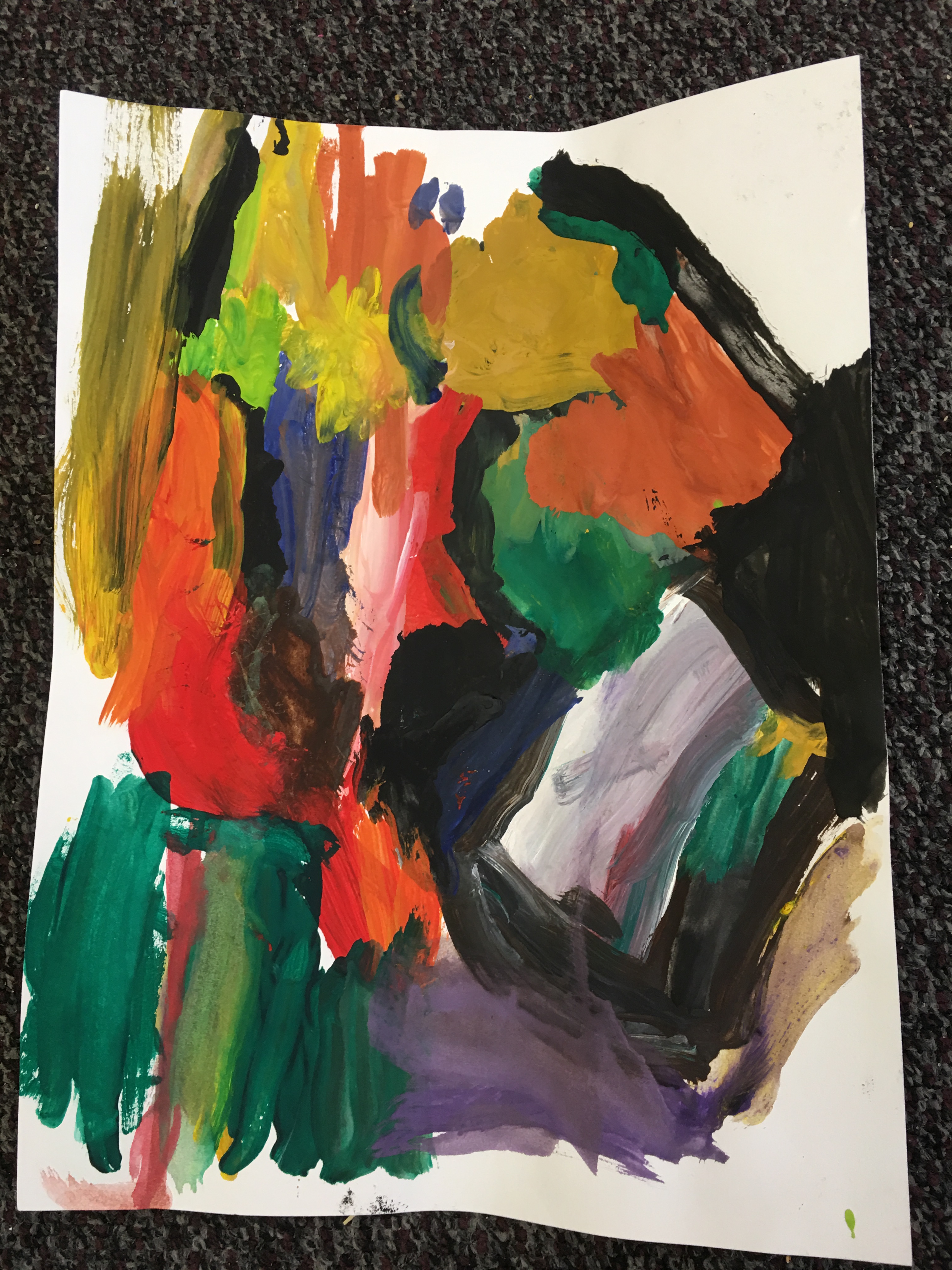
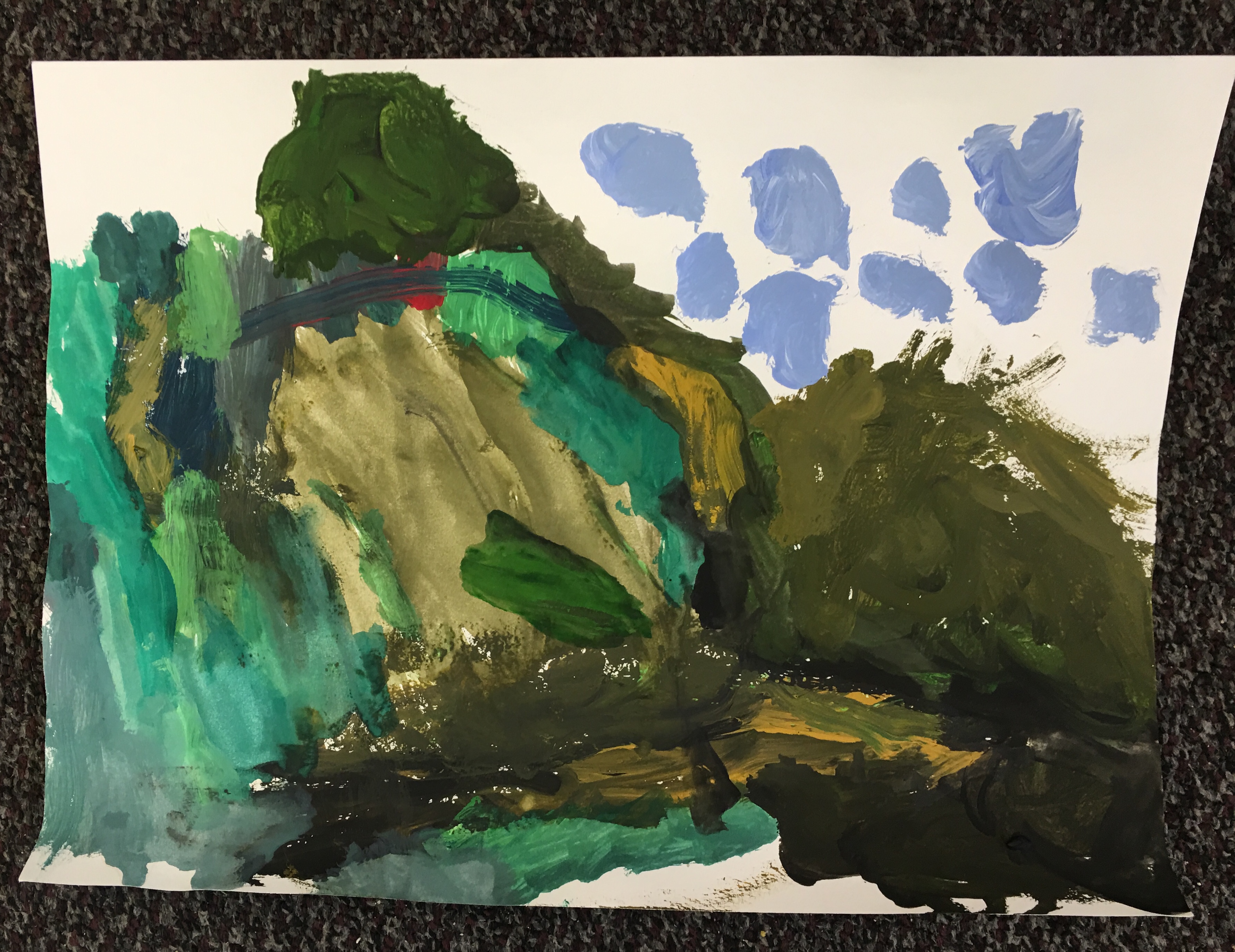
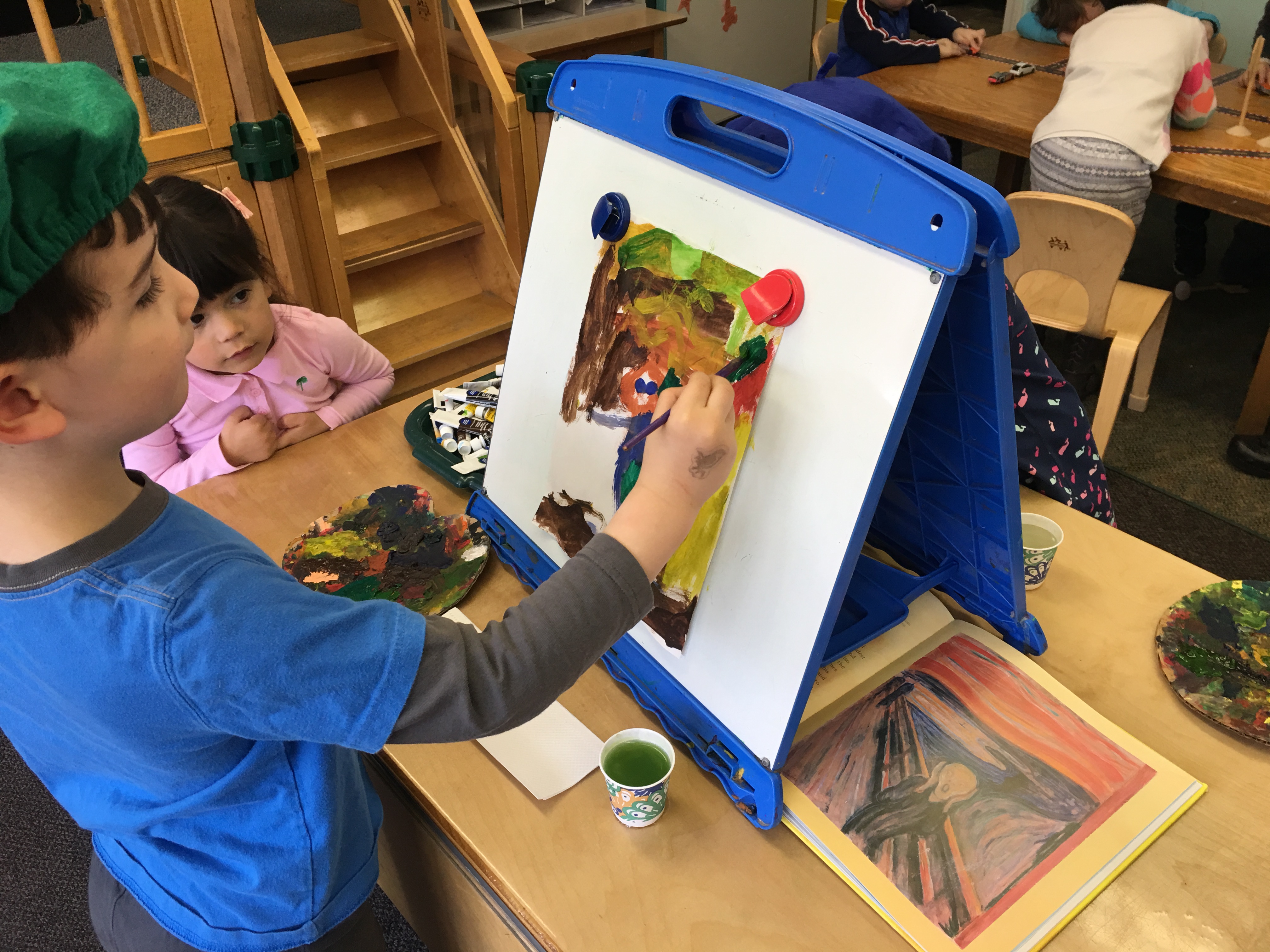
I teach art to my preschool class in a way that admires and respects the art of well-known artists.  Learning from greatness is a good beginning.  Young children are enthusiastic sponges when it comes to art, and I introduce many styles of painting.  Real is best, therefore children paint with authentic watercolor paints squeezed from tubes onto a palette.  Each April we host an Art Show for the community.  Children paint in the style of Picasso, Kandinsky, Monet, van Gogh, Matisse, Carle, and others.

image

I often think of the power of art and how that transcends to others.  Art had an influence on Nan, Nan had an influence on me, and now I have an influence on children.  Thank you, Picasso.

Jennie

Posted in art, Early Education, Teaching young children | Tagged , , , , | 62 Comments

Starry Night

I’m going to the Art Museum tomorrow, always an experience that fills me.  In anticipation I am sharing a favorite blog post from a few years ago.

Major pieces of art?  Masterpieces?  Introducing this to preschoolers?  It is not easy to explain to people how and why art can make a difference with young children.  A picture is worth a thousand words, and this picture was just sent to me.

IMG_1024.JPG Juliet and 'Starry Night'

Juliet the fourth grader is beaming at seeing Starry Night by Vincent van Gogh at the Museum of Modern Art in New York.  I have a story to tell.  It’s about teaching art in many ways, and about Juliet’s pathway to art.  As I say in my classroom, “It Happened Like This”…

When Juliet was a three-year-old in my class, she was thoughtful.  She played, loved stories and books, developed friendships, and drew pictures.  The next year things changed, or perhaps she just grew in her interests.  She drew pictures all the time, perfecting people figures and experimenting with color.  Children’s art adorns the classroom walls with the exception of a Starry Night poster, yet Juliet did not seem to focus on that piece of art.  Well, that’s what I thought.

And then Juliet met Milly, the master quilter.  Milly joined our class to quilt a magnificent Peace Quilt (which is now a permanent display at the National Liberty Museum in Philadelphia).  In the process of designing and creating the quilt, Juliet was a captive audience.  Making this quilt was a big deal, from sketching all the parts to selecting fabrics for each element.  She drew an exact replica of the quilt, which is my blog photo, down to every triangle in precise direction and color.

In the spring we studied France and the old masters, in preparation for our annual Art Show displayed for the entire community.  Juliet was in her element.  She was struck by Starry Night and using real paints from tubes on pallets.  She practiced brush strokes and mixing colors.  She loved simply looking at art, especially Usborne’s Children’s Book of Art.  As we worked on perfecting our pieces of art, we often played classical music.  Vivaldi’s Four Seasons became a favorite, and children would often ask for a specific piece.  “What would you like to hear today?  Winter, Spring , Summer or Fall?”, I’d ask.  Music and art go hand-in-hand.  Together, the results are impressive.  For our Art Show, Juliet drew the Mona Lisa.  It was the central piece in our exhibit.

When Juliet moved on to kindergarten her art continued to flourish.  She visited my class periodically, once to show me a winning polar bear she had drawn.  When her little sister joined my class Juliet visited more often, frequently admiring our Starry Night poster.  Now as a fourth grader, her trip to New York to see the beloved painting seems to be the pinnacle of the journey she started as a preschooler.  Perhaps, though, it is only the beginning for her.

Art makes a difference.

Jennie

Posted in art, Early Education, Teaching young children | Tagged , , , , , | 68 Comments

Maya Angelou

Did you know that Maya Angelou wrote a children’s book?  She did, back in 1994.  I have been reading her book to my preschoolers long before I really knew of her.

Embed from Getty Images

I was always drawn to her quote in the introduction of the book:

To all the children, for they are the hope of humankind.

Yes!  This statement was so profound, so direct, and so right.  It crawled under my skin and made me think.  Hard.  Every time I read the book, I read the quote.

My Painted House, My Friendly Chicken and Me

img_2219

The story of a child in South Africa, her family, and her best friend, a chicken.  Maya tells a tale that is engaging to children and full of interesting facts.  She manages to weave words that are as powerful as they are simple:

All children are hope for their families, and many Ndebele girls are named Hope.  If you like, you can call yourself Hope, too.  In secret, of course.

Many years after finding and reading this book, I stumbled across Maya Angelou’s powerful words.  She says things with few, well chosen words that make a difference.  She is an ember that lights a fire.  These are her words that made a difference for me:

I’ve learned that people will forget what you said, people will forget what you did, but people will never forget how you made them feel.

Jennie

Posted in Diversity, Peace, picture books, reading aloud, Teaching young children | Tagged , , , | 35 Comments

There’s a Story Behind Every Child.

img_2113

Noah and his big sister Emma

When Emma was in my preschool class we took a field trip to the Shriner’s Circus.  That was back in the day when going on a field trip did not require volunteers to carry seat belt cutters, undergo certification, pounds of paperwork and  an Act of Congress.  I dearly miss sharing new experiences with children that comes from a going on a field trip.  And the trip to the Shriner’s Circus had an unexpected moment that triggered a new pathway in my classroom.  It happened like this…

Before the circus performance the lights went out and a big American flag was lowered.  I had no idea that would happen, but no worries, I knew exactly what to do- stand tall and proud, put my hand over my heart, and sing our National Anthem.  Everybody knows that… so I thought.  I looked around and saw parents chatting away and children playing.  I was horrified!  I frantically dashed to each child, pulling off their ball caps and putting their little hands over their hearts.  I’m sure I looked like a crazy person.  Yes I was, because this was awful.

It never occurred to me that people wouldn’t know what to do when singing “The Star Spangled Banner”.  My doesn’t-everybody-know-that  frame of mind switched gears.  This was a teaching moment looking at me right in the face.  Emma to the rescue!  She was the child who knew what to do and showed pride, even at the tender age of four.

Back at school, Emma showed the other children how to sing and how to stand.  It was a start, but not nearly enough.  I asked the children, “What is a star spangled banner?”  No one knew.  How can they learn to sing with pride if they have no idea what they’re singing for?  They needed the backstory, and that is where my teaching took off: emergent curriculum at it’s best.

Emma’s Dad came to school to help the children learn about the American flag.  We learned about Francis Scott Key watching the flag during battle to see who was winning.  We began to sing other patriotic songs.  To this day, “God Bless America” and “This Land is Your Land” are classroom favorites.  Some years ago Milly and the children made a God Bless America quilt that hangs in the Boston Fisher House.  Thank you, Emma, for starting the ball of Patriotism rolling, many years ago.

Noah was the shy one.  He had difficulty saying goodby to Mom and Dad when he arrived at school.  All the hugs and reassurances in the world did little to help Noah.  To make matters worse, he was not alone.  Another little boy had the same struggle, and the two of them together often ignited many tears.

One day I pulled out my Autoharp.  After all, music and singing are a universal pathway to the heart.  In the words of Hans Christian Anderson, “where words fail, music speaks”.  I needed words, as I was failing Noah.  No, I needed music.  And, it worked!  The tears turned to sniffles, and then they stopped.  Noah was fascinated with a real musical instrument.  We sang and sang, and then we sang some more. The Autoharp became part of our daily routine.  Noah was also curious how the strings actually worked.  We discovered high and low sounds, and then we learned about  vibration.  A tuning fork and a dish of water became a favorite science experiment, especially with Noah.

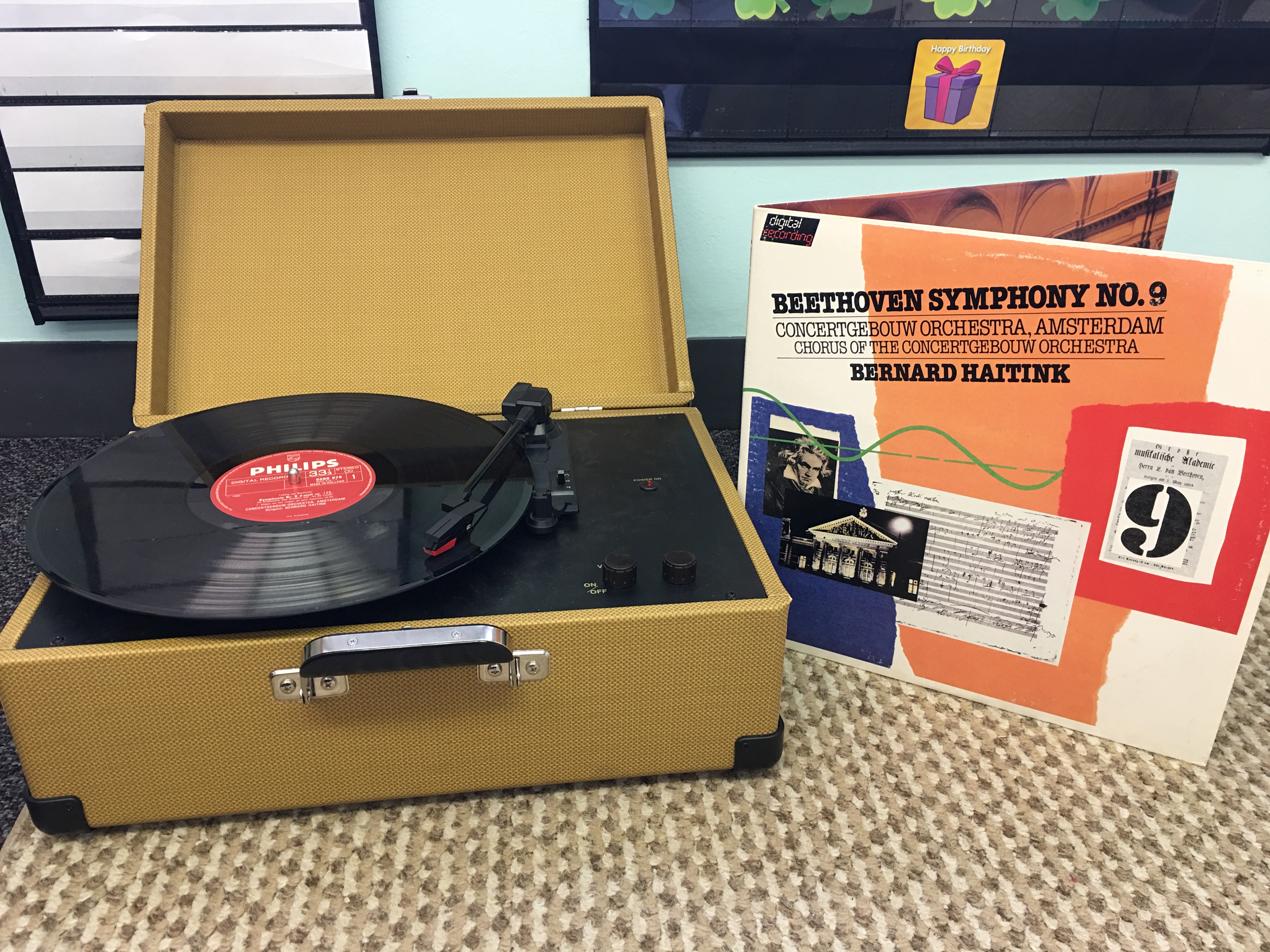
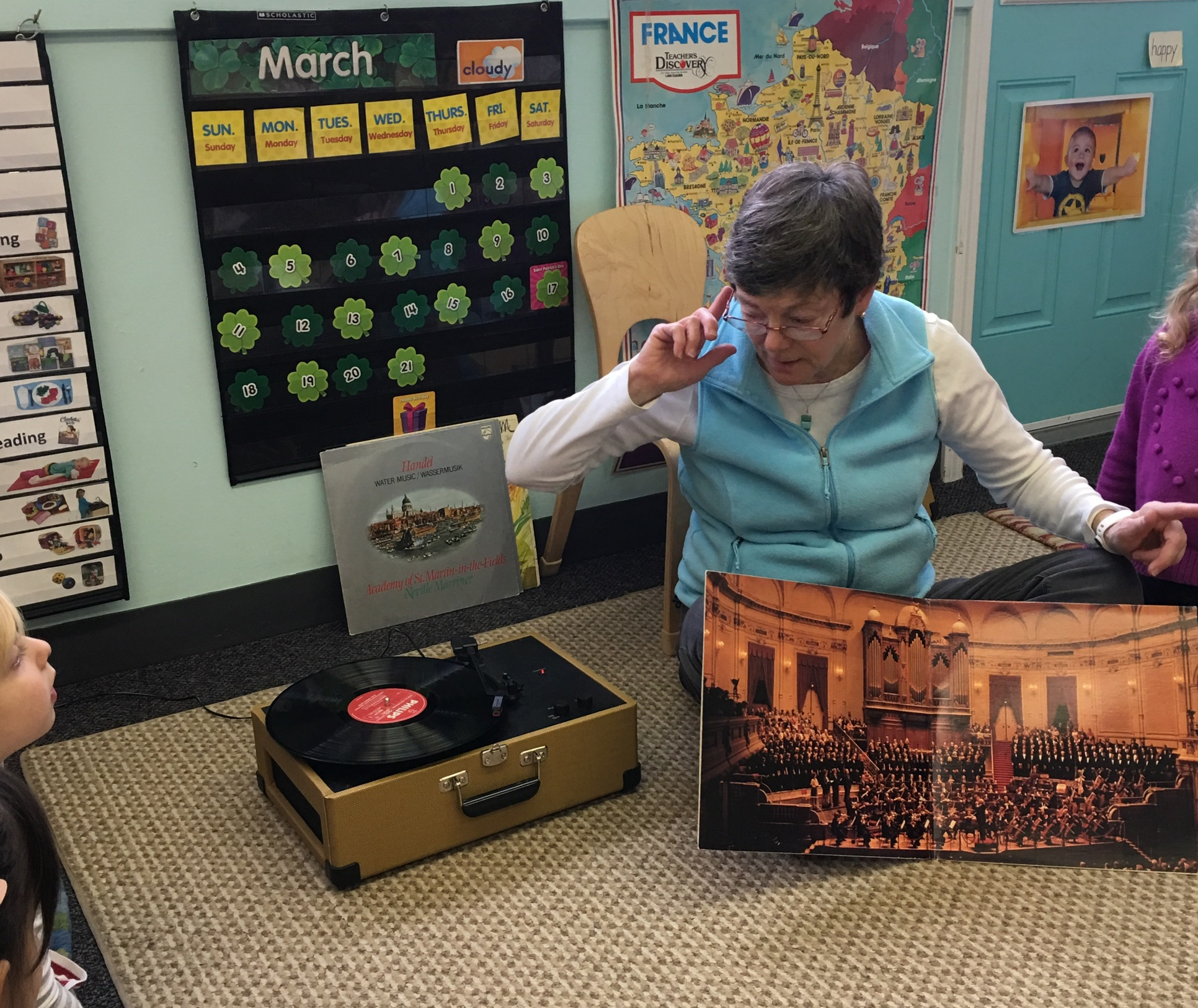
Thus began my immersion in music.  I brought real instruments into the classroom.  I brought in my old record player and record albums.  That was a huge hit, and today it still remains a classroom favorite.  When we painted seriously, preparing for our annual Art Show, we listened to classical music for inspiration.  It was wonderful, and still is to this day.  Thank you, Noah, for bringing music into my classroom.  I’m so glad it has become a part of your life.

Yes, there is a story behind each child.  And, they always come back to visit.  Noah now brings his music and instruments into the classroom.  Emma has been both a volunteer and works in the summer.  Those early beginnings have come full circle.

Jennie

Posted in Early Education, music, patriotism, Teaching young children | Tagged , , , , , | 40 Comments

In the Words of a Child

The best and most beautiful things in the world cannot be seen or even touched.  They must felt with the heart.” -Helen Keller-

img_2155

It happened like this… Children were gathered to hear a story.  I was ready to read-aloud two new books.  I was excited, and the children were, too.  I clutched the books to my chest, hugging them close and smiling a big, wide smile.  I said, “I got a Christmas present and I want to share it with you.”

pause, giving children a chance to understand that the present I am sharing is the books.

“What is my favorite thing in the whole, wide, world?”  I said those words with gusto.  Maybe passion.  Yes, it was passion.  And the children answered.

Aaryan said, “We are!”

Oh, my.  Yes, Aaryan, you are right.  Children are my favorite thing in the whole, wide, world.  The words of a child, indeed!

Jennie

Thank you to Linda over at El Space–The Blog of L. Marie for the two books.

Posted in Kindness, picture books, reading, Teaching young children | Tagged , , , , , | 56 Comments

Reading Connects All People

Reading should belong to everyone, but often we only think of how books relate to us. Steve McCurry is working to bridge that gap and show how much reading can connect disparate people. McCurry, one of the leaders in modern photography, has published a series of images called “On Reading”. He compiled the series from his […]

via Photographs of Starting a New Page — Kristen Twardowski

Posted in Diversity, Kindness, Peace, reading | Tagged , , , , | 16 Comments

Owling, Part ll

I am honored that author Jane Yolen read my blog post about going owling, sticky buns, and most importantly about her award winning book, Owl Moon.

img_2129

Jane Yolen replied,

“In the end of course, fame and fortune don’t matter.  It’s the child remembering your story with great fondness that is important.  Only that.”

Yes, Jane.  You are absolutely right.  Your book did just that.  I will continue to be a champion of giving children rich experiences through literature, so that they remember how it made them feel, and in turn become lifelong learners who grow kindness and goodness.  Books open the world, especially great books like Owl Moon.

With thanks and gratitude,

Jennie

Posted in Early Education, picture books, reading aloud, Teaching young children | Tagged , , , , | 18 Comments

Sticky Buns and “Owling”

Another Christmas, and another delivery of sticky buns.  Every year I feel like a child hoping that Santa Claus will come, except that Santa is actually “the sticky bun mom”.  This is perhaps the longest tradition in my family, and it started decades ago in my classroom.  Two young girls, Michelle and Nicole, adored being in my preschool class, especially listening to “Jennie Stories”.  They were sisters, and their mother made sticky buns.  But, that is only where the story begins.  It happened like this…

img_2128

For each year as a treat, the sticky bun mom joined the class to make sticky buns with the children.  Cooking is one of the best activities with young children, as it is hands-on and full of science and math.  Oh, we cooked up a storm in the classroom.  And we painted, and we read stories.  Stories became popular, particularly fairy tales.  The more I read-aloud, the more the children wanted.  I knew I had to do something to address this drive, this passion, that children had for stories and reading.

I did my first play performance with children.  After reading Rapunzel by Paul O. Zelinsky, it was obvious that the children craved more.  Acting out the story was just the thing to do.  Michelle played the part of Rapunzel, using a loosely knitted long shawl as her hair.  The play was a huge success for many reasons; it gave children confidence and language skills, and it expanded upon a book they loved.

I realized books were far more important than just the story.  They opened a big door to so much more.

img_2129

It was autumn that year.  We were learning about nocturnal animals.  I read Owl Moon by Jane Yolen.  Again, a book was incredibly beloved by the children.  This beautifully written story has illustrations done in pen and ink outlines, and watercolors.  We spent minutes, hours, talking about the illustrations; they became an important part of the story.  They brought the beautiful words to life.  I knew just what to do.

Yes!  The children could bring the book to life!  They can create a mural!

We decided to create an authentic Owl Moon mural, just like the book.  Oh, was it magnificent!  We drew the outlines of trees and people and owls with real pens, then water-colored the figures.  I remember the big sky was a blue wash.  But, the children weren’t quite satisfied with the owl.  They were right- it was missing something.  We scoured the playground for items to make the wings.  Nicole found pine cones, and we picked the ends off to create the owl wings.  Perfect!  The mural proudly hung in the hallway, but still it wasn’t enough, as Owl Moon had captured their hearts and was a powerful teaching tool. Each child made a paper bag owl to decorate the classroom.  Unlike many preschool projects, every owl was unique.  Children were proud.

I am so in-tune with young children; I can sense if they need more.

If Jane Yolen’s book Owl Moon started the interest in owls, then why not duplicate what happened in the story, “going owling”?  We did!  What an adventure on the playground at night, surrounded by dark and woods, calling for owls.  It was thrilling.  Parents and children gathered with spotlights to call into the woods.  Yes, an owl called back.

Fast forward to today.  When the sticky bun mom, and Michelle and Nicole, arrived at my house with the annual Christmas delivery of sticky buns, we talked about memories; “Jennie stories”, and also going owling.  Yes, owling.  They remembered!  They talked about the paper bag owls we had made that year.  Those hung as decorations in their home until this very year.  Michelle and Nicole described to me in detail each of their paper bag owls, with the same excitement as the day they made them, many decades ago.  Wow!

img_2121

No, they did not remember the book, but they remembered the words and the story. They remembered how those words made them feel.  They certainly remembered going owling.

Isn’t that what a good book does?

Jennie

Posted in Early Education, picture books, reading aloud, Teaching young children, Uncategorized | Tagged , , , , , , , | 62 Comments