An Art Museum For Book Lovers


People think of an art museum as… art, single standing pieces on their own right. Imagine masterful, award winning art combined with the best literature, in one museum. Exciting? You bet!  A hidden gem in Amherst, Massachusetts.

img_2522

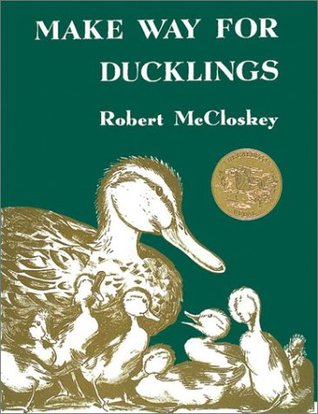
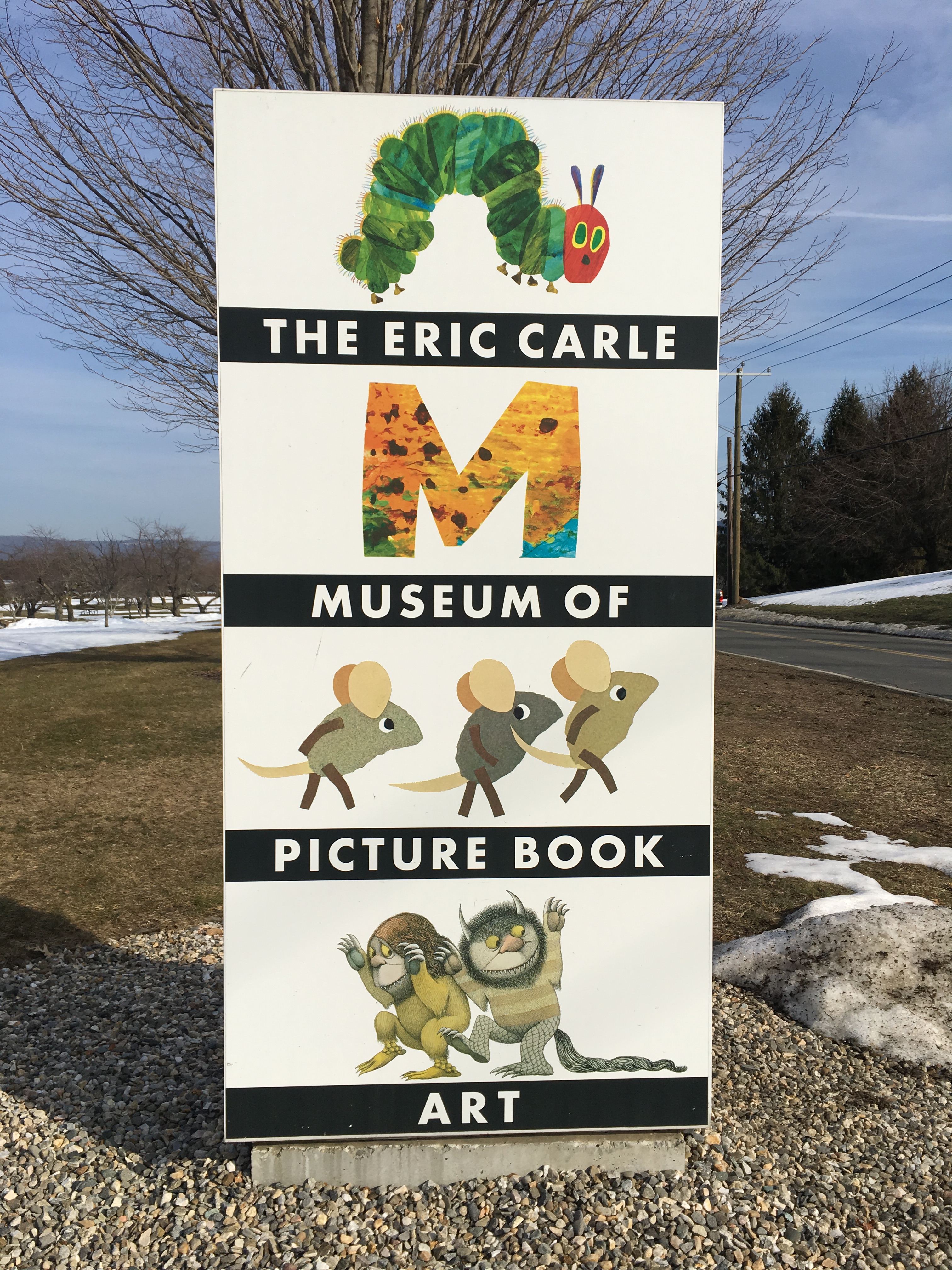
What is your favorite childhood book?  Madeline?  Perhaps it is  Make Way For Ducklings.  There are so many.  The Eric Carle Museum of Picture Book Art is dedicated to the art of children’s book illustrators.  I thought this was interesting, then I visited the museum.  Oh, my!

The exhibit way back then featured Ezra Jack Keats, author of The Snowy Day.   I am a preschool teacher and have read this wonderful book to my class hundreds of times.  Yet, I never expected to come face-to-face with his art.  I did.  To my great surprise it was made from cut-out linoleum.  I couldn’t walk away or let that go.  I was witnessing the real art of his award winning book.

Much like seeing the ocean for the first time, I was stunned.

I love and appreciate art, and I’m passionate about reading children’s books. There I was, staring at both.  Every visit to the Eric Carle Museum of Picture Book Art has been equally powerful.  Yesterday was no exception.  But first, let me back up and tell you about Eric Carle.

One of the staples in children’s books is Brown Bear, Brown Bear.  No, Eric Carle did not write this book; it was the first book he illustrated, his big break into the world of children’s book illustration.  At the time Eric Carle was the art director for an advertising agency in New York.  His life, before then, is the most powerful story of an artist.  Ever!

He was born in New York in 1929 and moved with his family to Stuttgart, Germany in 1936 to be with relatives.  1936 in Germany?  Not good.  His father was drafted into the German army, and Eric and his family fled to Stollen in the Black Forest.

His schooling is fragmented, but he continues to draw and paint and looks forward to an occasional class with his high school art teacher Fridolin Krauss.

Aware of Carle’s promise as a young artist, Herr Krauss invites him to his home one day.  He shows Carle a box of “forbidden art” by so-called degenerate artists like Picasso, Klee, Matisse, and Kandinsky. “Their strange beauty almost blinded me,” recalls Carle.  His teacher warns him not to tell anyone what he has seen.  “But, for his act of defiance,” says Carle, “Herr Krauss…opened my eyes to the beauty of German Expressionism and abstract art.”

Eric Carle saw modern art, “forbidden art” of the great masters, for the first time in his life.  His teacher risked his own life to show Carle the art.  The seed was planted.  Every time I look at a Kandinsky or a Picasso, I think of that moment.  Art can change the world.  It did for Eric Carle.

That first book, Brown Bear, Brown Bear, is fifty years old.  It is a beloved classic throughout the world, having been translated into 31 different languages with 16 million copies sold.  Happy anniversary!  Here are world-wide covers of the book:

img_2511

My preschoolers made a Brown Bear that we gave to the museum (which they displayed).

img_1684

Fast forward to the museum.  They have displayed the original art of Robert McCloskey and Make Way For Ducklings, and the original art of Ludwig Bemelmans’ Madeline.  Up close, very close.  Every pencil line and brush stroke were visible.  I was inches away from the pictures I had only seen in picture books.  For a book lover, this is as good as it gets.

img_0108

I recently saw the art of Hilary Knight’s Eloise, a beloved book from my childhood written by Kay Thompson.  As a child, every Sunday afternoon I would act out Eloise.  She was my first introduction to New York, and to bravery.  Eloise was brave.  She was a bit of a hero.

img_2507

When real, award winning art is combined with the best literature, it is win-win, a grand slam.  Reading the picture books, time and time again, and seeing the pictures ‘live’ is grand, indeed.

There is more!  The best bookstore by far (coming from me- someone who knows good children’s literature) is right there in the museum.  A piece of heaven.

The Eric Carle Museum of Picture Book Art in Amherst, Massachusetts is a treasure.

Jennie

Posted in art, Early Education, Imagination, picture books, Teaching young children | Tagged , , , , , , , | 86 Comments

Fragment of the Day- Harry Potter

May the words I say to children, and the words I write to others leave behind a little magic.

Posted in Uncategorized | 8 Comments

A Day at the Art Museum – Inspiring Children

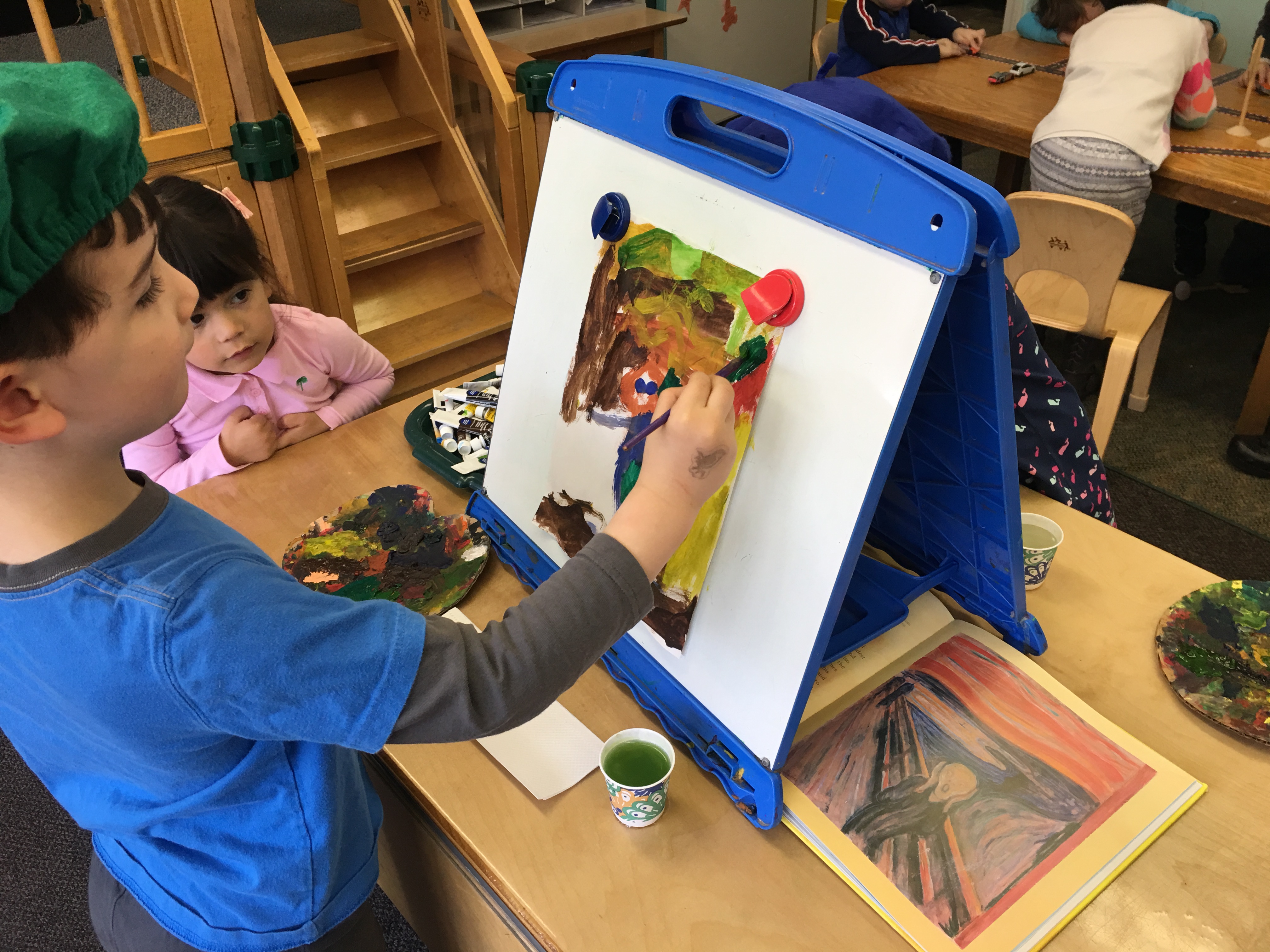
Art and preschoolers go hand-in-hand.  If I want children to feel excited and inspired by art, it must begin with me.  I recently visited the Currier Museum of Art in Manchester, New Hampshire and… oh my!

Let me back up.  I want to talk about real with young children.  This is important. Learning and joy come from playing with real things; tree stumps for building, tools at a workbench, cooking, forging through snow without sleds or shovels, live animals, musical instruments.  When I introduce something real, every child instantly wants to ‘be there’. Art is no exception.

img_2253

I was struck by this painting, a view of Mount Washington in 1880, by Gamaliel Beaman. Then I looked closely.  This is what I saw:

img_2251

Every brush stroke.  Raised paint.  Light.  Intense color.  I was inches away from a masterpiece.  Real.  

Art.  I need to share all of these real elements with the children in my class.  I need to fill their hearts the way mine is filled.  I want children to not only become excited, but to want to explore the world of painting.  That’s what I do.  Here is how:

img_2246

This 1940 painting by Hans Hoffman has the colors and brush strokes and fascination that will excite preschoolers.  I have no doubt.  Similarly, this 1996 Michael Mazur has color and form, but in a very different way.  Oh, this will definitely excite children.

img_2260

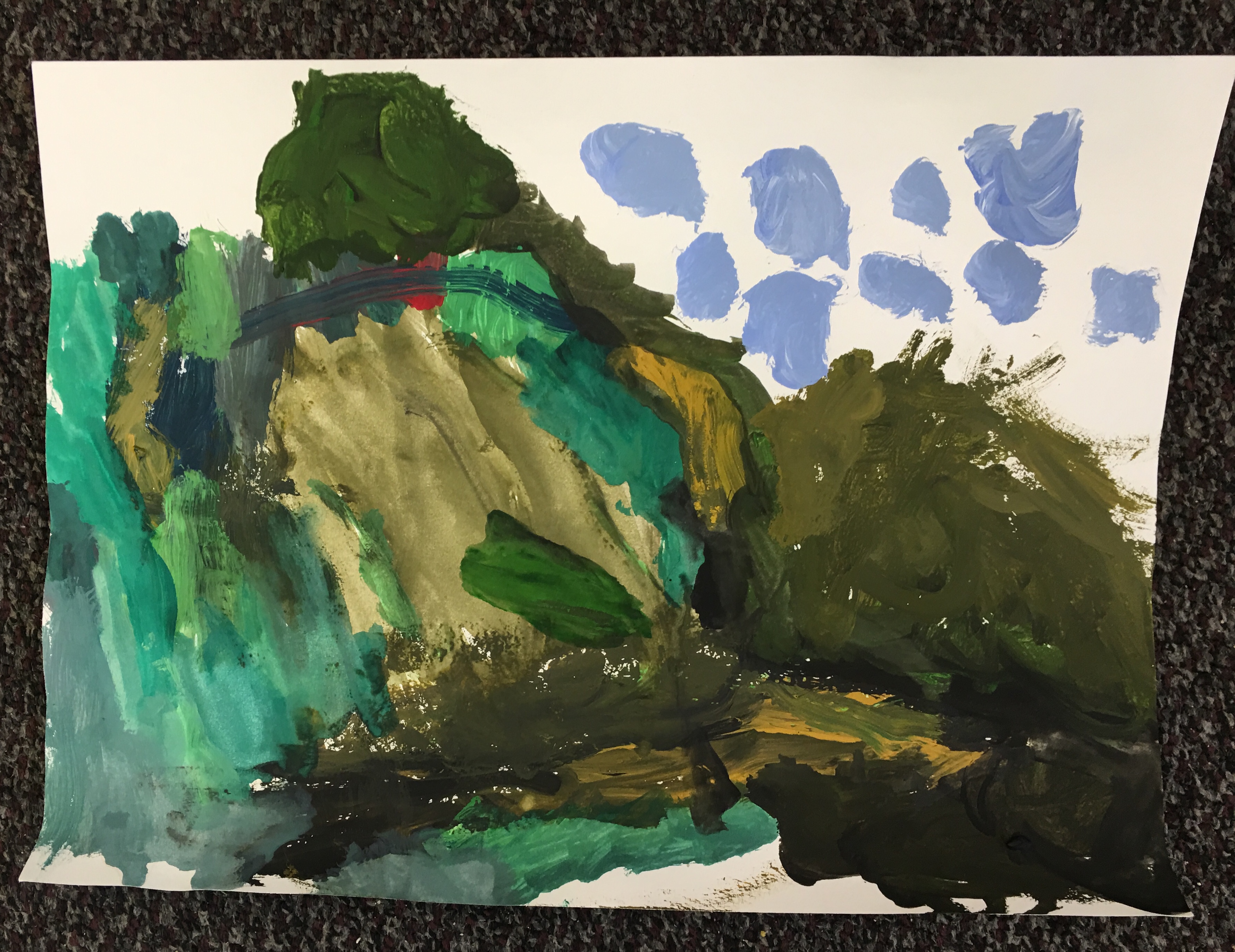
When children are introduced to art that has no borders, and is simply beautiful to look at, it fires the imagination and they become engaged.  They want to paint.  They explore with big brushes and little brushes.  Art is now fun!  Often, I can’t put the paper out for painting fast enough.

What next?  I make art experiences real.  Artist paints, water colors squeezed from a tube onto a palette becomes the medium for painting.  We talk about major pieces of art and learn techniques.  We study artists.  Most importantly, I teach children that art is valued. Therefore, their art is valued.  It takes multiple days to work on a piece of art.  Yes, children return to their art over and over again until they are satisfied.  Then at last, their finished work of art is deemed a ‘masterpiece’.

The lesson here goes far beyond art; every child feels empowered and worthy.  That in itself is a great thing.  The foundation for confidence and self-worth comes from experiences that are real.  Art does just that.

Count both me and the children as inspired.

Jennie

Posted in art, Early Education, Teaching young children | Tagged , , , , , | 54 Comments

World Read Aloud Day

Today, February 16th, is World Read Aloud Day.

img_2419

What could be better on this day than finishing reading a favorite book with my library reading group?  We have been reading The Wild Robot by Peter Brown since September.  Yes, September!  We meet twice a month to read, yet we talk, debate, laugh, worry, wonder…  That’s what happens with a good book.

People across the world are encouraged to read aloud.  You never know the difference you could make by reading to someone, be it a child, a grandparent, or a good friend.  Do you remember the first book that left you with wonder?  Someone read that book to you, and you can “pay it forward”.

Things happen in threes, so they say.  Besides finishing reading The Wild Robot, a child made me a bookmark.  It was lovingly sewn by her big sister on their new sewing machine. The big sister fondly remembers chapter reading with Jennie years ago, as does her brother and little sister.  I was moved.  I cried.  That bookmark will forever be in our classroom chapter reading book.

img_2499

And finally, Scholastic Books has Charlotte’s Web available for a dollar.  A parent in my class has purchased the book for every child in the class.  I am at a loss for words.

Read aloud today!

Jennie

Posted in Early Education, reading, reading aloud, Teaching young children | Tagged , , , , , | 41 Comments

“Katy and The Big Snow”– Geography, a Compass, and Measuring

Katy and the Big Snow, by Virginia Lee Burton is a classic children’s book that continues to be beloved today.  After two major snow storms this week, it was the perfect read.  The book never gets old, children always find something new.  This week was no exception.  Frankly, the book exploded into unexpected learning about a compass, geography, a yard stick, and more.

img_2458

It happened like this…

As we enjoyed reading the first page, I had an epiphany.  The border depicts all the trucks that belong to the highway department.  A border.  Wait a minute- the only other author that does that in her books is Jan Brett.  Of course; Jan Brett must have read Katy and the Big Snow when she was young and been inspired.  I felt like a child in school who “got it”.  This was exciting!

img_2474

We stopped to pull out The Mitten and Three Snow Bears.  They were different, yet the same; different because Jan Brett’s borders in her books are clues to the next page, the same because the borders in Katy and the Big Snow detail the story.  It took a long time to finish reading the first page.

A few pages later a child said, “There’s a compass.”  Sure enough, a compass is featured throughout the book.  Our Big Book of the World has a compass on each page, and we often talk about north, south, east, and west.  Understanding the geography of the town is key to Katy’s snow plowing in the story.  But wait, this compass is different!

img_2475

North is not pointing to the top, and there are eight main points, not four.  Quick thinking was necessary to seize this moment.  While I didn’t have a compass in the classroom (now I will), I had one on my phone.  We huddled together to look at the compass, and it was moving.  So, we spread out like a group of scouts on an expedition, walking around the classroom, finding north and more.

Back to the book’s compass, I asked children as I pointed, “If this is north and this is east, what is this (the smaller arrow)?”  Shouts of “Northeast!” came from everywhere, and with that momentum we identified all the points.

Then came the page with only words:

A strong wind came up and drifts began to form… one foot…. two feet….. three feet…… five feet…….. The snow reached the first story windows………. the second story windows…………

img_2476

The children seemed to understand that more dots in the text meant more snow.  As I read the words I held my hand above the floor to the approximate height, but that wasn’t enough.  I needed to show children how much snow is two feet, etc.  A yard stick to the rescue.  I use this in my classroom more than I use a ruler.  Young children need big!  I could show them one foot, two feet, three feet.  They got it- a lot of snow!

This is everybody’s favorite page, especially after measuring with a yardstick.  It puts a visual as to how much snow we measured, and beyond:

img_2477

So, Katy plowed out the roads in each location, north, south, east and west.  She helped the police, the schools, the airport, and of course the fire department.

img_2479

The story does not end here.  Learning and enthusiasm isn’t a switch that turns on and off.  It grows.  Today we looked at our new foot of snow and a child said, “It looks like Katy and the Big Snow.”  Yes, it did.  So, we went outside without coats, and with our trusty yardstick in hand to measure the snow.

img_2482

The snow was 16 inches high.  We went back inside and measured each other, the tables and chairs.  Everyone wanted to find 16 inches.  Children understood how that number on the yardstick measured the snow, and they wanted to measure, and measure again.  They understood that 16 was more than just a number.  In the eyes of the children 16 represented something concrete- eureka!  It clicked.  Boy, it was exciting to find 16 inches.

img_2484

This is emergent curriculum at its best.  That means something sparks the interest of children, and a teacher builds upon it.  The most important learning, things that stick and are the foundation for more learning come from the children.  Math, science, geography, literacy, art… the list is a long one, and is greatly enhanced through emergent curriculum.  Katy and the Big Snow is a perfect example.

Oh, how I love reading-aloud and the windows that open to learning!

Jennie

Posted in Early Education, geography, Imagination, Math, picture books, reading, reading aloud, Teaching young children | Tagged , , , , , , , , , | 22 Comments

Geography, Africa, and Preschool Immersion

img_2071One of our most treasured and well-used classroom books is the Big Book of the World.  We love to look through the book as it shows not only physical maps of the world, continents and countries, but also animals, agriculture, and industry of countries all over the world.  When we begin to learn about a new place, be it a state, country, or continent such as Africa, this book is a perfect tool and a complement to our satellite map.  It was our first step, as we learned about Africa.

img_2177

We spent at least two days “traveling”.  A satellite map was taped to a table.  We added magnifying glasses to get a close-up of both land and water, often getting sidetracked with discovery.  I asked questions:

What is the brown part of Africa?  Why is the water both dark and light blue?  Is there more land or more water in the world?  Where do you think the jungles of Africa are?

At this point we are clustered together, shoulder to shoulder.  Children have their own questions, typically beginning with “Where do I live?”  Yes, children need to learn where they live, and while we are learning about Africa we step back to find America.  Seeing it in the context of the whole world is important.

Our traveling expanded to include maps, travel tickets, real money, cash registers, clipboards, and pencils.  We have our very own travel box which comes along with us as we set up chairs to fly to Africa.

img_2369

Now, we are excited and ready to learn!  We made a huge map of Africa, dividing it into the desert, the grasslands, and the jungles.  We learned that Jambo Rafiki are Swahili words for Hello Friend.  Of course we were eager to greet anyone and everyone with those Swahili words.  We practiced writing those words, along with Africa and the words of animals.  It became our hallway display, along with art work of painting maps and animals.

img_2459

Animals are a favorite with children, and learning about African animals was even better.  We used large pieces of paper- tan, light green, and dark green- to represent the desert, grassland, and jungle.  Then we graphed animals using Beanie Babies to find out which animals lived where.  It was hands-on, and sometimes surprising, like discovering the crocodile lives in the desert.

img_2238

We hosted a traditional African Harvest Celebration, which involves four important steps:

img_2346

1) Teachers role modeled quarrels, “I’m not inviting you to my birthday party!” then worked out the problems.  Children often learn far better in an indirect way when it comes to conflict.  2) Teacher Shelley did real African drumming in a traditional costume.  3) I told the story of Abiyoyo, a classic African folk tale and a favorite with children. 4) We ate!

img_2347

Our grand finale was a play performance of the African version of the classic book, Caps For Sale- a book everybody loves.  The Hatseller tells the story of Ba Musa and his fugalan (bright colored) caps.  The monkeys chant “Hoo-hoo-hoo”.

img_2325

By taking the things children already know and substituting something new, such as the monkey’s chant, we open their world.  Preschoolers need to feel safe and grounded, yet they want to explore and learn.  Then, immersion can happen.  That’s what I do.

Jennie

Posted in Diversity, Early Education, geography, Imagination, Learning About the World, Teaching young children | Tagged , , , , , , | 32 Comments

Language, Literacy, Imagination, and Reading-Aloud

image

People often ask why I chapter read.  After all, many of the children in my classroom are are three-years-old.  When we chapter read, the children don’t have an image from a picture book.  They have to make the pictures in their head.  That requires language development.  The more they hear, the more they learn.  Even the youngest children benefit enormously.  For example, they may not ‘get’ the humor of the goose repeating everything three times in Charlotte’s Web, but they are still getting a huge dose of language.  And, that language is sparking their imagination.  No pictures; just words pouring into eager, young minds and creating their own images.

I read picture books as well, at least twice a day.  That’s a given!  As in chapter books, we stop to ask questions.  That’s how we learn.  Remember the five W’s and the H?  Who, what, where, when, why and how?  Those are the most important questions, because they are the foundation for stimulating language.  We stop our reading all the time to ask these questions.  When I read Rapunzel by Paul O. Zelinsky, it takes forty minutes to get through the book.  Really!  I ask, “How did he get in and out of the garden?”  “This does not look like my house; does it look like yours?”  “Where is this place?”  “How did Rapunzel get into the tower?”  “How was the tower built?”  Questions prompt so much interest and dialogue, not to mention imagination.

Fairy tales seem to spark the most conversation.  It’s no wonder that Jack and the Beanstalk, and The Three Billy Goats Gruff are consistently books that bring words to life, and turn a magical golden key to open imagination.  The world becomes an ocean and children sail with abandon.

Our conversations during chapter reading are often powerful.  Once when we read Doctor Dolittle’s Journey, a sequel to The Story of Doctor Dolittle, a child asked, “Are Indians bad?”.  What an opportunity that question created to talk about acceptance and diversity.  The classroom conversation felt intimate.  It’s not easy for a child to ask a sensitive question in front of the whole class.  Somehow, in the middle of reading aloud a good book, questions feel open, and we talk about everything.

Learning can happen unexpectedly, and reading aloud is often the catalyst.  Children don’t need to sit and listen to a book in silence.  Asking questions is a good thing!

Let me say it again: reading aloud is the gift of language, and language is the most important element in a child’s development and success in school.  Wow!  The number of words a child knows can be directly attributed to his or her success in school; not just in English, but in Math and Science as well.  Perhaps these are the most important words a parent can hear.  Reading aloud is a strong part of my classroom curriculum, and children love it!  The more you read aloud at home increases your child’s development!  The biggest bonus is bonding together.  Nothing beats snuggling with Mom or Dad, one-on-one, reading a book.  Life is good!

Jennie

Posted in Early Education, Imagination, picture books, reading, reading aloud, Teaching young children | Tagged , , , , , | 49 Comments

Take Time to Read

Reading is the essence of pleasure and learning. Thank you to Charles French for posting these important quotes. I would like to add one that Einstein said: “If you want your children to be intelligent, read them fairy tales. If you want them to be more intelligent, read them more fairy tales.” Yes, it is all about reading.

charles french words reading and writing

library-1021724_960_720

(pixabay.com)

“If you don’t have time to read, you don’t have the time (or the tools) to write. Simple as that.”

                                                                                  Stephen King

books-1082942__180

(pixabay.com)

“Read, read, read. Read everything — trash, classics, good and bad, and see how they do it. Just like a carpenter who works as an apprentice and studies the master. Read! You’ll absorb it.
Then write. If it’s good, you’ll find out. If it’s not, throw it out of the window.”

                                                                              William Faulkner

books2

(pixabay.com)

“We live for books.”   Umberto Eco

View original post

Posted in Uncategorized | 27 Comments

Literacy and Math

When I was in first grade, I mastered math placement.  Really.  Math is not my strong suit, but my teacher read aloud Millions of Cats by Wanda Gag.

img_2409 

The repeated text in the book is, “Hundreds of cats, thousands of cats, millions and billions and trillions of cats.”  I have come to chant those words, slapping my leg to the beat, every time I read this book to my preschool class.  I tell the children they need to help me say the words, and each time it appears in the book, they chant along with me, loud and clear.  Maybe my first grade teacher did the same thing.

img_2415

The illustrations are pen and ink, yet finding all those cats- hundreds and thousands and millions and billions and trillions- pulls children in.  They clamor to see the pictures.  The book was written in the 1920’s and continues to be a big hit.  A book must be excellent, first and foremost, before it can teach.

Picture books can teach math.  The outstanding ones, like Millions of Cats, sneak up on you.  They put math in a real context, but first they draw the reader into the story, such as finding all the cats.

Adding, subtracting, multiplying and dividing in preschool?  You bet!  A good story can do just that.  A case in point, The Doorbell Rang by Pat Hutchins.

img_2412

The story is about chocolate chip cookies.  Mom makes the best batch from Grandma’s recipe.  One dozen cookies.  The reader sees two children sharing a dozen cookies.  As friends arrive and the cookies must be shared, the reader then sees four children, and the words simply say, “That’s three each.”  That visual is subitizing.

img_2413

The new buzz word in math- subitizing- is being able to look at a grouping of objects, whether it is people, cookies, or the dots on a dice, and “know” what that number is.  This book continues with more children arriving, and more dividing of the cookies.  Of course it is the story itself, with a cliffhanger ending, that pulls in the reader.

And what about the ever-important counting and number recognition?  The gold standard for the richest book in building upon numbers is Anno’s Counting Book by Mitsumasa Anno.

img_2410

Math is sequential, a series of building blocks.  This book starts with zero and builds to twelve, each page adding one more.  For example:

img_2416

Not only does the count of each object depicted increase by one, a new object is added to each page.  Where number 2 shows two buildings, two people, two pine trees, at least seven different objects, number 9 shows many more objects.  The book also goes through the seasons, adding visual excitement to an I Spy-esque counting adventure.

img_2417

Children love good books.  If those books are about math, they will be interested in math.  And so it goes.  Pretty powerful.

Jennie

Posted in Early Education, Math, picture books, reading, reading aloud, Teaching young children | Tagged , , , , , , , , , , | 25 Comments

When Chapter Reading Isn’t Enough

Charlotte’s Web is a book that has a profound influence on children in the best of ways.  Children listen, often silent because of all the wonder that is going into their brains.  The words alone paint a picture that they relate to and understand.  Yes, close listening happens.  Yet, when I read-aloud The Story of Doctor Dolittle, children are actively engaged, asking question after question.  This is a book full of imagination and creativity.  They want to experience this book. Oh, how we talk!

img_2110

We talk about Chee-Chee and the monkeys in Africa.  We learn about vaccines.  We figure out how the Bridge of Apes is possible.  The Leader of the Lions and the King of Joliginki introduce the subtleties which are most important: goodness, right vs wrong…  then along come the pirates.  Oh, my!

We can’t get enough!  We need more.  So, we play The Story of Doctor Dolittle.  Props and imagination give children the chance to relive the book, over and over again.

 img_0406

Traveling to Africa in a “ship” with Polynesia, Chee-Chee and maps.  The classroom table turned upside down becomes the ship and Beanie Babies become the animals.

img_0403

Building the castle of the King of Joliginki.  Block building gives children the freedom to build a castle that’s fit for a king.

img_0402

Building the Bridge of Apes with a Barrel of Monkeys.  Hanging each monkey along a rope is exciting and tricky to do.

In the words of Einstein, “Creativity is Intelligence Having Fun”.  That’s what happens in my classroom.

Jennie

Posted in Early Education, Imagination, reading, reading aloud, Teaching young children | Tagged , , , , , , , | 65 Comments