How Reading-Aloud Made Me the Teacher and Person I Am Today.

My very first day of teaching preschool in Massachusetts, thirty-two years ago, was both career and life altering.  Lindy, my co-teacher, asked me to read the picture books to children each day after our Morning Meeting.  Sure (gulp)!  I was new, scared, and unfamiliar with many children’s books.  I had not been read to as a child, except for The Five Chinese Brothers from my grandmother.  I still remember the page that opens sideways, with the brother who could stretch his legs.  One book, and to this day I remember it vividly.

The book I read to the children on that first day of school was Swimmy, by Leo Lionni.  It was magical for me, and for the children.  The story line, the art, the engineering, the words… it was a taste of something I knew I had to have.  And, I couldn’t get enough.

image

The next few decades I consumed children’s books.  I realized that the more I read aloud, the more the children wanted to hear stories and be read to.  I displayed books in my classroom front-facing, so children were drawn to picking up and ‘reading’ the books. In this way, the children wanted to handle, hold, and turn the pages of books.  This was a big deal!  It was true hands-on learning, with exploding questions and interest.  I was the yeast in the dough, or perhaps the books were the yeast.  Oh, our Morning Meetings grew.  We had to include a children’s dictionary on the bookshelf so we could look up words that were new.  That was fun!

By this time I had become picky about good books.  Whenever I read a good book, it sparked so many questions and conversations, that sometimes it took ‘forever’ to get through the book.  The first time I read Rapunzel by Paul O. Zelinsky, it took forty minutes to finish reading the book.  I started with the inside cover, a picture of the courtyard, and simply asked questions; “Where is this?”  “Does this look like Massachusetts?”  “What is different?”

Reading picture books triggered big discussions.  I often stopped to ask questions.  Sometimes I would simply say, “Oh, dear…” in mid-sentence and let the children grab onto that rope.  Yes, I was throwing out a lifeline, a learning line, and it worked.  It was exciting, always engaging.

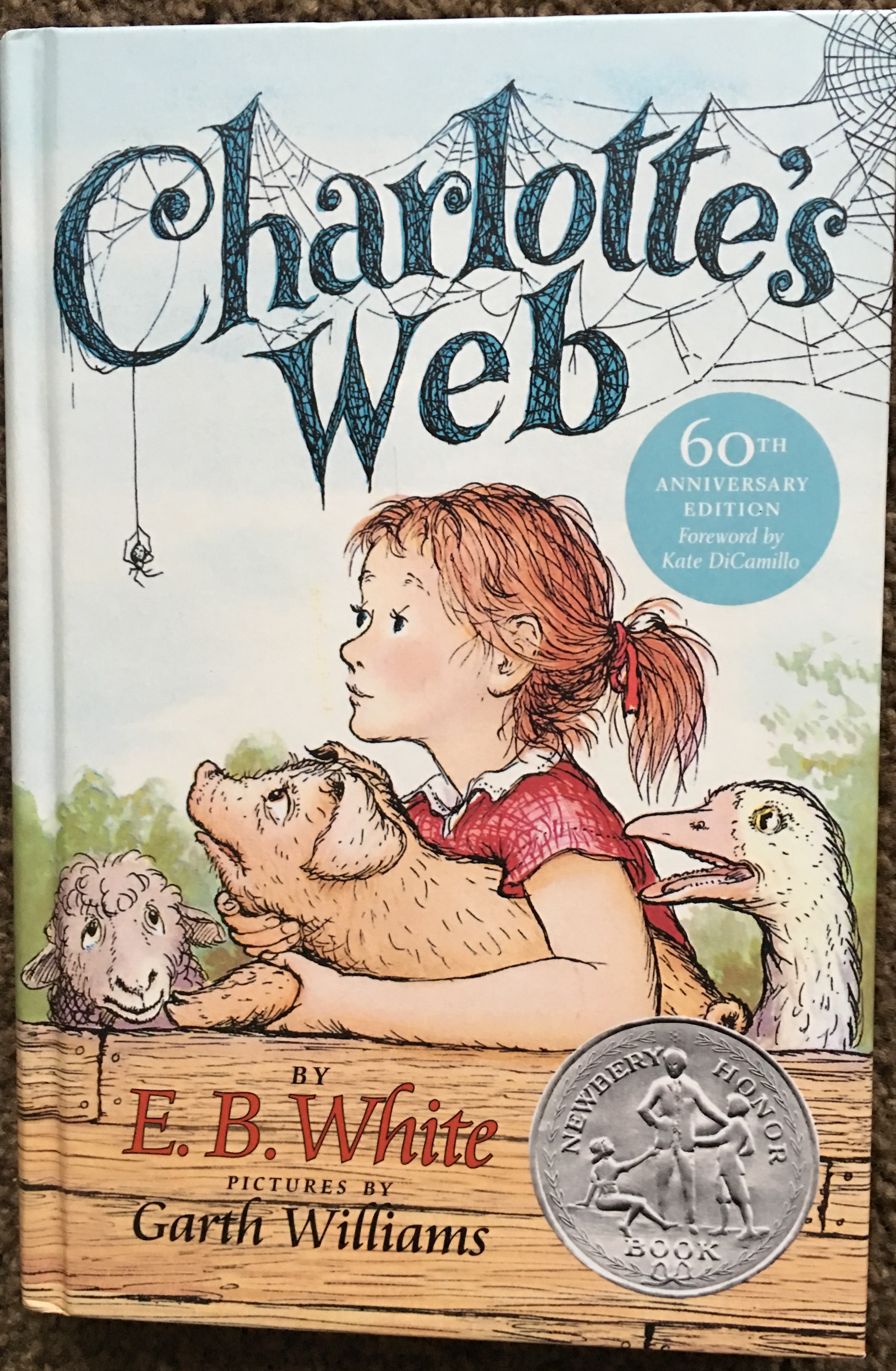
Before long, I started reading chapter books before rest time.  This was unconventional for preschoolers, yet it felt right because children were on their nap mats and needed to hear stories without seeing pictures.  I started with Charlotte’s Web by E.B. White, and have never looked back.  The first thing children learned was ‘you make the pictures in your head’.  This is thrilling, because we now have non-stop reading and multiple discussions, without pictures.  Thirty minutes of pretty intense reading-aloud.  My chapter books include the best of the best.

image

My teaching had become language based and child centered.  Often there were ‘moments’, things that happened because we were reading all the time.  Reading had spilled over into my curriculum.  The day we had set up a restaurant in housekeeping, children were ‘reading’ menus and ‘writing’ orders on clipboards.  I was spelling out the words to one child and listening to questions about the menu from another child.  I doubt these moments would have happened had I not read so often in the classroom.

I wanted to tell families what happened, about moments of learning, and of course about reading-aloud.  So, I started to write more information in my newsletters, and include details.  I wrote, and I wrote, sharing small moments and relating those moments to the big picture in education.

I attended a teacher seminar, and Jim Trelease, author of The Read-Aloud Handbook, was the keynote speaker.  As he spoke I wanted to jump up and rush over to the hundreds of teachers in the room, screaming, “Are you listening to this man?”  “Do you realize how important his message is?”  Instead I wrote him a letter and included one of my newsletters to families that spoke about the importance of reading-aloud.  That sparked his interest in my chapter reading, and he visited my classroom to watch.  I’m included in the latest version of his million copy bestselling book.

image

My public library asked me to direct a library reading group for second and third graders.  This was another new adventure in reading.  I read The Year of Billy Miller by Kevin Henkes, among many wonderful books.  Again, these were new books to me, and I loved it.  This past summer I embraced YA books, thanks to reading Wonder by R.J. Palacio.  I read every Kate DiCamillo book I could lay my hands on.  Every one.

image

My reading and reading-aloud continues to grow.  Thank you Read-Aloud West Virginia for getting the message of how important reading is to the public.  We are making a difference.

Jennie

Posted in Teaching young children, Uncategorized | Tagged , , , , , , , , , | 41 Comments

An Honor and a Thank You

I want to thank the American Legion Auxiliary for interviewing and including me in their magazine.  The recent edition of the American Legion Auxiliary Magazine features patriotism:

“Keeping America’s Patriotism GOING STRONG.  All across the country, Americans are demonstrating their loyalty to the United States in varied ways.”

image

“Inspiring the Next Generation” is the title of what I do.  I am so proud, and quite humbled.  Those words are big shoes to fill, and I am doing just that.  The article is beautifully written, encompassing singing, picture books, quilting, art, and especially stories of events that brought patriotism to life for children.

image

When I received the phone call last fall to be part of this important organization’s wonderful magazine, I surprised myself at how many stories I had to tell about teaching patriotism.  It isn’t something I do every day; it emerges naturally or spontaneously through singing, or looking at the map of the United States in our Big Book Atlas, or reading books like Peter Spier’s The Star Spangled Banner, or seeing an American flag.  Patriotism is just ‘there’, and children see it all the time.  So do I.

I have written about patriotism in many ways, and  my blog must have been a link that connected the American Legion Auxiliary with me.  I’m so glad.

With sincere thanks and gratitude,

Jennie

Posted in Uncategorized | Tagged , , , | 4 Comments

Singing “God Bless America”

Children love to sing.  Over the years in my classroom a favorite song always emerges; “God Bless America”.  The tune is nice and the words are simple for children to sing.  I bring all types of music into my classroom.  I sing all the time, even sitting on the long bench in the bathroom (that’s a favorite with children).  Usually I’m rhyming away with “Down By the Bay” or making children ‘jump and turn around’ with “Uncle Jesse”.  I play record albums of Handel and Mozart and the Beatles.  Music and singing is everywhere.

So, why is it that children love to sing “God Bless America”?  I think it is far more than the tune or the words.  When we sing a patriotic song we talk about ‘presence’, how important it is to stand tall and proud.  We learn how to put our right hand over our heart.  That’s an event in itself, finding our right hand and also where the heart is in our body!  We talk about respect, and how singing for our country should be respectful.  Children embrace this.  Somehow they feel empowered, or perhaps prideful.  It’s as if they somehow know there is something bigger or more important to be singing about — a meaning or purpose behind the words.  They simply love this song.

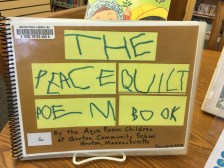
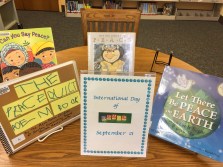
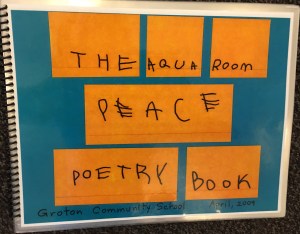
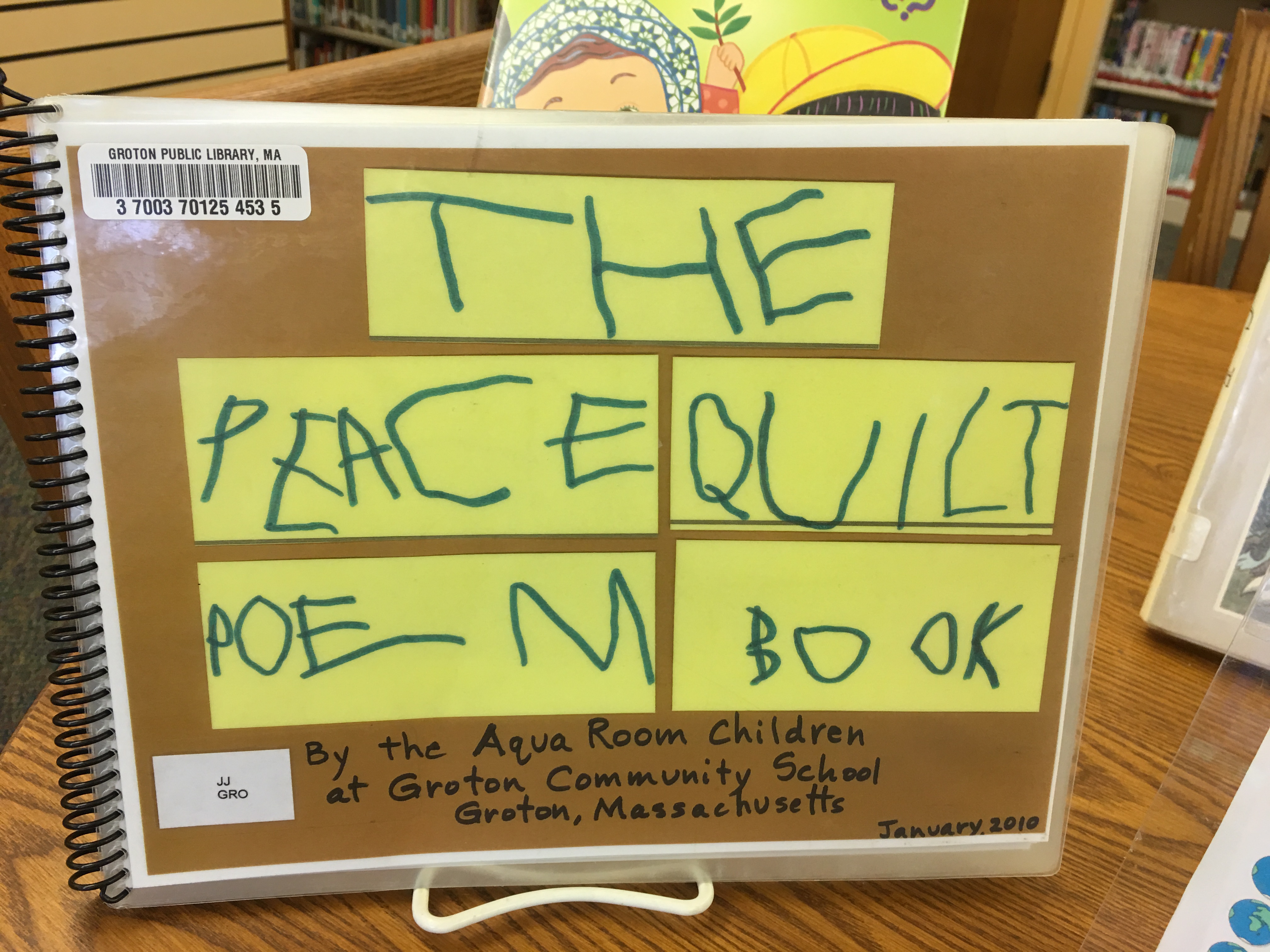
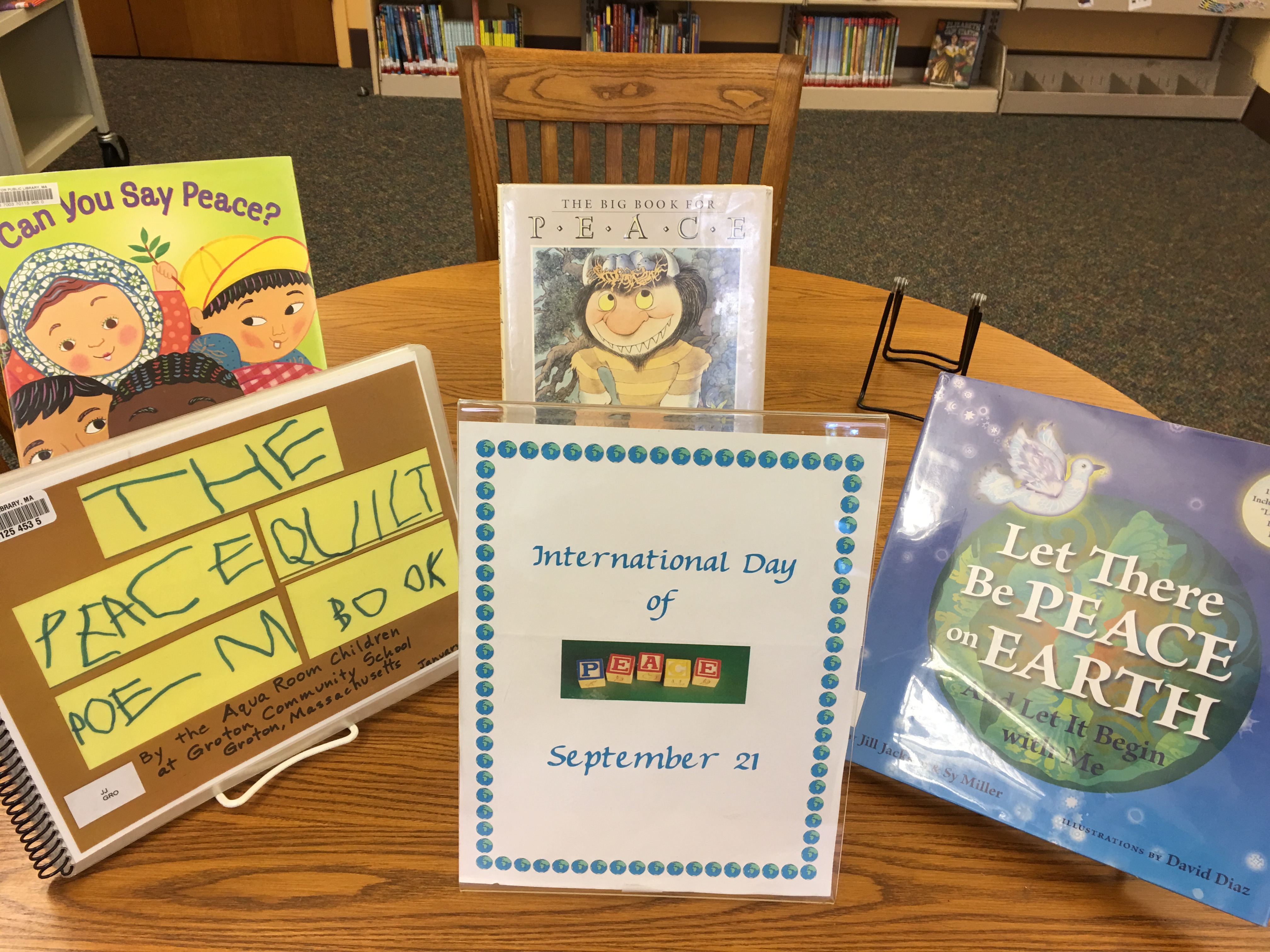
Milly the quilter loves this song, too.  She has been under the weather lately, so the children wanted to sing “God Bless America” and make this video for her.  Milly has worked with my class to make magnificent quilts that hang in museums, including a God Bless America quilt that hangs at the Fisher House in Boston.  Hats off to you, Milly!  We’re on another wonderful quilting journey this year with the children.  It is a Peace Quilt, based on what children think peace looks like.  First we wrote a poem of their thoughts, then turned the poem into a book, and now into a quilt.  Stayed tuned as the quilting evolves.  We already have the sketch drawn.

Jennie

Posted in Teaching young children, Uncategorized | Tagged , , , , , | 2 Comments

Mindfulness, Part II

I always write about the little moments, things that happen; things that I know deep down inside are gigantic in the world of ‘importance’ and ‘all knowing’.  Those moments can easily slip by if you’re not in the zone.  Yes, in the zone.  Ask any athlete how hard that is, and they’ll tell you.  It’s the moment you are ‘there’: in the present, totally focused, and so much a part of what’s happening that anything else is out of your thinking.  Mindfulness.

I played a game with children, ‘Hear the World’, that consists of cards with nine photos, and a handful of chips.  You listen to a recording of different sounds from around the world and find the correct photo of that sound on your card.  It’s not as easy as it sounds; identifying the sound of a baseball bat connecting with the ball and fans cheering, bagpipes, a tin whistle, and screeching monkeys takes full concentration.

So, how do children (or adults) get into a mindful state of being?  We close our eyes, breathe, and then listen.  Sound familiar?  Hasn’t this been a successful practice for centuries in other countries?  In my class, we pretend to pick a flower, smell it slowly and deeply, then hold up our first finger as a candle and blow out the candle.  We do this three times.  Then, we’re ready to listen.  As such, children could really play “Hear the World” and recognize the sounds.  Last week we listened to the sound of the ocean, as that is our current unit of study.  Not knowing ahead of time what that sound would be forced the children to focus their minds.  And, smelling the flower and blowing out the candle prepared the mind for readiness.

After listening to the ocean we ‘brainstormed’ how it made us feel.  Children said, “I think of fish swimming and water and sharks.”  “It makes me feel like summer”.  “It makes me feel better.”  “It makes me feel peaceful.”  We were then ready for geography!  First we looked at our Big Book Atlas and discovered that the world has more water than land.  We talked about north and south and how that relates to cold and warm water temperatures.  We then switched maps to a satellite map, which of course shows light and dark blue, and that prompted a long discussion on the depth of parts of the ocean.  The following day we planned to learn about lantern fish, so this was a perfect preview.  One child traced his finger along the coastline and asked why that water was so light blue.  Liam immediately answered, “It’s shallow.”  I doubt that my class could have stayed together that length of time in such a curious state of wanting to learn had we not prepared with mindfulness.

Schools throughout Massachusetts are incorporating mindful practices into the classroom, and it is often referred to as “a focus on well-being.”  A featured article in the Boston Globe by James Vaznis on January 5, 2016 highlights schools in Reading, MA.  As the article states, beyond helping children to simply focus so they can learn, this practice also addresses the social and emotional well-being of students.  Teaching students to manage their emotions can help them deal with a multitude of serious issues, including bullying, mental illness, substance abuse, or trauma.  It’s not simply “feel good” education. School teachers have deliberate conversations with children in order to connect and learn about the child.  They also have ‘open circles’ so children can have free dialogue and discuss problems.

I had to smile when I read that, as lunch time in my classroom is intimate, full of conversations about each other, including ‘Jennie stories’.  It’s detailed in one of my earliest postings on 5/13/1214.  After all, if I want to learn about my students, they need to learn about me as well.  I’m glad to know that I’ve been practicing many of these techniques for years.  I knew in my heart I was doing the right thing.  Now, I have expanded with more ‘tools’ in my belt.

And yes, as I hinted in my first mindfulness blog post, we have started to listen to classical music.  Handel’s “Water Music” had children not only listening, but painting and dancing as well.

Jennie

Posted in Teaching young children, Uncategorized | Tagged , , , , | 2 Comments

Spirit Animal Blog Award

Spirit Animal Blog Award

I have been nominated for the Spirit Animal Blog Award.  Thank you, Charles French https://charlesfrenchonwordsreadingandwriting.wordpress.com for nominating me for this award.   I am honored, indeed.  When a blogger receives recognition from a fellow blogger it is very important.  Thank you, Charles.  Please visit his wonderful blog!  This Spirit Animal Blog Award is a tribute to what I teach and then write about.

Spirit Animal Blog Award Acceptance Rules:

1.) Thank the blogger who nominated you and link back to their page.

2.) Post the award on your blog.

3.) Write a short paragraph about yourself and what your blog means to you.

4.) If you could be an animal, what would it be?

5.) Pick and notify ten nominees.

About Me:

I am a preschool teacher with a passion for reading aloud, music, art, and discovering the world through the eyes of children.  I seize the moments in teaching when children are inspired and excited about learning, as those moments are often the best teaching moments.  That’s what I write about on my blog.  As a fellow reader and writer, I love connecting with people through their blogs.

My Spirit Animal

My spirit animal is a dragonfly.  They are peaceful, energetic, and interact with people and animals.  They have a quiet beauty, yet are vibrant and engaging.

blue-dragonflyMy Nominees:

Rich, https://goodmusicspeaks.com

Tricia, https://neverlessthan.com

Marie, https://playfuldirections.com

Paulette, https://paulettemotzko.wordpress.com

Robin, https://witlessdatingafterfifty.wordpress.com

Ellis, https://ellisnelson.com

https://teachingontheverge.com

Marcia, https://marciastrykowski.com


Posted in Uncategorized | Comments Off on Spirit Animal Blog Award

Music Brings Unexpected Learning

A child brought to school a CD with the “Star Wars” theme song.  Fortunately it was a recording of all the John Williams movie themes, and that means good music and a golden opportunity for learning.  We began with mindful listening to the sound of instruments as the first song on the CD was not “Star Wars”.  That sparked a huge discussion on high and low sounds, and the obvious need to see instruments and hear them individually.

Cello

We were on a roll of emergent curriculum, with children wanting to learn.  I was trying to fill their minds with every tool I had; books, pictures, and the iPad.  I started with string instruments (they loved the cello) and moved to horns.  At last we put it all together with a full orchestra.  After all, John Williams was a conductor.  Here is what I wrote to families:

When Unexpected Learning Happens

Yesterday was a perfect example of how planned teaching and curriculum can go out the window because something wonderful happened. Owen brought in a CD of John Williams music. He has written scores of award winning movie themes. The “Star Wars” theme song was big on Owen’s mind. It’s a great piece of music. We played it, yet the CD doesn’t begin with “Star Wars”. That was a good thing, because children had to really listen. Mindfulness. We did our breathing ahead of time so our listening was ready to go.

As we listened we heard different instruments. We decided to raise our hand if we heard a certain instrument. Strings, horns, and drums were the beginning. Then we included the flute. At this point we stopped to talk about high and low sounds, and how each type of instrument has families of highs and lows. Wow! This was getting exciting and complex. Children were focused.

I grabbed a popular classroom book that shows all the instruments. We began with the string family, introducing the violin and the cello. Not only did we talk about high and low, we pretended to hold and play the instruments, under our chin or set on the floor. When we moved to the horns, we learned that you need to blow into the instrument to make a sound. It was fun to imagine sliding a trombone and putting your hand into the bell of a french horn.

At this point we introduced the orchestra itself. John Williams was a conductor, so we began with what a conductor does. We thought it was pretty cool to stand on a platform and use a baton to tell the instruments what to do. An orchestra is a ‘big curve’ around the conductor. But, what does an orchestra look like? We knew what the instruments look like. This was another step in our unexpected learning. Yes, we had picture books, but we also have technology. We used the iPad to watch the Chicago Symphony Orchestra prepare for a performance, tuning up and practicing. Then we watched them perform.

Finally, we watched John Williams conduct “Star Wars”. Every child was clustered and listening. The shouts of, “There’s a violin”, and “That’s a trombone” happened all the time. This was full circle. It brought together everything we had learned. The moment was remarkable.

Jennie

Posted in Teaching young children, Uncategorized | Tagged , , , , , , | 11 Comments

Children’s Stories

Children have incredible words, given the opportunity to tell their story.

Castle Story IMG_0420

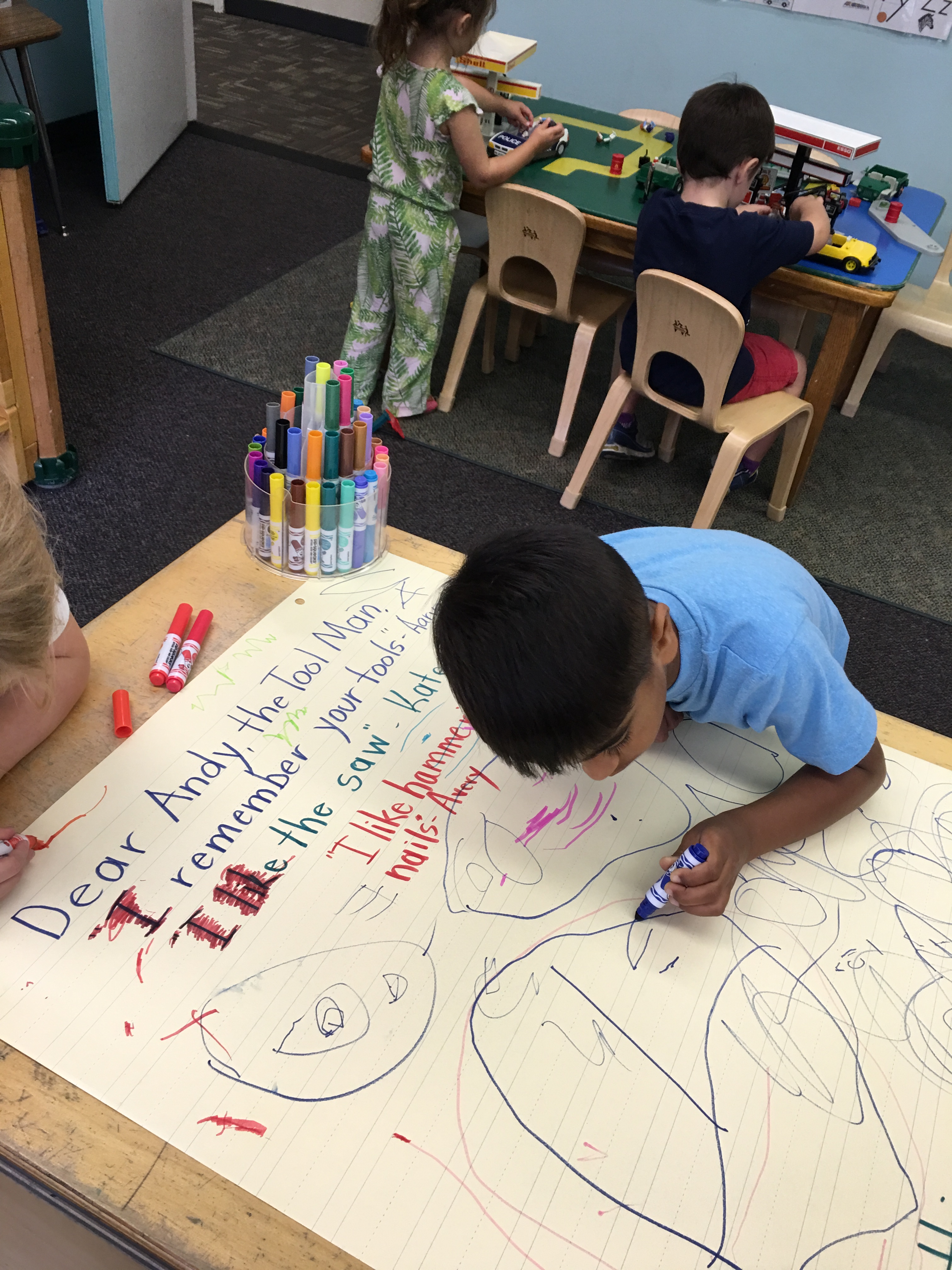
As I took down a hallway art display I read (yet again) the story that children had created about living in a castle.  What would they do and who would they want to be?  Open ended questions for children fuel the fire in the brain.  Actually, opened ended questions give children freedom to say how they really feel and what they really think.  There are two important things to know: children need to be empowered; they need a chance to speak up without judgement.  Children need to be inspired; they need a shot at creativity.  We’re talking two things, the mind and the heart.  If I can fuel both, then I have done the best for children.

The best way to inspire and empower children is through language and literacy.  Hands down I know this to be true because thirty years haven proven it so.  Read a story aloud. Don’t be afraid that the words or storyline might be difficult.  That’s a golden opportunity to stop and learn.

When I was in high school we read Moby Dick and Beowulf.  I hated the books and could never feel a part of any discussion.  I was on the sideline.  Never did I feel that I had anything to contribute.  My empowerment and inspiration were zero.

What if my teacher had put down the book and just talked about what happened?  I have thought about that quite a lot.  It would have made a difference.  It might have given a shy girl a little chance at speaking up, or an opportunity to really think.

What if someone had read to me books like Charlotte’s Web when I was young?  I would have had the words to say how I felt.  I might have had a better chance at reading Moby Dick.  I think about this all the time.

When I read stories to children, stopping and talking and asking questions is as important as reading the story.  The next step is giving children an opportunity to tell their version, because it builds upon what they know and want to know.  That can be writing a group story or even planning a play performance by the children.

I love the story my class wrote.  When they get to high school, maybe they will be able to read and discuss Moby Dick. I’m giving them a good start.

Jennie

Posted in Uncategorized | Tagged , , , , | 3 Comments

The Boy With the Red Hair

January is always a busy month at school, and tonight I was tired.  My husband and I had errands to do after school, so we had dinner at a small local restaurant.  Just when I thought I had nothing left, in walked a family and they sat at a big table next to us.  The little boy was a chatterbox to everyone at his table.  He immediately drew a picture of himself on his place mat.  I could definitely see; how could I not notice a very busy, very enthusiastic preschooler, who was very intent on drawing himself?

He was the boy with the red hair.  He told me so.  Funny thing, eye contact and a smile are nothing short of working miracles.  When we caught each others eye and smiled together at a random moment, the boy with the red hair picked up his drawing and came over to show me.  He told me everything, describing his eyes, moustache and beard, and of course his red hair.  I asked if he forgot something, hands and feet.  He firmly announced he had not, and pointed to the lines he had drawn as arms and legs.  He was especially proud of his red hair.

As this was taking place, we were shooing people away.  Family, waitresses, even my husband seemed to be interrupting.  There I was with the boy with the red hair whom I’d known for less than two minutes, having a deep and important conversation.

You just don’t know what is right around the corner.  Little things can become big things in an instant.  When dinner was finished I walked over to the mother to tell her all the great things about her child; creative thinking, language skills, social skills, sense of self, and more.  For me it was just obvious and something I wanted to pass on to her.  To the mother, it was a sunrise, words that she won’t forget.

I think I had the best night, and the boy with the red hair might feel the same way.  The mother might feel she had the best night, ever.  The little things became a big thing.  That’s exactly what happened tonight.  I’m so glad I don’t miss those moments.

Jennie

Posted in Teaching young children, Uncategorized | Tagged , , , | 4 Comments

Reading Aloud. ‘Star Wars’, Move Over

Thursdays I read aloud at the library.  I chapter read, and that is far different than reading a story.  Each Thursday ends with and then?  For thirty minutes children are glued to every word, because those words are powerful and exciting, and heart pounding.  The words are complicated and make children think.  We sit together, close.  When I read aloud I yell, whisper, cry, gasp…whatever those words on the page are saying.  They push every button and pull every string, and I read it just that way.

Here’s the best part; the brain is the most sophisticated computer, far beyond the wealth of information and technology we already know.  When the brain hears the words from reading aloud chapter books, it goes into action and makes amazing pictures.  We see exactly what is happening in our mind.  It triggers the heart with a call to action.  On the highest level it makes us change through learning.  The brain is supreme, and what it does with the words it hears from books is better than any movie can hope to do.  Star Wars, move over!

Today was a typical chapter reading day at the library; heart pounding, laughing, and learning.  We’re reading Indian in the Cupboard.  Omri took both Little Bear and Boone to school in his pocket.  There we problems when Little Bear stabbed Omri, then Omri and Patrick got into a big fight.  Omri had to give both Little Bear and Boone to Patrick at lunch time.  Oh, do you know Little Bear and Boone are three inches high and have come alive through Omri’s cupboard?  And, they’re from different times.  Things got worse with a fight in the cafeteria.  That’s where we had to leave it today (with children begging to keep reading) because we read way over our time.

The rest of the chapter continues to build, and that’s just what the brain does best of all; making mental connections with every word and sending them into pictures, memory, and thinking.  I can’t wait for next Thursday’s chapter reading.  The and then? is a constant.

Ellie Letter

Is a book better than a movie?  You bet!  Children know.  Anoushk wrote me, “Keep reading with us”.  I will do that!

Jennie

Posted in Teaching young children, Uncategorized | Tagged , , , , , , | 5 Comments

Mindfulness

I brought my stack of magazines with me on a trip out west so I could ‘catch up’, read and toss.  I typically pick up a book to read so my pile of magazines was growing.  As I settled in to reading on the plane I found a common theme in all the magazines; mindfulness.  There were articles about reducing stress, focusing on strengths, relaxing, down time, yoga, connecting more effectively with others, and more.  I wasn’t surprised at all.

Mindfulness is the hot topic and ‘buzz word’ in education.  It has reached a high level that began with yoga decades ago.  Educators understand that if the mind and body are working together, learning takes place.  So what is mindfulness, and why is it important ?

Mindfulness is a way of paying attention to, and being in, the present.  It is sensory, not cognitive, and taps into different parts of the brain.  With children, it helps with emotional regulation and cognitive focus; children first need to develop emotional and social skills before effective learning can take place.  The cognitive piece fits right in, when a child is focused and ‘in the moment’- mindful.

Tapping into the senses in a purposeful way helps make the mental connections necessary to pay attention.  I like to use sound.  Years ago I began using a bell, like the one they use at a store counter to get the attention of the employee.  I wasn’t thinking mindfulness, I was thinking of how I could make math and science games at group meetings more exciting and engaging.  When children took a turn, they got to ring the bell.  It was simple and powerful at the same time.  Now, I use different bells with different sounds before starting an activity.  One bell has a ring that lasts for a long time.  We close our eyes and silently count until the ringing stops, then share our numbers.  Being in the present means being aware of and including each other as well.  Another bell has a shorter sound, so I ring it a number of times and we count the number of rings.

I have two tuning forks of different sounds.  As I play them in a child’s ear other children cannot hear a sound, yet they are focused, in the present, and mindful.  Once all the children have listened to the sound of the tuning forks we can have a discussion rich in learning, beginning with “W” questions.  We can use other senses, such as feeling the vibration of the tuning forks, and watching the vibrations make water splash.

When we use our senses and begin mindfulness, we first close our eyes and take a few slow, deep breaths to ‘get ready’, much like an athlete warming up muscles.  Perhaps this practice is part of why chapter reading aloud is successful in my class; before listening to the words we turn off the lights, take a breath and close our eyes.  We ‘make the pictures in our head’.  External stimulation is eliminated, and our brain has to rely solely on listening.  Children therefore learn and understand, including deep discussions.

Listening to classical music, particularly identifying certain instruments, is part of my curriculum.  This year I plan to make it mindful!

As adults, we yearn to find peace and relaxation, get away, cope with stress, and simply be happy in the present.  If this is not easy for adults, imagine how difficult it is for young children to manage themselves.  Unlike decades ago, children today are often anxious and bombarded with external stimuli.  On top of that, test taking and scores have swallowed much of school time, leaving little for real and meaningful learning, along with follow-through of thought provoking questions and discussions.  The mental connections often aren’t happening.  Teachers and parents can make a difference by adding simple mindful practices to the classroom and at home.  Let’s use what we know about the brain and about children, and help them to learn.  I do!

Jennie

Posted in Teaching young children, Uncategorized | Tagged , , , | 4 Comments