Growing Readers

The most important thing I do in teaching is reading aloud to children.  I love what I do.  It started my first day of teaching when Lindy, my Head Teacher, handed me the book Swimmy by Leo Lionni and asked if I could read it to the class.  I was transported into a new world, and that began my daily journey of reading aloud.  I call it a journey because my decades of reading aloud has brought me to understand the tremendous difference it makes on the lives of children.

Recently Emma asked me if she could return to my class and read aloud Goodnight Moon by Margaret Wise Brown.  This was the book she remembered hearing every day, before I read aloud from our chapter reading book.  Emma was so proud.
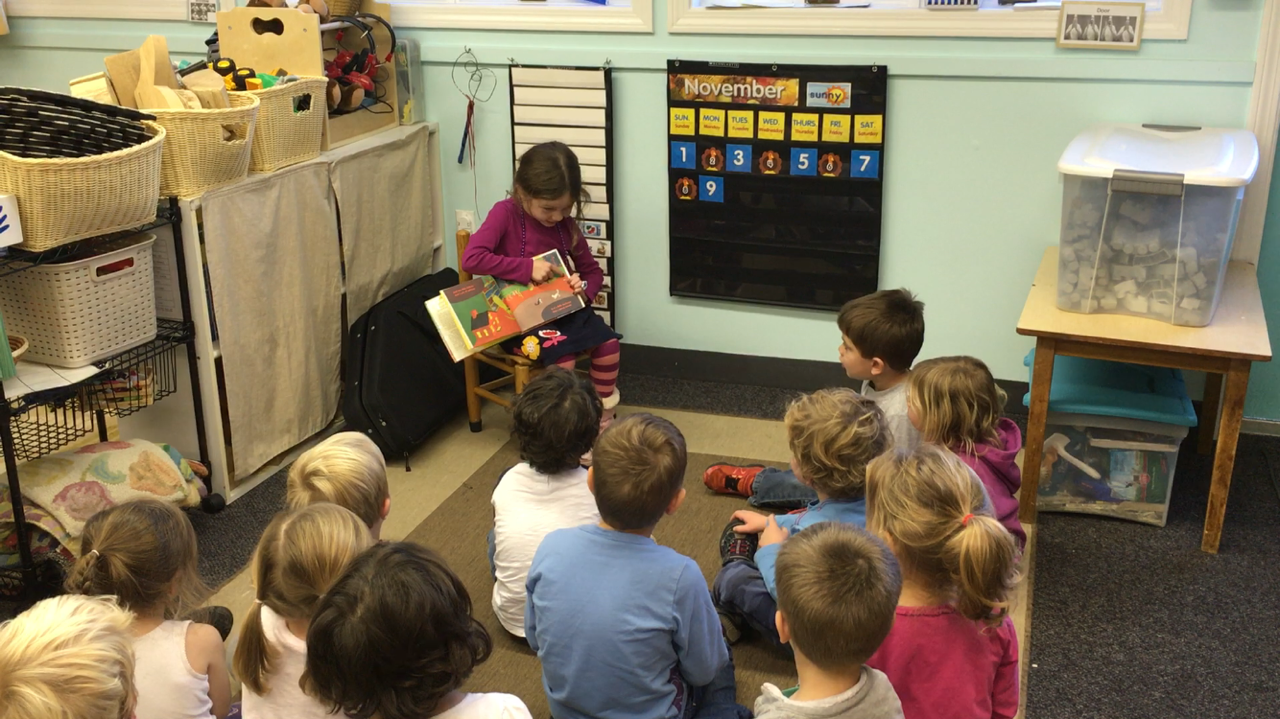
Emma Belcher image1-1

Not only was Emma proud, she was becoming a reader herself.

The research and documentation on the cognitive benefits of reading aloud is staggering.  Hart and Risley’s groundbreaking study a few decades ago, Meaningful Differences in the Everyday Experience of Young American Children; found that the total number of words a child hears is directly related to academic success.  In the study, children from professional families heard forty-five million words by the age of four.  Children from working class families heard twenty-six million words, and children in poverty heard thirteen million words.  Their follow-up study documented that years later there was a tight link between academic success and the number of words heard.

Author Jim Trelease is correct when he says, “The knowledge of almost every subject flows from reading.  One must be able to read the word problem in math to understand it.  If you cannot read the science or social studies chapter, how do you answer the questions at the end of the chapter?”

First we hear words, and then we speak words, then read words, and finally write words.  It all starts with language.  The brain is an amazing reservoir, and all the words that are poured in (receptive language) eventually manifest and come out as expressive language.  Listening and hearing = comprehension, and the accumulation of words that enter the brain will naturally flow to reading.

Author Pam Allyn uses the phrase “marinating vocabulary” when she talks about reading aloud.  She points out that words develop into important dialogue, and that comes from both books and storytelling.  She is really saying hearing words in a myriad of ways further develops vocabulary, thus cognitive development, and reading.

When I learned these facts and began reading the research, it cemented all that I instinctively knew in my soul.

Yes, there is more.  When you read aloud to a child you are educating their heart, giving them the seeds of goodness.  After all, it takes far more than knowledge to become a good citizen.  The givers and the doers, the mothers and fathers, teachers and leaders and workers all have a commonality.  That begins with words, language, and stories.  Good books impart everything from discovering the world, to the subtleties of making choices and decisions, with words woven carefully through characters.  The point is, hearing a multitude of different stories is building one’s self.  Books and stories show you the way.

Perhaps John Phillips, founder and benefactor of the renowned school Phillips Exeter Academy, said it best of all more than two centuries ago:

“Goodness without knowledge is weak and feeble, yet knowledge without goodness is dangerous, and both united form the noblest character and lay the surest foundation of usefulness to mankind.”

Educate the mind and also the heart.  Read aloud.  Make a difference.  Grow a reader.
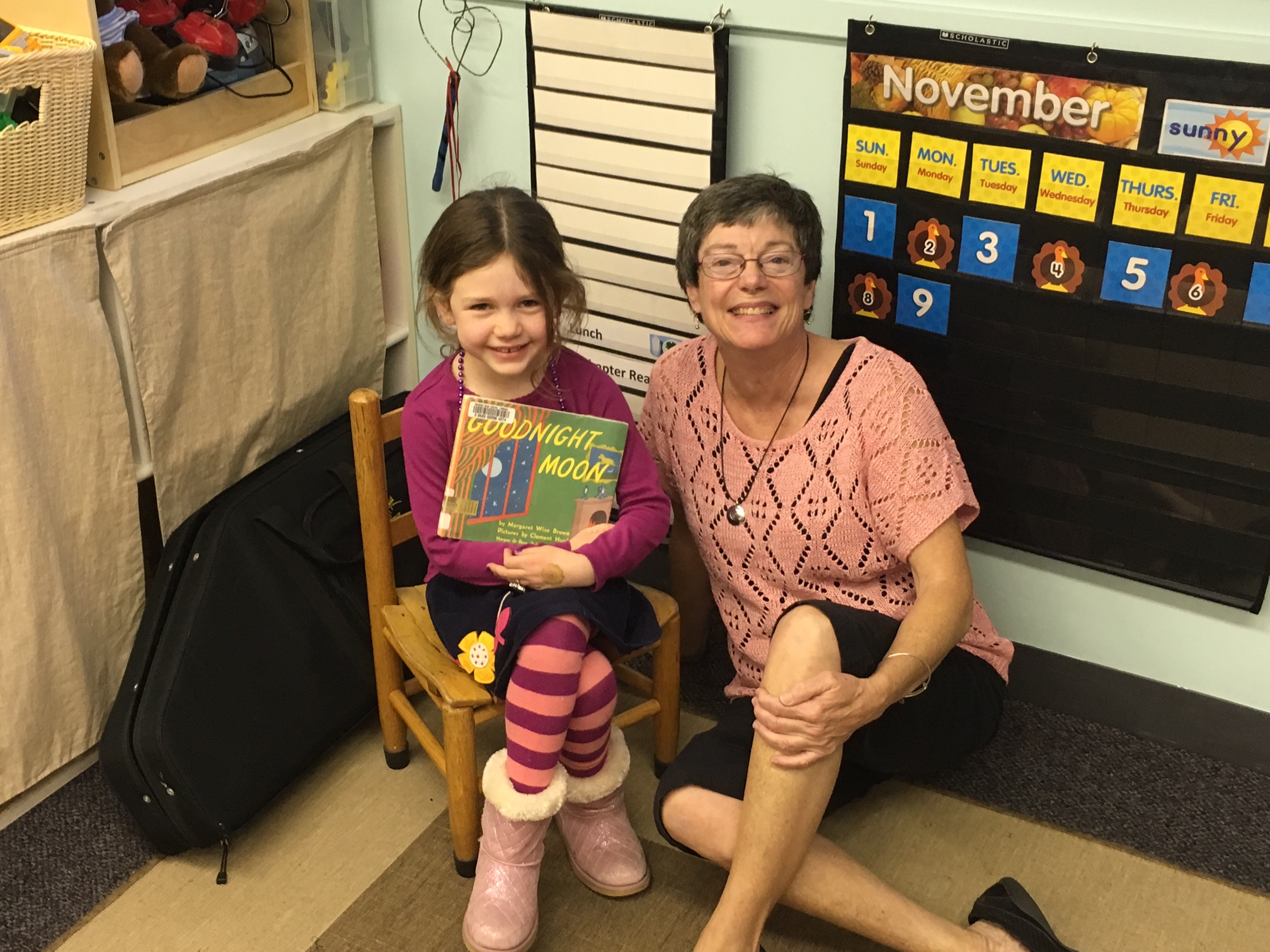
Emma Reading Goodnight Moon IMG_0281-1

Jennie

Posted in Teaching young children, Uncategorized | Tagged , , , , , , , | 1 Comment

Teaching Patriotism to Young Children

Today was “Red, White, and Blue Day”.  The day before Veterans’ Day is a perfect time to teach patriotism.  How do you teach patriotism to young children?  The best place to start is with singing.  We sang “God Bless America”.  Some of the children know this song, but for many this was new.  They loved it!  We spread patriotism to all the classrooms in school, and that started with singing “God Bless America”.

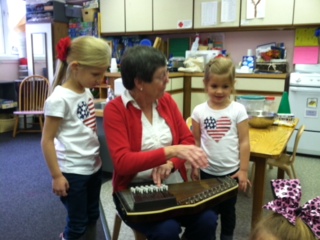
Hannah and Emma photo-1

I held a big American flag for the children.  Seeing a full size flag close up is a far different experience than seeing it at a distance on a flag pole.  We talked about the red white and blue colors.  We talked about the stripes and stars, and we counted fifty stars.  That concrete number of stars led to the number of states, of course.  I raised my hand and said, “I know one of those states, Massachusetts!”  The chaos that followed was loud and wonderful.  Everyone wanted to talk about Massachusetts and states, and also the flag.

I taught children how to properly shake hands.  They simply didn’t know exactly how to do that.  Right hand to right hand, thumbs up and interlocked, a firm squeeze and a shake.  When you meet a member of our Military, knowing how to shake a hand and say “Thank You” is important.

I asked the children, “What is patriotism?”  They didn’t know.  We pulled out our big dictionary (which we use all the time), and found the word ‘patriot‘: One who loves and supports his or her country.  I asked each child if s/he loved America, and of course the the ‘yeses’ were unanimous.  Finding the word in the dictionary was exciting and hands-on.  It seemed to validate what was brewing and what we were teaching.

I educate the heart.  That’s the foundation for children’s learning.  If their heart isn’t in it, learning the academics is a struggle.  Yet, there’s far more to educating the heart, and that begins with all those important values; kindness, giving, and character.  They make you feel good, give you confidence, and more importantly shift your thinking to others.  A teacher said it well, “Classroom, classmates, self”.  She was talking about the order of importance in her classroom.  I remember when a Navy Blue and Gold Officer said the same message but in different words, “Ship, shipmate, self.”

This is most important, because children need to have a strong foundation of self in order to grow.  Once they do, they can spread their wings and learn.  And, learning those all-important values from the heart will give them the tools they need most in life to become more than academic learners; to become good citizens.

Patriotism is a great way to teach the heart.  That’s what I did today.

Jennie

Posted in Teaching young children, Uncategorized | Tagged , , , , | Leave a comment

A Halloween Story

It happened like this… When I was eight years old I went trick-or-treating with my little sister, Sarah.  Back then children went trick-or-treating alone.  There were no Moms or Dads.  And, we never went out until it was really dark.  All the way dark.  I dressed up as Raggedy Ann and Sarah dressed up as a scarecrow (although she looked more like a hobo than a scarecrow).  We each had a pillow case to collect all the candy which we called our ‘loot’.  We were so excited!

Then my mother said, “Jennie, don’t forget to go trick-or-treating at Mrs.  Crotty’s house.”  Mrs. Crotty!  She was really old.  She always looked mean and she never smiled.  Her house was dark brick with big bushes and trees everywhere.  Everything was always dark.  Her house was as old as she was.

I said nothing to my mother.

Sarah and I headed out trick-or-treating.  We had the best time!  We got tons of candy, too.  When we got back home we dumped our pillowcases out on the rug in the den and sorted through all the candy.  I gave Sarah all my Tootsie Roll Pops and she gave me all her Reese’s Peanut Butter Cups.  Yum!

Then my mother said, “Did you go trick-or-treating at Mrs. Crotty’s?”  I had forgotten, of course.  When I heard her words I felt like a lightening bolt had hit me while I was falling off a roller coaster.  Again she said, “Well, did you go to Mrs. Crotty’s house?”  All I could do was look down and shake my head.  My mother was not happy!  She said, “Jennie, I told you to go.  So take your sister’s hand and go right now”.

I took Sarah’s hand and we went back outside together.  Now it was really dark and trick-or-treat was over.  There were no lights on at anyone’s house.  We slowly walked to Mrs.  Crotty’s house.  As we turned the sidewalk and walked up her walkway I squeezed Sarah’s hand and she squeezed mine.  I was so scared.  We got to Mrs. Crotty’s porch which was pitch black and surrounded by weird branches.  As we approached the front door I said to my sister, “You knock.”  “Oh, no” she said, “Mother told you to do it.”  So, I took a deep breath and knocked on the door.

A moment later I heard the door slowly creak open.  Just as I was ready to run the lights came on and there stood Mrs. Crotty, smiling.  I’d never seen her smile before.  She said, “Hi Jennie.  Hi Sarah.  Come in.”  We stepped inside the door.  “Wait right there!”  We didn’t move.  She ran to the back of the house and returned with two gigantic popcorn balls, covered in melted butter and caramel.  They were still warm.  Yum!

And I was so afraid.  Silly me.

Jennie

P.S.  This is a popular ‘Jennie story’ in my classroom.  Happy Halloween!

Posted in Teaching young children | Tagged , , , , | Leave a comment

Death and Dying, and Chapter Reading

I finished reading our first chapter book of the school year, Charlotte’s Web.  Children were engrossed in this book because it is a story about the heart, and my most important job is educating the heart.  As such, they began to understand the depth of true feelings.  Charlotte the spider died.  That opened the door for questions, and some of those questions were in the form of silence.  That’s when I put down the book and talked with the children, and listened.

Death isn’t an easy topic with children.  Addressing death and dying with young children, and with their families, is typically not part of a teacher’s curriculum, or even part of the books and stories they read.  When Charlotte died this week, here is what I wrote home to the children’s families:

Yesterday we finished our first chapter book of the year, Charlotte’s Web. It is a wonderful story, and your children loved it. Chapter reading is one of the favorite times of the day because children are captivated by words alone. Those words make the pictures in their heads, and those words make their minds think and their hearts feel. That is the power of reading aloud.

“Can’t you just read more?” is what children ask when we stop reading. That means they are listening and comprehending. Chapter reading is a bridge from understanding a book to feeling a book. That’s a big step for children. In Charlotte’s Web, Wilbur the pig makes his best friend with Charlotte the spider, yet he suffers through sadness and loneliness. Charlotte the spider dies at the end, as all spiders do. These facts are part of the story, yet are vastly overshadowed by the storyline itself. That is why a good book imparts a tremendous opportunity for learning.

Death and dying happens, and when it can be introduced to children in this way, it can better give them tools of understanding. It can also be a soft step to real events in a child’s life. When a grandparent dies, or even when a classroom pet dies, perhaps Charlotte’s Web gave a child understanding and compassion. Did we talk about Charlotte when we read the book? Of course we did; not only her death, but her children (all five hundred and fourteen), and the words she wrote in her web. And, we will continue to talk. Often children bring up questions months later, and we listen and answer.

Sarah and I have a wonderful dialogue when we finish a book. I become very sad and a little teary. Sarah asks, “What’s the matter, Jennie?” I reply, “The book is over. I don’t like that! It was so good. I’m really very sad.” Sarah perks up and says, “But we get to read another new chapter book.” I reply, “Really? When?” Sarah says in a big voice, “Tomorrow!”

That’s our circle of chapter reading, much like the circle of life.

When I first started teaching, our school’s director always stressed the importance of teaching families.  She understood that in order to educate the child you also need to guide parents and families.  She was emphatic about sending newsletters home, and adding one paragraph that would teach something to families.  She was right.  She also felt that educating children and families about death and dying was important.  Gulp!  For many teachers that was an uncomfortable topic to address.

A few years later our beloved classroom guinea pig, Elliott, died unexpectedly.  I was devastated.  First I knew I had to tell the children, then I knew I had to tell their families.  That was my diving board, and I put my fingers to the keyboard and wrote.  I talked about letting children ask questions and giving them an opportunity to say goodbye.  I talked about being honest.  I talked about how perhaps experiencing the death of a pet can help make the death of a loved one down the road a little easier.  The words flowed.

Over the years there have been many classroom pets who have died, and many stories and books about death.  I listen.  I ask questions.  Children always have a voice.  Chapter reading really is much like the circle of life.  I am educating the heart.

Jennie

Posted in Teaching young children, Uncategorized | Tagged , , , , , , , | 1 Comment

So, What Happened to Dinner?

I worry that dinner together just doesn’t happen enough with families.  You know, the good old sit down together, passing and serving food, talking about the day.  The benefits are huge, and I’d like to tell you why.  I’ll start with my classroom.

My classroom lunch time is really a big family dinner, or at least what a dinner at home should be like.  We talk, together.  The bonding is one thing, the language is another.  When we have our conversations it’s more than the words we use.  We listen, share new thoughts, have discussions, learn about each other, and share stories.  This is much deeper than just vocabulary words. It has to do with learning, comprehension and succeeding in life.  Let me bridge those thoughts from words and language, to succeeding in life.  That’s a huge leap, yet it is very true.  Here are some stories and statistics to fill in the middle.

A few decades ago a study was done to see if there was a common denominator among National Merit Scholars.  Surely they were all on the debate team, or volunteered, or played an instrument, or were class president.  There had do be a common denominator, and there was just one; those scholars had dinner at home with their families at least four times a week.  Are you surprised?  I was.  I expected that it would be the books they had read, yet reading books is really grounded in language, and language starts with…well, dinner.

I’d like to share with you the first newsletter that I sent to families, back in the 90’s.  Before that, my information was like Dragnet, “Just the facts, Ma’am”.  This newsletter became my moral compass, and still is.

After attending a teacher seminar and hearing the moans and groans about lunch time in the classroom and then reading an article about the benefits of mealtime with families, I thought you might enjoy a little verbal window into our classroom at 12:00 PM.  Is it chaos or is it beneficial?  Yes, there is chaos.  The logistics of getting 15 children set up for lunch is no small feat.  On the other side, lunch time is almost like a casual circle time – a time we often engage in in-depth conversations, sometimes light and fun, sometimes deep and serious!  We have debated if girls can marry girls and boys can marry boys; we have nominated our favorite cereals and our hated vegetables.  We talk about nutrition, manners, health, nightmares and monsters.  The questions are endless.  Everyone’s opinion is valued.  Isn’t that wonderful?  A favorite is, “Tell me when you were a little girl.”  Children derive such comfort and support when they know that their teacher had all the same fears and troubles when they were young.  Just ask your child about Jennie and the peas and the piano.  I think I am asked to tell this story at least three times a week.

Did you know that the benefits of verbal dialogue among families at dinner is as effective for language development as reading?  A key to language and reading readiness is in both conversation and listening.  I believe that our lunch time provides all of these opportunities plus socializing, nutrition, education, and reinforcement of table manners in a fun, sometimes relaxed, sometimes chaotic, environment.  Please join us anytime for lunch.  It’s great.

This is as true and meaningful today as it was way back then.  Here is another important fact to consider: the number of words a child hears can be directly attributed to his / her success in school.  That means, talk in meaningful ways with our children, read aloud, discuss and debate things, encourage both their listening and their dialogue.  Gee, that sounds like having dinner together!

Jennie

Posted in Uncategorized | Tagged , , , , | 1 Comment

Singing a Peace Song

Singing and music with children is transforming.  It happens every time; as soon as I pull out the autoharp or ‘song jar’ I have a classroom of children who are craving the experience of music and singing.  I’m not a big fan of playing a music CD with children, with the exception of one song; “Bells of Peace” by Jack Hartman.  I love that song, and so do other teachers and children in our school.  Liam just adores the song.

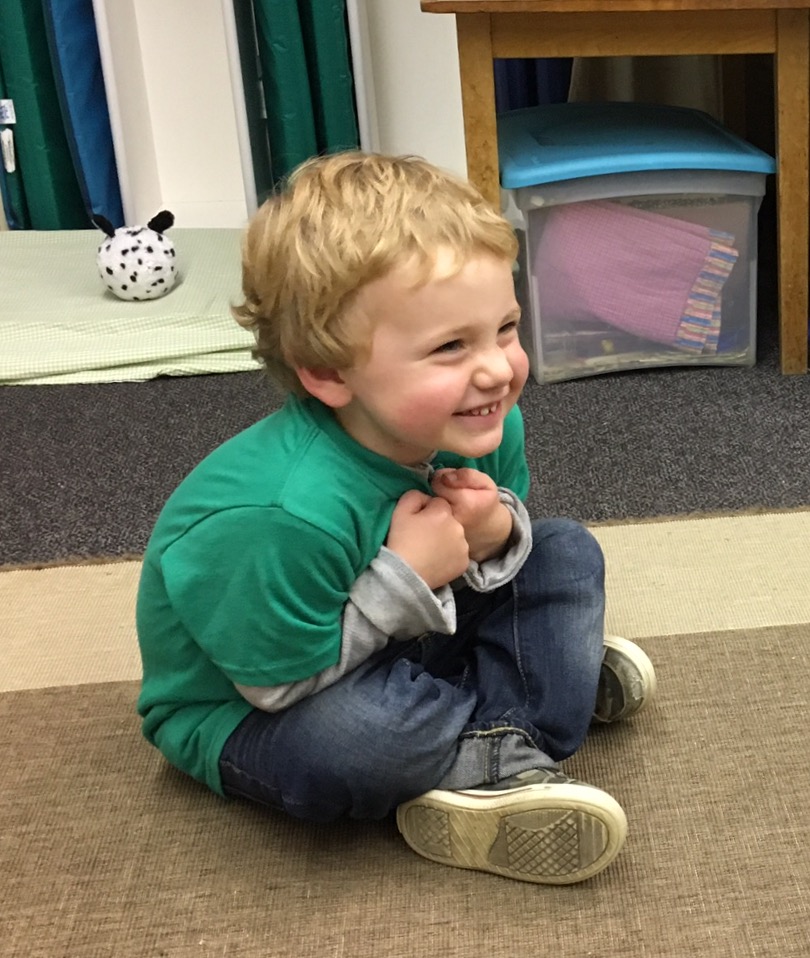
Liam alone

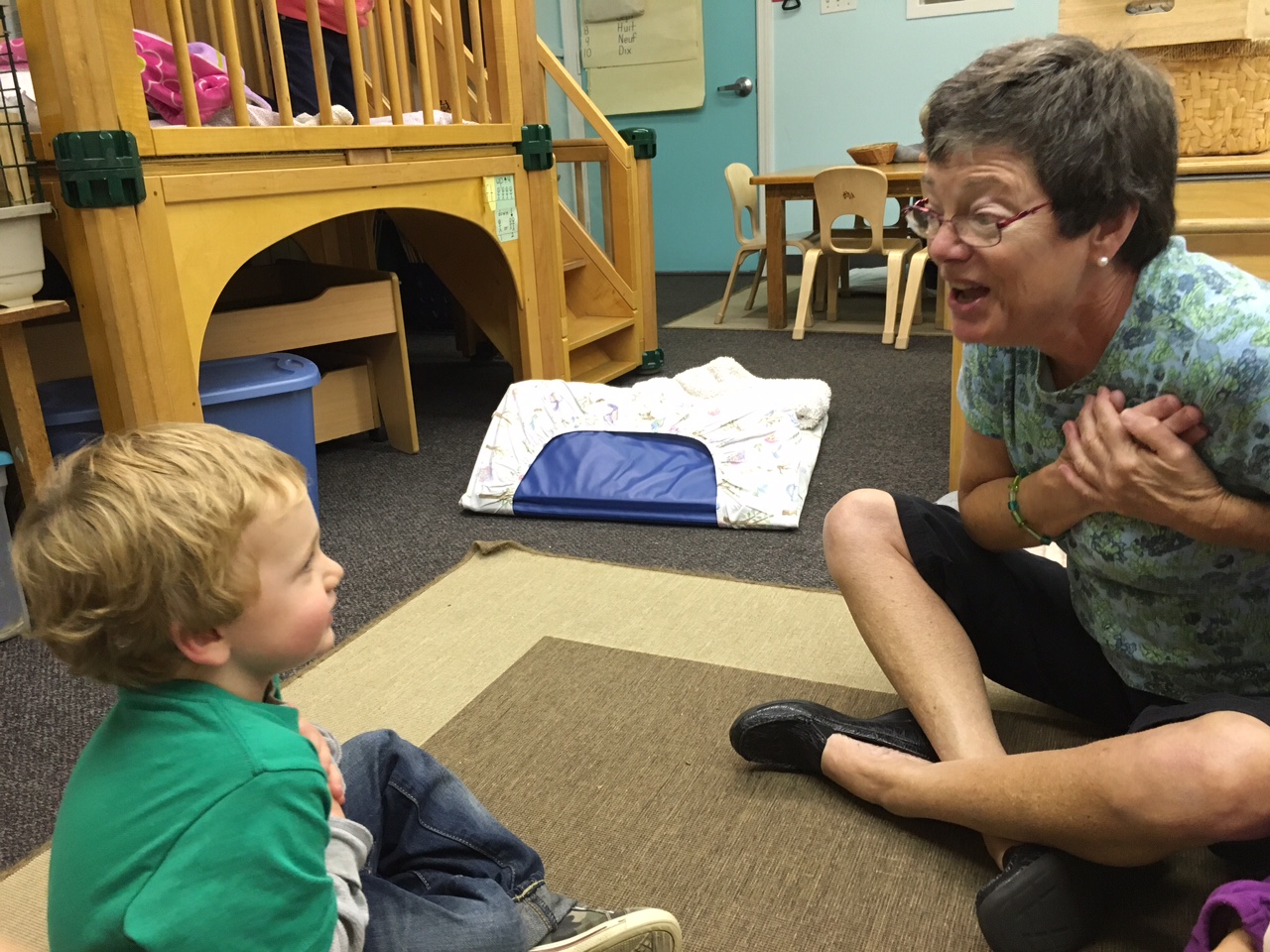
Each October children gather at our school’s Peace Pole.  It’s an obelisk with ‘peace’ written in multiple languages.  We sing songs of peace as part of a rededication ceremony.  Something wonderful happened at our ceremony last week.  When the entire school began to sing “Bells of Peace” I caught Liam’s eye, and he caught mine.  We sang together.  It was just the two of us even though the room was overflowing with children, families, and teachers.  We were alone, yet together.  We sang our hearts out.  And, we sang our hands out, as we use sign language with this song.

Of course we have to practice many times.  The words, “They ring from your heart”,

Liam, heart

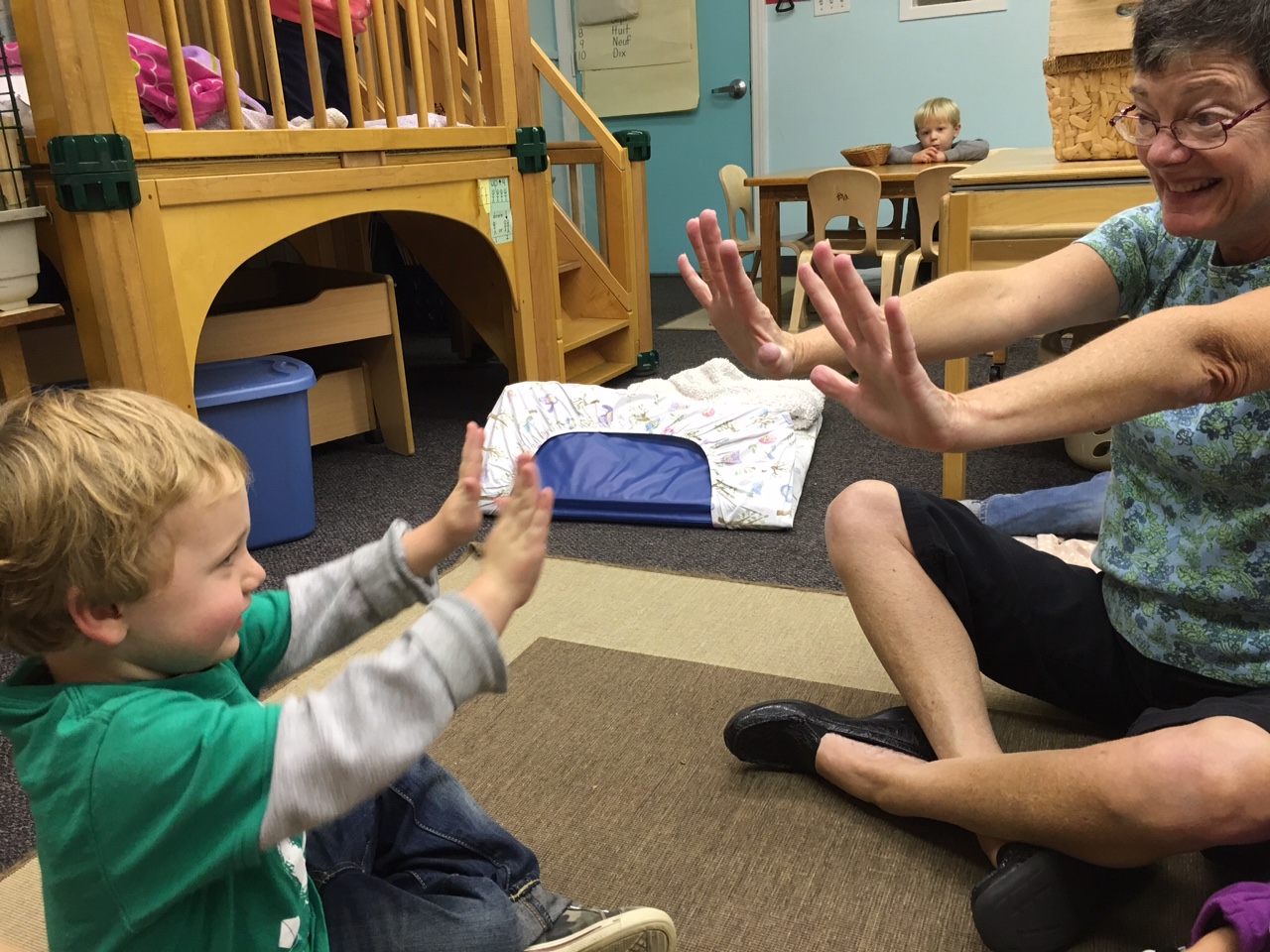
“Your mind and your hands”

Liam, hands

…are very powerful words.  They’re words that you feel when you sing.  Sometimes you have a tough time singing because the words get caught in your throat.  That happens to me.

Teachers talk about ‘moments’, capsules of time that make a difference or leave a big impact.  Singing with Liam was one of those moments.  Music is everything to young children; it engages their minds and moves their bodies, it reaches deep into their souls to make them laugh, or beg to sing again and again.  It’s that powerful.  That’s why I sing to a child in the bathroom, or at rest time, or sing on the playground.  I sing any moment I get, because it makes a difference.

Yo-Yo Ma said, “Music is the glue that joins people together.”  He was so right.  Liam and I were certainly glued.

Jennie

Posted in Teaching young children, Uncategorized | Tagged , , , , , | Leave a comment

Writing to an Author

I write and I read.  When I read something that knocks my socks off, I write to the author.  This doesn’t happen often.  Perhaps that’s because it takes quite a lot to knock my socks off.  Yet when I do write, my letters are handwritten; a typed letter would never do.  Heaven forbid an email.  In my heart I know that pen to paper is the most personal and sincere way to write.  Often remarkable things happen.

Every year in my preschool class I chapter read aloud.  The first book of the year is always Charlotte’s Web.  When I began reading this year, I opened the book and there was a forward from the Newbery Award winning author, Kate DiCamillo.  That was ‘it’, my big push to write to the author.  She has been in my life the past two years in many ways.  It all started with Inga, my friend and fellow teacher who loaned me her copy of Flora and Ulysses.  It is one of the best books I have read.  Then, ‘Read Aloud West Virginia’ hooked me up to Kate DiCamillo’s Facebook page.  I host a reading group at my  public library for second and third graders which put me into another whole world of reading. This  opened my window, and then I read Because of Winn Dixie.

I wrote a two-page handwritten letter to Kate DiCamillo.  I had to.  I told her how she’d come into my life in unexpected ways, and told her about me and my pathway in reading books and reading aloud.  I told her how I had found not only her books but many others, such as Wonder, A Week in the Woods, and The Year of Billy Miller.  I had discovered a new world beyond picture books.  Kate DiCamillo wrote back to me.  She thanked me for reading aloud, told me she was grateful, and called me her friend.  Her card to me was handwritten, too.

Some years ago I attended a teacher conference and Jim Trelease was the keynote speaker.  He is the author of the million copy bestseller, The Read Aloud Handbook.  That speech knocked my socks off.  It affirmed everything I do and know to be true.   After the conference I wrote him a letter.  I had to.  Yes, it was handwritten.  I included a newsletter I had sent to parents in my classroom about reading aloud.  He wrote back to me.  He wanted to know more.  Jim Trelease visited my classroom and wrote about my reading in his recent edition.

Many years ago I read Jack and the Beanstalk by John Howe to my class.  When I read the line where Jack’s mother is upset and calls him a ‘stupid boy’, one child asked me why the author wrote and said the word ‘stupid’.  Good question.  The only way to find out was to ask the author.  So, again I wrote a letter to an author, handwritten of course.  John Howe responded in kind with an eloquent answer as to his use and the definition of the word ‘stupid’.  I still have his handwritten letter stored among my treasures.

Today I told two children at the library to be brave and write to their favorite authors.  One child is a huge fan of Patricia Polacco, and I encouraged her to write a letter.  Somehow I think the rewards that a letter brings to an author may be just as big as the rewards for the writers.  They certainly were for me.

Jennie

Posted in Teaching young children, Uncategorized | Tagged , , , , , , , , , , | Leave a comment

Jennie and Milly the Quilter

I had dinner with Milly the quilter tonight.  She has been such an important part of my classroom over the years.  Her quilts are works of art, and when she quilts with children somehow she creates a magic connection that all children feel.  It’s her soul.  She has the heart of a nurse and the joy of Santa Claus.  I have written about Milly on my blog a number of times (great stuff!), yet tonight was altogether new.

Milly and Jennie Photo

We have become good friends over the years with the same sense of humor and same outlook.  Tonight she told me about her recent trip to Francestown, NH where she was the featured speaker at a quilting convention.  I sat with my elbows on the dinner table listening to Milly tell her story.  She came alive describing how she told the audience, well, everything she’s done with quilting, including the quilts she made with my classroom (I felt honored).  Apparently she interjected plenty of stories and ‘brought the house down’.  She may be invited to be the guest speaker at a big quilting event in Peterborough, NH.  I told her I’d better be invited.  I just want to sit in the back row and listen.

Milly was shown a picture of a quilt made by the wife of Francis Scott Key.  It was a eureka moment for her.  I watched her face light up as she described the triangles in the quilt.  She was so excited to tell me details about how the triangles became a mathematical pattern.  I didn’t fully understand; I just listed and watched her, much like watching someone who got a birthday present.

Milly talked about that quilt with her quilting groups.  I’m sure they could tell how inspired she was, so they bought her a book that featured the quilt!  Then Milly began making the quilt herself.  She had decided to make the main part of the quilt, as making the full quilt would be a daunting task.  Then, she had dinner with her granddaughter’s husband’s family.  She was eagerly telling them the story of the wife of Francis Scott Key.  Low and behold, the husband’s family are direct descendants of McHenry…as in Fort McHenry in Baltimore, Maryland…as in “The Star Spangled Banner”…as in Francis Scott Key.  There was no doubt that Milly knew she had to complete the full quilt.

Perhaps I write this story because this is just like me, often unexpectedly inspired.  Like Milly, I never know when a moment like seeing triangles might become the catalyst for an amazing path of learning in my classroom.  Emergent curriculum.  And the final word is the best part; Milly wants to make another Peace Quilt with my class.  I have just seen my very own triangles!  We’ll begin this new journey together in November.

Jennie

Posted in Teaching young children, Uncategorized | Tagged , , , , , | 1 Comment

Visiting Carl Larsson

Posted in Uncategorized | Leave a comment

Marinating Vocabulary

‘Marinating Vocabulary’.  I heard Pam Allyn, a guru on reading and reading-aloud, speak those words last week.  They hit me like a stone.  Each time I read aloud from a chapter book those words do far more than go into the brain.  They truly marinate, by mixing words with feelings, life experiences, and the comfort of a ritual.  The lovely repetition of sounds and words is holistic, giving reading aloud a greater importance.

Ritual is essential.  Finding a time to read aloud every day means that you will do it, and enjoy it along with your children.  Life is way too busy; one parent commented that by the time dinner was over and homework was done, both the children and the parents had no energy for reading aloud, it was a chore.  Bedtime is the typical time for reading aloud, yet it may not be a good time.  Whoa!  I had never thought about family reading aloud at a different time.  Have you?  Well, Jim Trelease, author of The Read Aloud Handbook, most certainly has.  I distinctly remember the photo of him reading aloud to his older children as they washed the dinner dishes.  He found the right time for the ritual of reading aloud.

When you find that right time and begin reading aloud in earnest, the dialogue will become far more than words.  Children will remember the story, yet they will most remember the sound of your voice; how you say the words and read the story.  That’s what makes the words ‘stick’, and that’s what marinates vocabulary.  That’s why my chapter reading and my storytelling to children is what they remember.  Pam Allyn talks about ‘putting your voice into someone else’s heart’.  My grandmother read to me, and that was my strongest connection with books.  She was my heart, and I can still recall what I was thinking every time she read to me.  Marinating vocabulary.

By the way, the sign of true innovation is flexibility.  So, reading can be in many forms.  Looking at words in print, whether in a book, on a iPad, in a newspaper, in comics, or other formats are…well, reading.  That’s a good thing.  Be flexible in everything from scheduling reading to what your child is reading.  As long as reading is happening, that’s all that matters.  You are making a difference by doing so.

Bottom line:  Children who have been read to, and have access to books, are academically one year ahead of their peers in school, in all areas.  Now, that is powerful!

Jennie

Posted in Teaching young children, Uncategorized | Tagged , , , , , , | Leave a comment