-
Recent Posts
Recent Comments
Archives
- April 2026
- March 2026
- February 2026
- January 2026
- December 2025
- November 2025
- October 2025
- September 2025
- August 2025
- July 2025
- June 2025
- May 2025
- April 2025
- March 2025
- February 2025
- January 2025
- December 2024
- November 2024
- October 2024
- September 2024
- August 2024
- July 2024
- June 2024
- May 2024
- April 2024
- March 2024
- February 2024
- January 2024
- December 2023
- November 2023
- October 2023
- September 2023
- August 2023
- July 2023
- June 2023
- May 2023
- April 2023
- March 2023
- February 2023
- January 2023
- December 2022
- November 2022
- October 2022
- September 2022
- August 2022
- July 2022
- June 2022
- May 2022
- April 2022
- March 2022
- February 2022
- January 2022
- December 2021
- November 2021
- October 2021
- September 2021
- August 2021
- July 2021
- June 2021
- May 2021
- April 2021
- March 2021
- February 2021
- January 2021
- December 2020
- November 2020
- October 2020
- September 2020
- August 2020
- July 2020
- June 2020
- May 2020
- April 2020
- March 2020
- February 2020
- January 2020
- December 2019
- November 2019
- October 2019
- September 2019
- August 2019
- July 2019
- June 2019
- May 2019
- April 2019
- March 2019
- February 2019
- January 2019
- December 2018
- November 2018
- October 2018
- September 2018
- August 2018
- July 2018
- June 2018
- May 2018
- April 2018
- March 2018
- February 2018
- January 2018
- December 2017
- November 2017
- October 2017
- September 2017
- August 2017
- July 2017
- June 2017
- May 2017
- April 2017
- March 2017
- February 2017
- January 2017
- December 2016
- November 2016
- October 2016
- September 2016
- August 2016
- July 2016
- June 2016
- May 2016
- April 2016
- March 2016
- February 2016
- January 2016
- December 2015
- November 2015
- October 2015
- September 2015
- August 2015
- July 2015
- June 2015
- May 2015
- April 2015
- March 2015
- February 2015
- January 2015
- December 2014
- November 2014
- October 2014
- September 2014
- August 2014
- July 2014
- June 2014
- May 2014
- April 2014
- March 2014
Categories
- America
- American flag
- art
- Author interview
- behavior
- Book Review
- books
- chapter reading
- children's books
- Community
- David Wiesner
- Death and dying
- Diversity
- Dogs
- E.B. White
- Early Education
- Einstein
- England
- Eric Carle
- Eric Carle Museum
- Expressing words and feelings
- Family
- geography
- Giving
- Giving thanks
- Gloria
- Halloween
- Heart
- history
- Imagination
- Inspiration
- jack-o-lanterns
- Jim Trelease
- joy
- Kindness
- Learning About the World
- Leo Lionni
- Library
- literacy
- Love
- Math
- military
- Mindfulness
- Mother Nature
- museums
- music
- Nature
- Particia MacLachlan
- Patricia MacLachlan
- patriotism
- Peace
- picture books
- picture stories
- Play
- play performances
- Poetry
- preschool
- quilting
- Quotes
- reading
- reading aloud
- reading aloud
- robots
- School
- self esteem
- Singing
- storytelling
- Student alumni
- summer camp
- teaching
- Teaching young children
- Thanksgiving
- The Arts
- The Beatles
- trains
- Uncategorized
- wonder
- Writing
- young children
Meta
-
Join 9,647 other subscribers
- Follow A Teacher's Reflections on WordPress.com
What Music Does For Art
“Where Words Fail, Music Speaks” – Hans Christian Anderson-
Every year I am surprised when I bring to school my old record player, which looks much like a suitcase. I simply but it down on the floor in front of the children and look at it. Then, I wait for the wonder of what happens next. As children predict what they think it might be, I open the lid and start to carefully touch the turntable and the arm… and then turn it on.
Just watching all the parts move and listening to the sound of the needle is thrilling. I then pull out a record album, on this day Vivaldi’s Four Seasons- another ten minutes of focus and excitement. “It’s a big CD!” said many of the children. “Let’s listen to the music it makes,” said I. And we did. You could have heard a pin drop. “Violins!” said Allie. Ah, yes. We listened to a little of Winter, Spring, Summer, and Autumn. It truly filled us all. Deeply.
We were ready to paint. We’re making masterpieces, art that uses real artists paints on palettes. This is important work. I said to the children:
“Do you know what happens when you hear wonderful music? It goes into your ears, then into your heart, and out your fingers. It helps you to paint a real masterpiece.”
Lexi was deep into her work. Vivaldi was playing on the record player. While I was busy with another child, Lexi started hollering, “Jennie! Jennie! The music stopped. I’m not finished with my masterpiece!” I quickly started the record again, and looked at her painting. Oh, my! Yes, music makes a difference.
I have introduced children to impressionism and Monet with different brush strokes, to van Gogh’s Sunflowers (they already adore Starry Night which hangs in the classroom), and to Franz Marc and his Large Blue Horses. Parker liked the art of Kandinsky, and he wanted to look at a picture of that art while he painted.
Can there be anything more wonderful than watching a child fall in love with classical music and painting with focus and heart?
What if the music is not classical, and what if the art is not painting? Here is what happened: Last week Colin was on the playground and suddenly started singing, “Oh, What a Beautiful Morning.” What! Thinking he must be singing something else, I asked him to sing again. He did, every word and with perfect pitch. I sang along with him, of course. Then, I asked him if he knew “Oklahoma”. No, he didn’t. Well, since I have a record album of every Rodgers and Hammerstein musical, I promised him I’d bring the record in to school the next day. I did. He was so excited!
We sang and sang. We sang loud. We danced in the room. I let the record play, and I went to be with other children. Colin wanted to draw. Twenty minutes later, with the music filling the room, I saw that he was still working at his drawing. This was all freehand, and double-lined. Wow.
Can there be any doubt that music makes a big difference?
Jennie
A Gift of Charlotte’s Web
When Sydney’s mother asked me if she could get every child in the class a copy of Charlotte’s Web, I was speechless.
“Scholastic has the book for a dollar this month. It’s really not much”, she said.
Not much? Are you kidding? One dollar might not be much, but putting a book in the hands of each child, a book they adore, is priceless.
The books arrived. I was beside myself. I just sat and held all the books. It was a treasure. You see, I knew that giving each child the book would be far more than chapter reading. It would be ownership. Their very own copy. Not a book in the house or in the library, but their book.
Next, I distributed the books to children so that they could feel and turn the pages of their book. Of course, everyone wanted to find the pictures, which led to great conversations and memories of our chapter reading many months ago. We had to take a group photo!
Then, Sydney and I sat together to write a letter that would go inside of every book. Sydney signed it, of course.
In the words of E.B. White, author of Charlotte’s Web, “Always be on the lookout for the presence of wonder.” Thank you, Sydney.
Jennie
Before Smartphones and Computers Kids Had Real Fun
The best learning takes place outdoors, where children have to figure things out on their own. No parents or teachers to guide them. This is critical, divergent thinking. That is what astronauts need. So do artists and writers, musicians and scientists, doctors and teachers. Thinking outside of the box, using your hands, and having fun are the skills children need to learn and succeed. All those elements come alive in the greatest classroom of all — the outdoors.
Posted in Uncategorized
24 Comments
The Art Show Begins
Next week we begin in earnest to prepare for our annual Art Show for the entire community. In past years children have painted major works of art. I am never surprised when they love a piece of art. I am always surprised at the results, their masterpieces. They are remarkable. Always.
Starry Night by Liam, from Vincent van Gogh’s Starry Night
The Girl in the Garden by Colin, from Claude Monet’s Gladioli
Replicating the art of Vassily Kandinsky
How can this be, with preschoolers? How can a four-year-old see, understand, and have the passion to create?
It begins with looking at art, really studying and talking about what they see. I ask so many questions. We just look and talk, together. Sometimes I say, “Oh, my!” Or “Wow!” and stop. Children jump at the chance to say something. That is when they begin to see. Children have open minds; they have not been encumbered with the ideas of others. Their minds are sponges and their hearts are open. Therefore, art is exciting. It creates an “I can” attitude. Nothing is impossible. Or should I say anything is possible.
When I show children art, I often stop to say, “Miles, you could paint that!” As I do this with art, children cross the bridge from liking to I can. The next step is to allow them to paint anything they want, give them real paints and tools, and let them work on their painting over and over again. After all, a masterpiece was not made in a day.
When a child feels satisfied that their art is complete, it is framed in a mat and unveiled. That is when a child names their masterpiece. Giving a title validates how important their work is. This is the grand finale before the art is displayed.
I can’t wait to begin next week and see what children create.
Jennie
Why Do Play Performances?
Paying attention to children and what they like is the key to their greatest learning experiences. It’s called emergent curriculum, and this is much like how it happens:
“Imagine being on a quest with a group of children, walking through the woods, and suddenly discovering something shiny on the ground. You pause to look, brush away the dirt and leaves, and uncover a hatch. You stop, knowing the excitement is just the beginning, and ask questions. Oh, those “W” questions lead to hours of wondering and predictions. At last, you open the hatch and discover there is no darkness. There is light and a beautiful stairway, leading to the joy of learning.”
In order for emergent curriculum to happen like this, I have to be open and let my instincts be my guide. Of course, it is the children who always start the ball rolling. And, a play performance can often be that shiny hatch, what the children want when they are involved in learning.
We studied Fairy Tales recently; reading stories, telling stories, writing stories, using props, learning about different characters. The children deemed Goldilocks a “not-listener”. They were right. We then voted on the Fairy Tales we liked the best, and one was The Three Little Pigs.
The children were interested in the story and the characters. After reading different versions, we debated on what the wolf really did. Did he eat the pigs, or did each pig rush to the house of his brother when the wolf was huffing-and-puffing? Hands down, the popular choice was the pigs running away. So, the only thing left to do, in order to make this thinking and studying work, was to become the characters ourselves. That meant a play performance.
After all, isn’t that what a good book ultimately does? The reader becomes the characters.
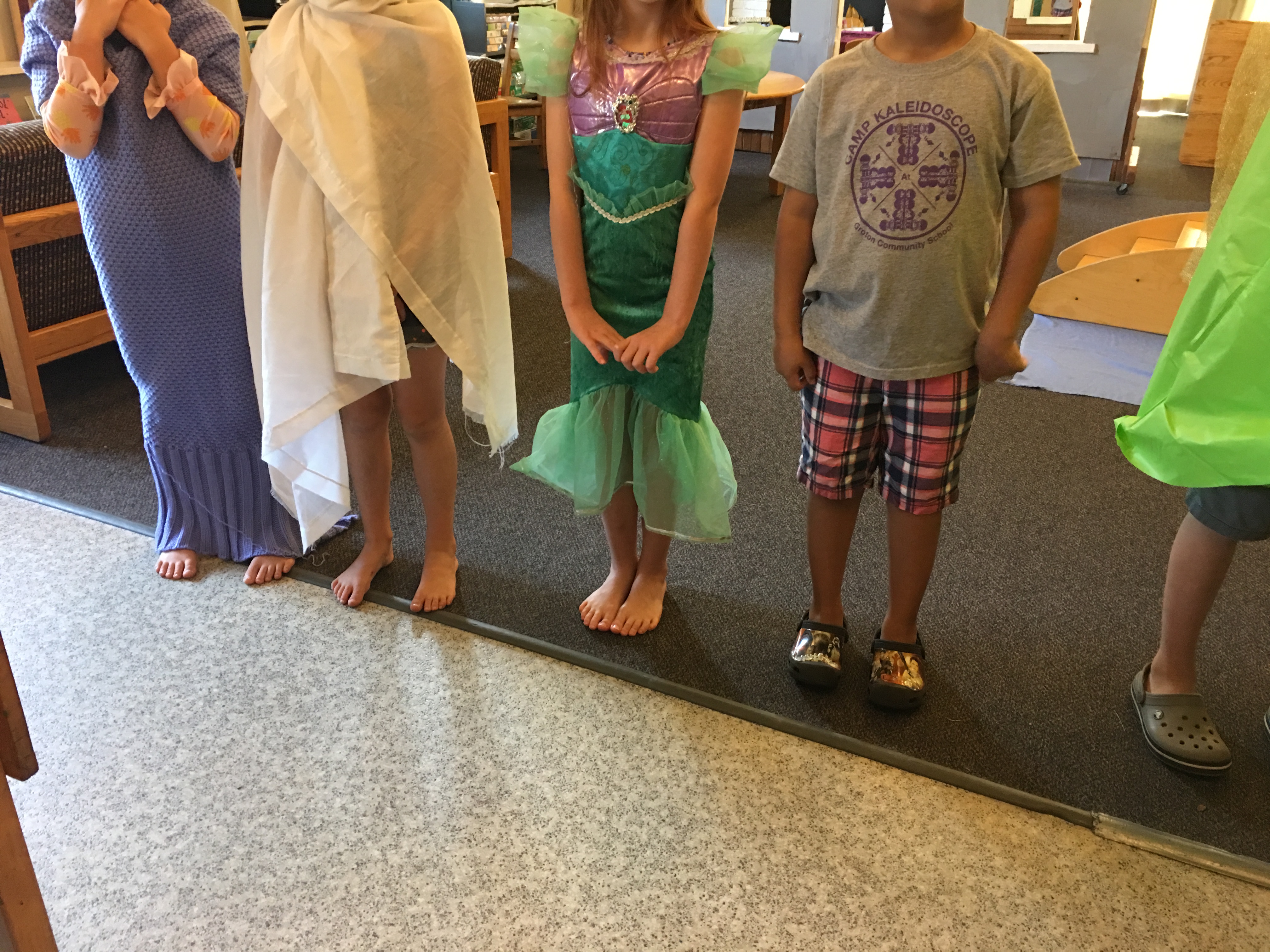
Costumes? Oh, no. The only thing we needed were the pig’s houses.
We placed the straw house and the stick house atop our classroom tables, and the brick house alongside our loft. Children chose to be pigs, wolves, and sellers. Then, I stood back and watched amazing things happen.
Jayden, one of the quiet and younger children, and only three-and-a-half years old, decided to be a seller. When the pigs came to buy his straw, he belted out, “I don’t think that’s a good idea!” When the next group of pigs came to buy his sticks, he said, “That is NOT a good idea”, with the confidence and determination of a real seller of sticks. I could hardly believe it.
Wolves and pigs nailed the words they wanted to say, and became the characters. Even the old sow, the mother pig, had a grand performance.
Why did this play work? There were no costumes, no set lines to say, just the children wanting, needing to do this in order to go along that stairway in the light, under the hatch.
I have watched far too many plays with nervous children worrying if they mess-up their lines, and plays that focus on the costumes. It makes me sad. It has nothing to do with learning and developing self-esteem. What do children really need to experience? Self-esteem, bravery, and joy. Those will be their foundation. I know this to be true; it all started with Kevin…
Kevin was what teachers refer to as an “observer”, a child who watches others, usually at a bit of a distance. He was painfully shy. Even talking with his teachers was not easy for him. Kevin was in my summer camp group, and we did a play performance at the end of each camp session. Kevin decided he wanted to be a dog in the play. We sneaked into the storage room so children could pick anything they wanted to make their own costume. Kevin found a piece of brown card stock paper, cutting out a small triangle.
“It’s my tail”, he exclaimed with a satisfied look on his face. “Do you need anything else?” I asked. “No, I’m all set.”
When the play began, Kevin walked onto that stage with tall shoulders and a big smile. Of course, no one could see the tail, but that didn’t matter. Kevin knew it was there. He was terrific in the play. We did another play, with children wanting to sing “The Star-Spangled Banner.” That is one difficult song! Yet, the group was sure, mainly because one boy was quite a gifted singer. The plan was to have him in the front, and the other children behind him holding the American flag. We practiced. It worked.
As we lined up behind the curtain, ready for the play to begin, the boy panicked and refused to sing. He was in tears. Before I had a moment to help out, Kevin stepped forward and quietly announced he would sing. Kevin! He was wonderful. The audience cried silent tears.
That’s what happens when children have the freedom to be, and the support to ‘just do it’.
Today Kevin is in a top college, a math and science guy. He wears a big smile, and he has a knowing warmth about him, much like someone who has had a few life experiences under their belt. He has, indeed.
Jennie
A Few Quotations on Reading
These quotes on reading convey all that is important, and they say it so well.
charles french words reading and writing
https://commons.wikimedia.org)
“Once you learn to read, you will be forever free.”
Frederick Douglass

“You’re never too old,
too wacky, too wild,
to pick up a book
and read to a child.”
Dr. Seuss

“If you don’t like to read, you haven’t found the right book.”
J.K. Rowling
Posted in Uncategorized
20 Comments
Thank You, Sergeant Curran, Our Pen-Pal
“Thank you.” Those are the most fundamental words, next to “please”, that shape children’s character. It is far more than manners; saying the words is one thing, doing the words is another.
My class is thanking Sergeant Curran, stationed in Afghanistan. We’re doing it the good, old fashioned way; writing letters and drawing pictures. We are Pen-Pals!
For children, expressing their thoughts in words and drawings is age appropriate and very genuine. That is exactly what we did for Curran. After we wrote and decorated our big letter, we drew him individual pictures.
Children need to learn that kindness and thanks matter. They need to learn about the big, wide world. They need to learn about other people. Curran is our Pen-Pal in the big, wide world. When he was a little boy, his favorite book was Mr. Gumpy’s Outing, by John Burningham. We love that book! Curran’s dad came to school and read-aloud this book to the children.
This made Curran ‘come alive’ for the children. Suddenly he was one of us. Then, when we went to our big book atlas to find Afghanistan, it mattered. Because Curran was there. He is our Pen-Pal.
Saying “thank you” by doing acts of goodness makes children feel good. They care, and want to do something. By doing they are learning the most important things in life.
We will bake up a storm, then have a bake sale at school. We’ll take the money we raise, walk to CVS, and let the children buy whatever they think Curran will want or need. That will be a great care package!
Jennie
Jim Trelease Quote, Reading and Writing, and a Journey of Teaching
A great quote can pack as much power as a good book. When both come together in one package, then you have it all. That’s Jim Trelease. That’s The Read-Aloud Handbook.
“People would stand in line for days and pay hundreds of dollars if there were a pill that could do everything for a child that reading aloud does. It expands their interest in books, vocabulary, comprehension, grammar, and attention span. Simply put, it’s a free “oral vaccine” for literacy.”
Yes, they would! This author is, and always has always been, a strong advocate for reading aloud. Fortunately, he is a terrific writer and researcher. His million-copy bestselling book, The Read-Aloud Handbook, is now in it’s seventh edition. It is packed with research that should make every parent and teacher run to the library. It is also full of stories that bring reading aloud alive. I have written two of these stories on my blog; “Reading Aloud Makes a Big Difference. Here’s Proof” (11/23/2014) and “Reading Aloud; A Source of Making Cuban Cigars” (12/5/2015). Please read, because you will be a glued as I was.
I love a good story. Here is the story of how I came to be a reader and a writer. More importantly, here is a story of making a difference in the education of young children. It’s not about me, I just happened to be the educator who did all those important things. Jim Trelease played a big role:
“It happened like this…”
When my children were little, three things happened; on our first trip to the library after moving to New England, my daughter saw Jumanji by Chris van Allsburg (fairly new at the time) on the book shelf and exclaimed, “That’s the book my kindergarten teacher read to us!” That began my love of our library and Gerry, the librarian who always knew just the right book for any child. Next, I began teaching preschool, and my head teacher handed me Swimmy by Leo Lionni and asked if I would read aloud to the children every day. Finally, a fellow teacher put a book in my hands, The Read-Aloud Handbook by Jim Trelease.
I call this a hat trick, or more accurately a grand slam (because those three home runs led to reading and writing).
Over the next few decades it was obvious to me that reading aloud made the biggest difference in the lives of children. Not only did they learn and become good students (and readers), they were always drawn to books. And, I was, too. The more I read to them, the more I became excited and engaged in the stories. I began stopping to ask questions. It became common to have long conversations about new vocabulary words and about the subtleties of morality, not to mention all the ‘W’ questions. Reading had become far more than reading. It had become the foundation for my teaching, and the link to everything I taught in the classroom. There was always a book handy to give children both the visual and the auditory tools of learning. Books cemented my curriculum.
I wrote newsletters to parents. All the teachers were required to do so, and that is a good thing. Then, I would include a paragraph about what happened in the classroom, what we read, or how we learned something new. That’s when I began becoming a writer in earnest. I wrote about our class pet dying, and why it was important for children to grieve and ask questions. I wrote about lunchtime conversations, geography using satellite maps, and of course about reading aloud.
I started chapter reading at rest time, and wrote even more newsletters to families. Then I attended a teacher conference, and Jim Trelease was the keynote speaker. I had (and loved) his book, so I looked forward to hearing him speak. Well, I was thunderstruck. His presentation was as good as his book. Every word was electrifying. I wanted to stand up and scream at the packed house of teachers and yell, “Are you listening to this man? He’s telling you the most important things you will ever need to know. Listen to him!” They were listening, but not like I was.
When I returned to school, I wrote Jim Trelease a thank you letter and included one of my newsletters about chapter reading. I wanted him to know that some teachers were doing exactly what he was teaching. Time went by, and I received an email. The seventh edition of The Read-Aloud Handbook was in the works, and could he possibly visit my classroom. He did! Yes, I’m in the book. When I turned out the lights at chapter reading so each child could ‘make the pictures in their head’, he smiled. He understood.
To this day, my gift to a new baby is a copy of Goodnight Moon, and a copy of The Read-Aloud Handbook to the parents. Best gift any new parent could get. Guaranteed!
Jennie
This post was originally published May 1, 2016.