Girls Reading Books

Reading, captured through art. What could be more beautiful? Marcia Strykowski shows us.

Marcia Strykowski

XX Albert_Anker_Lesendes_Mädchen 1905Have you ever watched a child, or anyone for that matter, deeply engrossed in a book? Maybe they wear a slight Mona Lisa smile. Maybe they glance away from the page for a minute, but still have a faraway look in their eyes. Or maybe they even cry, gasp, or laugh out loud. There are so many gorgeous paintings from the 19th century of people reading books. This one (upper right) is slightly after that period (1905) and is by Albrecht Samuel Anker (April 1, 1831 – July 16, 1910). He was a popular Swiss painter and illustrator who often depicted scenes of 19th-century Swiss village life. XX Eduard_Klieber_(Kopie_nach_Meyer_von_Bremen)_Lesendes_Mädchen_1855For the sake of post length, I’ve limited my favorite portrayals to the following: young girls reading books by themselves. The picture at left was created in 1855 by Austrian painter Eduard Klieber (1803-1879).  It was around the time of many of these paintings (mid 1800s)…

View original post 519 more words

Posted in Uncategorized | 5 Comments

The Pen is Mighty

Writing is a powerful thing.  And, so is reading.  To my surprise and delight, this is what I received in the mail recently:

imageYes, it is a postcard from author Kate DiCamillo.  It is even signed, “Your Friend”.  I sent her my blog post on ‘Really Understanding Children’, because Beverly, the character in her book Raymie Nightingale,  is just like my Beverly at summer camp.  Well, it was really more than that; I truly understood both children.  I needed Kate DiCamillo to know that.  I think she does, as she wrote this on the bottom of the postcard:

imageThe words read, “P.S.  Thank you for sending on your wonderful blog about Beverly and Beverly.”

The pen most definitely is mighty.  It holds more power than typing the keys on a keyboard.  Handwriting seems to hold real feelings.  I remember the curves of the letters in my grandmother’s writing.  When I go back and read them again, decades later, the same wave of “I know” comes through her written word.  My father rarely wrote, but when he did his message had heart.

My mother always said, “Jennie, send a note, and make sure you use black ink.”  I still do.  Somehow, I know when I write that letter or note, by hand, it will convey so much more to the reader.  I am ready to write a letter to Colin’s parents; he did a quick video for Milly the quilter, practicing sewing.  Milly taught him how to sew last year when she visited my classroom.  Colin has also made Milly a video singing “You are My Sunshine”, and Jingle Bell Rock” (his favorite song).

Why am I writing to Colin’s parents?  I showed the video to Milly at her nursing home, and I saw Milly’s face as she watched.  Oh, my!  She was overcome and smiling ear-to-ear.  Not only did she watch it again, she had me show the nurses both Colin videos.  Colin’s parents need to know what a tremendous thing he has done for Milly.  So, I will write, handwritten, and with black ink.

Kate DiCamillo did, too.

Jennie

Posted in Early Education, Teaching young children, Uncategorized | Tagged , , , , , | 33 Comments

The Greatest Question

“Jennie, tell me all the chapter books.”

That was Jackson’s request, profound and unexpected.  This is his whole wide world of reading aloud.  And, this is the greatest question.

Jackson and I were on the playground this morning.  He was hot from swinging and joined me in the shade, along with other children.  I was telling children about trees and clouds; at least I think so.  Given what happened, my recall of events beforehand is blurred. Whenever Jackson joins me, he always has something to say about a book.  He wants to tell me ‘what happened’.  He needs to tell me.  I was the teacher who opened the world of books to him, and just my presence triggers all the passion and excitement that he feels when being read-aloud to.

Earlier this summer I loaned Jackson my worn-and-torn copy of “Little House on the Prairie”.  Borrowing your teacher’s book vs checking it out at the library?  That’s a no-brainier.  As the summer has progressed, Jackson has wanted to tell me things that have happened in the book; important things to him.  Yet, when he needs to tell me, it is often at a terrible time.  We’re not in the same group at Summer Camp, so we see each other on the fly.

When we were getting ready for Big Pool Swim with only minutes to spare before the van arrived, Jackson had to tell me about “the boards that went across the water”.  He was using hand gestures because he was excited, compelled to tell me about this.  I knew what he meant; Pa had built the cover for the well.

Children had to be ready to get onto the van, and I was responsible.  I knelt down to listen to Jackson, because when an adult (especially a teacher) listens to a child, it is ‘fairy dust’. Oh, what a gift.  Other teachers helped out, therefore those few important minutes of conversation were not lost or swept away.

Today was just as unexpected and far more important.  When we were in the shade, Jackson asked a question that is the Holy Grail for a child who had fallen in love with reading aloud:

“Jennie, tell me all the chapter books.”

I told him about many chapter books, including “The Wild Robot” by Peter Brown.  Jackson wanted to know more about the “Little House” series, and we talked about those books.  I asked if he wanted to borrow mine… need I say more?

Many children are incredibly smart and intuitive.  It all begins with reading aloud.  Growing a reader means growing a child who is accomplished in math, science, art, music… everything.  Yes, reading is the foundation for learning and education.

I hope another child asks me to tell them ‘all the chapter books’.

Jennie

Posted in Early Education, Teaching young children, Uncategorized | Tagged , , , , | 35 Comments

Roots and Wings…and Thunderstorms

image

Last evening I was outdoors with my husband and our adult daughter watching the big thunderstorm rumble into our yard.  We were all enjoying the anticipation as well as the storm itself.  I asked my daughter what memories popped into her head whenever she heard a big storm.  She replied, “Camp, of course!  We had nothing else; no TV, no computer, just the outdoors.  Thunderstorms were great!”  Funny thing.  This was the same experience with me as a child at camp.

We talked about exciting and adventurous experiences in our childhood, and about childhood itself.  We analyzed why children feel the way they do, and what is it that ‘makes a difference’ when they grow up.  One thing kept ringing loud and clear.  Children who are given experiences that challenge them, who are encouraged to take a chance and ‘do it’, and who have the firm love and support of their family, seem to grow up with a good, strong sense of self.

Roots and wings.

In my classroom I approach each learning experience and activity, planned or unplanned, as an exciting opportunity.  We are a family.  We help each other, support each other, and encourage each other.  We provide roots for each other with daily routine, tenderness, and a positive, fun attitude.  We give each other wings when we learn how to write our name, pump a swing, stand in front of a group to talk, or try something new.

Roots and wings.

Remember, it’s all the little experiences, over and over again, that we build upon.  It’s not the big things that make a difference.  Dancing with painted feet, coming to school at night and singing in the dark, shopping in a real Indian market, painting to classical music, setting up nap mats for other children, finding a new place on our big map with the magnifying glass, reading all the name cards without help… it is the culmination of all these activities, and many others, that make the difference.

I hope that in years to come, children and their families sit through a thunderstorm together, walk through the woods together, or sing in the dark together, and find it is an experience that is exciting.  I hope that my Aqua Room classroom, and all we have done together as a group, has helped to give children the experiences to feel a happy and confident sense of self.

Roots and wings.

Jennie

Posted in Early Education, Teaching young children | Tagged , , , | 20 Comments

Quotations on Teaching

Terrific and important quotes on Education from Charles French.

charles french words reading and writing

 Malala_Yousafzai_par_Claude_Truong-Ngoc_novembre_2013

(https://commons.wikimedia.org)

“One child, one teacher, one book, one pen can change the world.”

                                                                              Malala Yousafzai

john-f-kennedy-63160_960_720

“There is an old saying that the course of civilization is a race between catastrophe and education. In a democracy such as ours, we must make sure that education wins the race.”

                                                                                John F. Kennedy

John_Dewey_cph.3a51565

(https://en.wikipedia.org)

“Education is not preparation for life; education is life itself.”

                                                                               John Dewey

View original post

Posted in Uncategorized | 9 Comments

Really Understanding Children

Beverly came to camp a little late. She quickly joined all the campers as we were singing camp songs, hoping no one would notice her.  She wore her signature no-smile, crossed her arms, and plunked herself down beside me. She had been crying, hard, and wanted nothing to do with anyone or anything.

I just knew. I understood, even though I know very little about Beverly.  I didn’t say a word.  That would have been all wrong.  Beverly was much like the other Beverly, Raymie Nightingale’s Beverly.

image

The next two minutes felt like a time warp.  It was just the two of us; campers were singing away, and we were alone.  Beverly held her knees close to her chest as if tucking herself in would protect her.  I put my arm around her and kissed the top of her head.  I didn’t let go. Beverly liked that.

Who was this child?  In the few short weeks I have known her, she has been aloof, an observer, sometimes putting on a tough front.  Just like Raymie’s Beverly.  Stomping away and pouting with crossed arms is… well, Beverly.

The easy route is to look at a child, match their behavior to what you know, and then respond.  If this always worked, the number of children who need help and the workload of teachers would diminish, drastically.

What is the magic answer?  Connecting with each child, not you to  them but them to you. There is a big difference.  Children know; they sense everything and are intuitive.  They know if a teacher or an adult genuinely likes them.  They know.

I paid attention to Beverly.  I was not judgemental, even though her clothes were different and her lunches were different.  Different is a good thing, but people often applaud different in the big picture, not the little things close to home.  Acceptance is far easier on a broad scale.  Beverly was not on a broad scale; she was ‘right there’.

Beverly smiled at me later that day.  From across the room.  Today when camp started, she sat next to me and smiled again.

I have a new best friend.  Raymie did, too.

Thank goodness I really understand children.

Jennie

Posted in Early Education, Teaching young children, Uncategorized | Tagged , , , , | 22 Comments

Why Do Play Performances With Children?

Timothy planned his own costume.  He wanted to be a seagull, and he thought a white plastic trash bag cut along the sides would be perfect.  It was.  This made Timothy soar in his performance; not only as a seagull, but as an empowered child.  His costume was far better than anything I could have given him.

image

Every summer my school offers a summer camp program.  The most exciting part of my camp group (six and seven year-olds) is the ‘play performance’.  It didn’t start that way at all.  Camp is camp, and that means having a real experience of outdoors, swimming, knature activities, arts and crafts, and camp songs.  Play performances seemed to evolve on their own.

Our camp has four themes.  When we are Kings and Queens, my older group is the ‘Mighty Mighty Dragons’. When we are The Wild West, my group is the ‘Mighty Mighty Mustangs’.  We’re Stingrays and Cheetahs for the Safari and Ocean units, always ‘Mighty Mighty’, of course.

It started with the Wild West years ago.  I couldn’t help but notice that the children began to do things on their own.  They built a tower for our mustang puppet, made up songs, and pretended to be different characters out west.  This was emergent curriculum, children so ready to act out something.  That ‘something’ turned out to be an incredible play performance. I can’t liken it to the success of building a difficult block structure, or learning to read, or painting the best piece of art; this play had that same level of accomplishment yet much more, because it involved the joint efforts of all the children.  That’s collaboration.  Pretty incredible for six and seven year olds.

Here’s where it gets remarkable; the children planned everything from script to costumes to parts.  I only guided and encouraged.  Well, I added the excitement of surprise by sneaking the children into the storage room to find a prop or a part for a costume.  We did this crawling the hallway and dodging all the other groups, James Bond style.  A scarf became a dress, and poster board was cut into cowboy chaps and a doorway.  The play became a special secret, even to parents.  The camp director ‘got it’ and became a spy.  Of course all of this empowered the children.

Kevin was shy, yet he seemed to like being part of the play.  When we sneaked into the storage room to look for items, he wanted to find something for his dog costume.  He found a piece of brown card stock paper and was eager to cut it out.  I saw that he was cutting out something tiny, a triangle to be exact.  “That’s my tail”, he said.  I asked what else he needed for a costume.  “Nothing”, he said.  When we walked out on stage, he stood so proud and tall.  He loved his costume.  No one else could even see it, but that didn’t matter.  Kevin knew it was there- it was his.  He walked out onto that stage with tall shoulders.  In his performance he was no longer the shy boy.

Owen often asked when his Mom would pick him up or how many hours there were in camp.  Swimming wasn’t his favorite activity, especially with the big water slide and cold water.  He didn’t have a large circle of friends at camp.  Yet when the children planned the play, he wanted to be ‘head of the cheetah family’.  There are six days in a camp session, and by day four he cried.  Day five was too much, and at drop-off Mom just took him home.  Oh, we had talked about the play on and off, and he really wanted to do it.  We even talked about his tall orange socks and how they would be a perfect cheetah costume for the play.  Day six, the last day of camp and ‘play day’ arrived.  Owen came to camp, a little unsure.  He was a star in the play!  Boy, did he pull it off with a huge smile.

I have learned along the way not to assign parts or give costumes or even have a say in the play.  Children always come up with something amazing and far more interesting than I could.  I never underestimate young children.  And, I always support their ideas.  That’s why our play performances are incredible.  When children are empowered and encouraged to do something on their own, they rise to the occasion.

Just ask Timothy, Kevin, and Owen.

Jennie

Posted in Early Education, Teaching young children, Uncategorized | Tagged , , , , , | 21 Comments

“Children need art and stories and poems and music as much as they need love and food and fresh air and play. “

Posted in Uncategorized | 10 Comments

Happy Birthday, America!

image

Posted in Uncategorized | Tagged | 2 Comments

The Boy Who Cried Tears of the Heart

image

Chapter reading is one of our treasured moments of the day at school.  I know this, and so does Jackson.  Books bring to life the imagination, the world, and the past.  The anticipation of ‘what happens next’ stirs excitement every day.  Children listen and talk.  They ask questions.  Jackson is first to remember what we read yesterday and ask questions about what we read today.  When I ask children, “At chapter reading where do you make the pictures?” they answer “In your head.”

When we finish reading a good book and then start a new one, emotions run high and low.  The end of a good book is so satisfying and pleasant, yet…it is over.  That is the wonderful roller coaster of reading.  And, with each chapter book we read, we ride that roller coaster again and again.

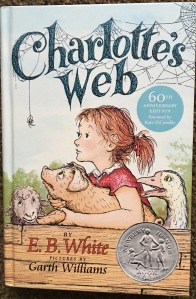
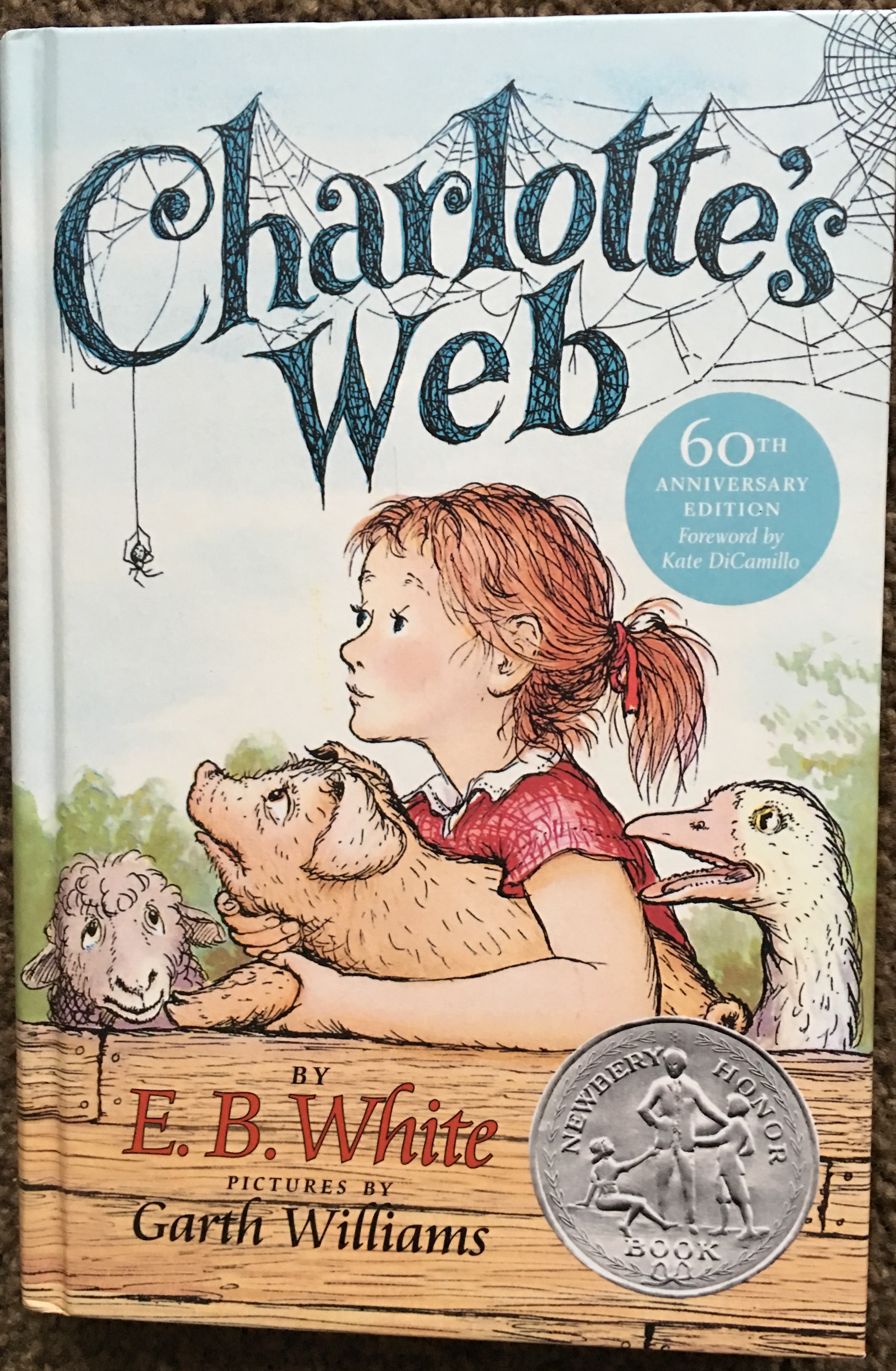
In the fall I begin the school year by reading “Charlotte’s Web”, always a favorite.  When I chapter read, it is rest time, the lights are out, children are on their nap mats, and they listen.  Boy, do they listen.  Often I stop and ask questions.  We talk about Templeton and his unsavory character.  We laugh about the goose that repeats things three times.  Of course we talk about Wilbur and Charlotte.  Children are learning new words and using their brain to associate all that language with the story.  More importantly, children are learning right and wrong, values and morals.  They are beginning to develop character and goodness.

Jackson worried when Wilbur went to the fair.  He became very fond of Charlotte.  The more we read about Templeton, particularly when he refused to get Charlotte’s egg sac, the more Jackson became bitter towards Templeton’s character.  Jackson ‘got it’; the language and literacy and learning for him now included the subtleties of morality.  But, the best was yet to come.

As the year progressed, I read aloud the chapter books “The Story of Doctor Dolittle”, “Mr. Popper’s Penguins”, “My Father’s Dragon”, and finally the Laura Ingalls Wilder books.  “Little House in the Big Woods” had three components that were quite important to children and to making a difference.  First was learning about the past.  I connected generations.  When I told the children that my grandmother was born when Laura’s child was born, and they had the same names, that was huge.  Yes, my grandmother was Rose, the same age and name as Laura’s daughter.  I told stories about living in a log cabin, because my grandmother did, and I also slept in that log cabin in Lowell, WV.  Connecting the past for young children is a great learning experience.  Secondly, Pa told stories.  Well, I tell stories much the same way as Pa, real ones about my childhood.  They always start with “It happened like this…”.  My stories (the children call them ‘Jennie stories’) helped bring Pa’s stories to life.  Storytelling is equally important to reading chapter books aloud, as children get a huge dose of vocabulary and have to ‘make the pictures in their head’.  Finally, this book is non-fiction, the first chapter reading book all year that is real.  So, each time we talked about something that happened, it had an entirely different feeling.  Our conversations became much more in depth, a bit serious, simply because this was real and true.  Children were learning.

Jackson was really learning.  He was becoming ‘one’ with the book.  Every fact and Pa story seemed to notch another mark in his learning; and by now it was pleasure learning for him.

Our last chapter reading book of the school year is “Little House on the Prairie.”  Pa, Ma, Mary, Laura, and baby Carrie move from the big woods of Wisconsin to the Kansas prairie.  Every child was so vested in both chapter reading and “Little House in the Big Woods”.  This next book was like frosting on a cake. We used our big map book to find Wisconsin and follow a route to Kansas.  I was able to incorporate my family history when Pa and his neighbor Mr. Scott dug a well.  Pa was careful to light a candle and lower it into the well.  Mr. Scott thought the candle was ‘foolishness’, and therefore did not light the candle one morning.  My grandfather worked in the mines, and I brought in his painted portrait, as a boy, with a candle attached to his mining cap.  Now, that brought the story and the chapter to life.

One of the characters throughout is Jack, the dog.  As the family travels in a covered wagon, Jack happily trots behind the whole way.  Then I read the chapter, “Crossing the Creek”.  The creek rises quickly; Pa has to jump in to help the horses get the wagon across the water.  After they are on the other side, Laura says, “Where is Jack?”

I read this chapter with heart, and the passion of what is happening.  I always read like that.  When Laura says those words, the children are stunned.  Shocked.  They know.  I finish reading aloud, sometimes standing and pacing, because this is a big deal.  I, too, have a lump in my throat.

Jackson pulled his blanket over his head.  His body was jerking in sobs, yet he was holding those sobs deep inside.  I scooped him up, and we disappeared to a quiet place to read aloud, together, the next chapter.  Jackson needed to know that Jack the dog found his way home.  I think I was calm when I read the chapter to him.  We were wrapped together in his blanket; perhaps we both sobbed a bit.  It was my greatest moment in teaching.  I had taught the most important values through reading aloud, and Jackson was moved to tears.  He cried tears of the heart.  So did I.

Reading aloud is the best thing I do with, and for, children.  They are preschoolers.  Yes, I chapter read to four-year-olds.  It is marvelous.  After three decades of teaching, I know this is “it”.  Jackson is proof.

Jennie

Posted in Early Education, Teaching young children, Uncategorized | Tagged , , , , | 44 Comments