Friday was a rainy day. I played the autoharp, and children sang and danced their hearts out. I love rainy days. I love music. More importantly, children love music. A child came up to me in the middle of the songs and asked, “Jennie, can you play “I Want to Hold Your Hand?”
Did I hear that correctly?
“I Want to Hold Your Hand”, by the Beatles?
Yes, that was exactly the song he wanted to hear.
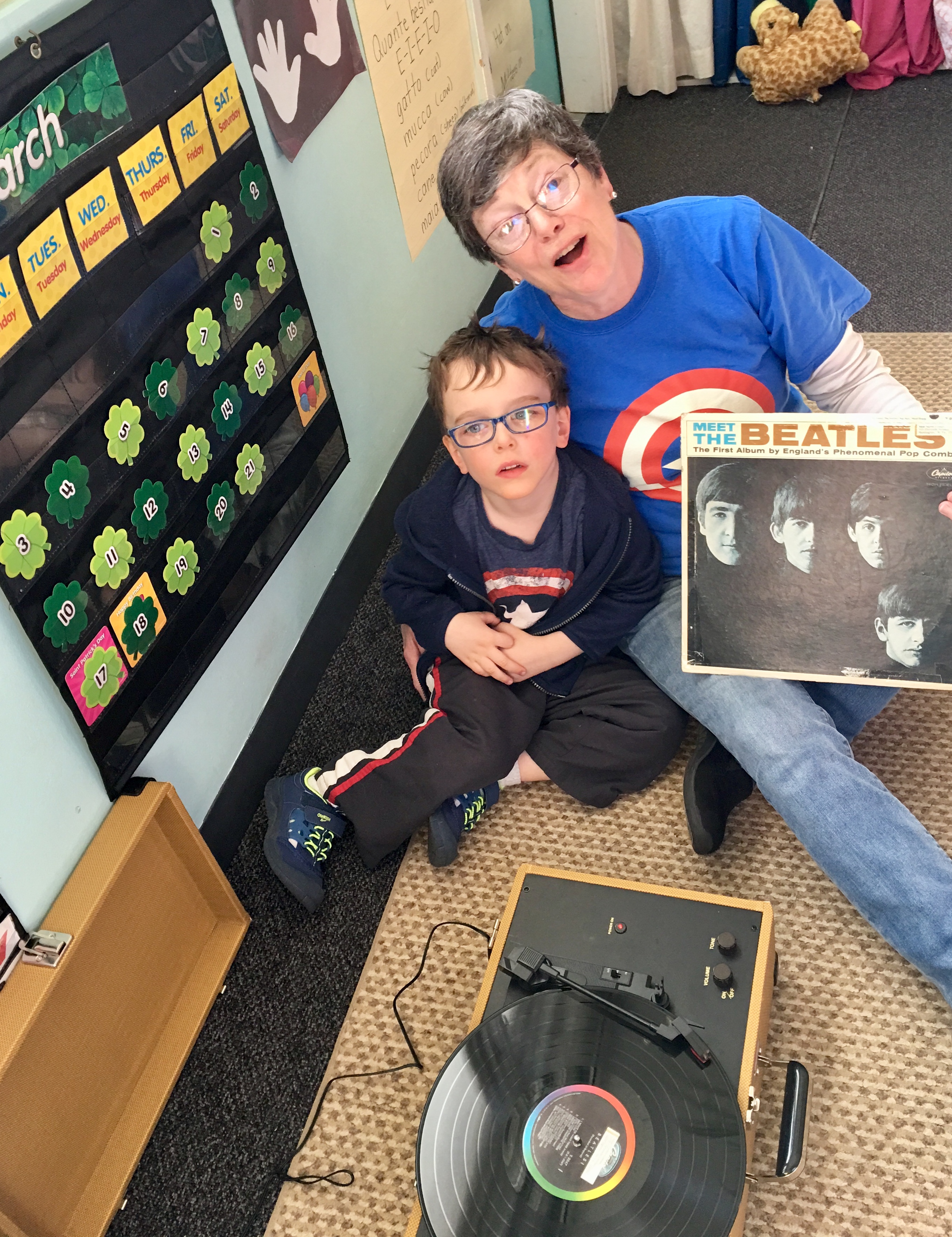
After I got over my initial shock and excitement, I said, “Better yet, I have the real song, a record album. I’ll bring it in on Monday.” And I did. You could have heard a pin drop as I pulled the record out of the album cover with fifteen saucer eyes staring at what was happening. It was wonderful.
I turned it on, and children watched in amazement at the spinning record and the arm. The song came on. “I Want to Hold Your Hand” is the first song on the record album. The child lit up like a lightbulb. I sang along, and I reached my hand out to him every time the words said ‘I want to hold your hand.’ And then I kept going, singing along and holding children’s hands. All I could think was:
This is as good as it gets. I’m giving a child a song he wants to hear. I’m introducing music on a record player. I’m playing some of the best music from my teenage years, and the children love it.
I finished reading aloud the chapter book, The Story of Doctor Dolittle. This is a favorite book with children, and I discourage watching the movie which makes silliness out of an excellent story.
The animals are the characters, each with an engaging personality. Doctor Dolittle is the essence of kindness and understanding. The adventures he and the animals encounter are thrilling, from monkeys and a king in Africa, to pirates and kidnapping on the high seas. I read this book aloud to children every year. It never grows old.
At the end of the story, Doctor Dolittle is serenaded each night under his window. Children asked, “What is a serenade?” Every “What is…” question is my opportunity, and I grab that brass ring. As much as I explained a serenade, I was not able to make that word come to life…
Until a few days later. I was out to dinner with my husband at a favorite Mexican restaurant. Two people strolled over to the table next to us, a man with a guitar and a woman with a microphone. They began to serenade the couple who were having a celebration.
Sernade! I whipped out my cell phone.
“What are you doing?”, asked my husband. He was not wearing a happy face.
“I have to video this for the children.”
“Have you lost your mind?”
“No. I have to show the children what a serenade is. Doctor Dolittle was serenaded and they didn’t understand.”
“What are you talking about?”
“I’ll explain later.”
I was able to get a short video to show the children. They loved it! Now they understand ‘serenade’.
After the song, the musicians broke into “Cielito Lindo.” We knew the song and sang along. I swayed, even though my husband gave me a disapproving look. The Spanish words sound so beautiful. Why weren’t we taught to sing the song in Spanish when we were young?
A quick shopping trip followed dinner. Can you guess what song was playing over the store’s intercom? Yup, “Cielito Lindo.”
Brilliant and profound quotations on diversity. ‘Gloria’ couldn’t have said it any better. She is the real deal when it comes to diversity. Thank you, Charles French.
A journey with children is much like a walk on a path. There are many things to discover along the way, and there are multiple junctions, crossroads and turns. The children direct which turn to take – if I pay attention.
Today we began learning about art in depth. It was a terrific start! When we read a book later that morning, the path turned. Boy, did it ever turn. Let me start at the beginning:
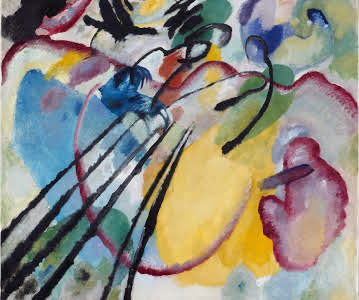
We looked at major pieces of art, again. One look is never enough. The more we look, the more we see, and the more questions we have. Children were struck by the art of Kandinsky, especially the piece above. I slowly panned major works of art to the children, only announcing the title and the artist.
Large Blue Horses, by Franz Marc
Haystacks, by Claude Monet
Tiger in a Storm, by Henri Rousseau
The Three Musicians, by Pablo Picasso
and on and on…
Can you see in your mind what was happening? Can you feel a tiny ping of excitement? The children could. Art speaks for itself. I didn’t need to say a word.
Then I showed children real artist paints – in tubes! I showed them a palette and brushes. My teaching partner donned a beret and demonstrated how to squeeze out the paint on a palette, and use a brush with water. Since the children liked Kandinsky’s painting, that’s what she painted:
It was fascinating to watch. Children were rarin’ to go. They were empowered to create a masterpiece. And they knew it would take many days. A masterpiece is never created in only one day. Day one of art had started.
After painting and feeling very satisfied, it was time to clean up and sit down for a story before lunch. Since the art of Kandinsky was popular, I read The Noisy Paintbox, The Colors and Sounds of Kandinsky’s Abstract Art, by Barb Rosenstock. Highly recommended!
The story begins with Kandinsky, a proper Russian boy, getting a paint box from his aunt. As he paints, the colors make beautiful sounds. He paints the music he hears. Now, if this sounds odd to you, it makes perfect sense to children. They understand. Perhaps we can all learn more from children, or from artists.
At the point in the book where Kandinsky is a grown man, and has forgone his art (because it didn’t conform to ‘proper art’), he goes to the opera. That awakens his art. He heard the colors singing. He saw the music dancing.
“Jennie, what is opera?”, asked a child.
Well, isn’t that the best question I could have heard? We knew about a symphony orchestra, but not an opera. Yes, I explained an opera. Better yet, I pulled up an Italian opera on YouTube, La bohème.
The children were so struck with the music that they stood up. They watched the singers. They listened. No one moved! No one made a sound!
I whispered to myself, “These children are three and four years old. I’m showing them a video of La bohème, and they’re enthralled, transfixed. They love this!”
Art should make you feel. Like music. -Vasya Kandinsky-
A big thank you to Annika Perry for my Sunshine Blogger Award Nomination. If I can be a ray of sunshine to a fellow blogger, that in itself is a tremendous thing. While I am not a participant in awards, the nomination is greatly appreciated. Thank you for spreading sunshine, Annika. Please check out her awesome blog, Annika Perry’s Writing Blog at annikaperry.com
Now, this was not a trick question. Rather, it was a ‘PSA”, Public Service Announcement, for the kids I cross as a school crossing guard. I thought that I was just reminding them of the date.
“Yes, it’s Pi Day!”
“Pie Day? No, it’s March 14th!”
“That’s right, ‘Pi Day’, 3.14…..”
They had me. They were teaching me, turning the tables from our usual morning exercise. And, it was fun, lots of laughs.
These kids are sharp!
The mathematical ‘Pi’, of course, is the ‘ratio of the circumference of a circle to its diameter’. No, I didn’t know that. At one time, maybe, but years ago. One of the kids, a high school student, told me. I had more questions, but we were across and my ‘source’ was heading for her building, probably to a quantum physics class.
We are learning about Italy, which is just perfect as we prepare for our annual Art Show. It’s only a few days into the learning, and already we are bursting at the seams in the best of ways. Here is what happened today:
Our first art activity was fun. Nothing serious, just combining Italy and art. We glued tissue paper circles onto paper, and then dropped cooked spaghetti dipped in black paint on top.
The children know that pasta doesn’t come from Italy. It was invented in China (ice cream was, too). Still, it was fun to drop and throw spaghetti. We learned about pasta and much more in a favorite book from a series, Look What Came From Italy.
As we read the book today, we also discovered that Italy is the home for inventing pretzels, the radio, the fork, lock & key, and the cookie. How cool is that? And then I turned the page in the book to discover that the concept for a symphony orchestra was from Italy.
I showed children the picture- the big curvature on a stage with instruments grouped together. They had no idea about a symphony orchestra. Of course not, they’re three and four years old. I talked about instruments and music to fifteen blank-faced children. And then I knew I had to do something. This was too important. This was music, and a symphony. Children needed to learn and hear.
Can you tell I was passionate?
I grabbed our iPad and typed in ‘symphony orchestra performance’. What came up couldn’t have been a better introduction. A ten minute video of the Symphony Orchestra of India had every child spellbound. They saw and heard each instrument, including a banjo and a djembe. We watched the video twice.
The best was yet to come. The picture book I read aloud before lunch, No One Saw, showed important pieces of art.
This is what I did:
I showed children the book cover and just waited. I said nothing. McKinley’s face lit up. She pointed above the loft and said, “We have that!” Yes, we have a Starry Night poster hanging on the wall. Then we looked carefully at the picture on the book. It showed van Gogh’s brush strokes in greater detail.
“How do you think he did that? Do you see the colors? His brush strokes went this way and that way.” I moved my hand in circles and curves.
Ah, I had planted a seed.
It was time to read the book. I opened the book to this page:
I acted surprised. Actually, I acted startled. My big, booming voice said, “Eddie! You could do this! Look!” I put the picture in front of him. Eddie’s saucer eyes stared at the painting, and he shook his head ‘yes’ over and over. I could have said that to any one of the children. All would have had Eddie’s response.
“Eddie, what colors would you need?” We talked about the colors. Children had to really look at the painting.
I moved on to the next picture in the book:
“Mia! You could do this!” In the same manner that I did with Eddie and Monet’s haystacks, I repeated the process with Mia and Georgia O’Keeffe’s flowers. I continued with other works of art, like Sunday, by George Seurat. We had to look closely to see the many, teeny-tiny dots that he painted.
When I turned the page to this painting by Mary Cassatt:
Emmett nearly jumped out of his skin. Before I had a chance to say anything, he said, “We have that in the blue bathroom!” Yes, we have that hanging in the children’s bathroom. Emmett recognized it immediately.
Here’s the thing. Before children begin to create art in earnest, they need to feel art, feel that they can do this. They need to see art with all its colors and brush strokes. They need to be empowered.





 A Teacher's Reflections