
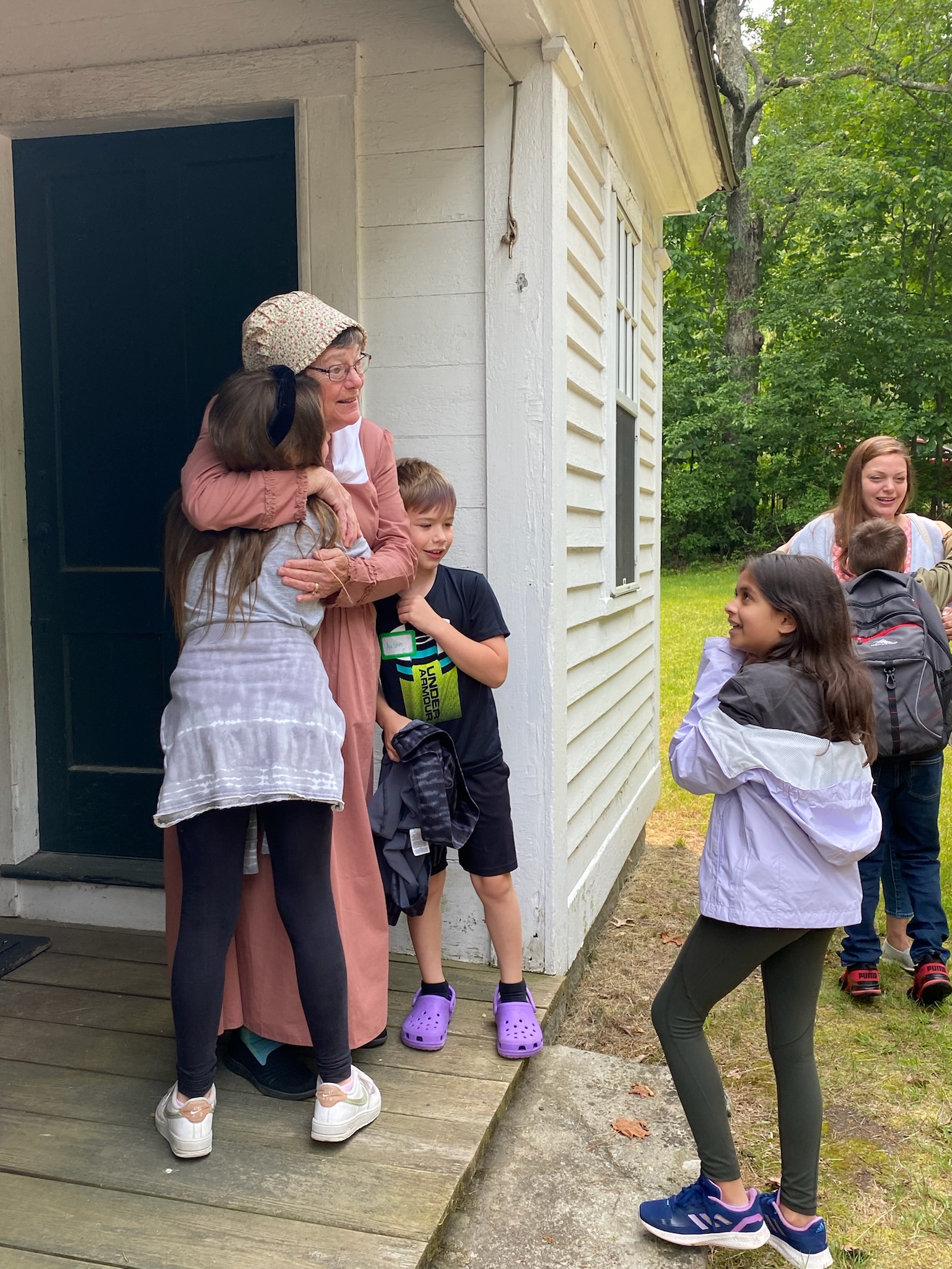
I get to bring history alive for third graders in town. This year one of the children who remembered me (many do), came up to me after the event. First she hugged me and told me she missed me. Then, she had a worried look on her face and asked,
“So Jennie…is this what you do now? Are you still teaching?”
“Brooke, I do this, but I’m still teaching.”
Brooke said a very loud “Whew!”
Here is my post about Jennie the schoolmarm. I hope you enjoy reading it as much as I enjoyed writing it:
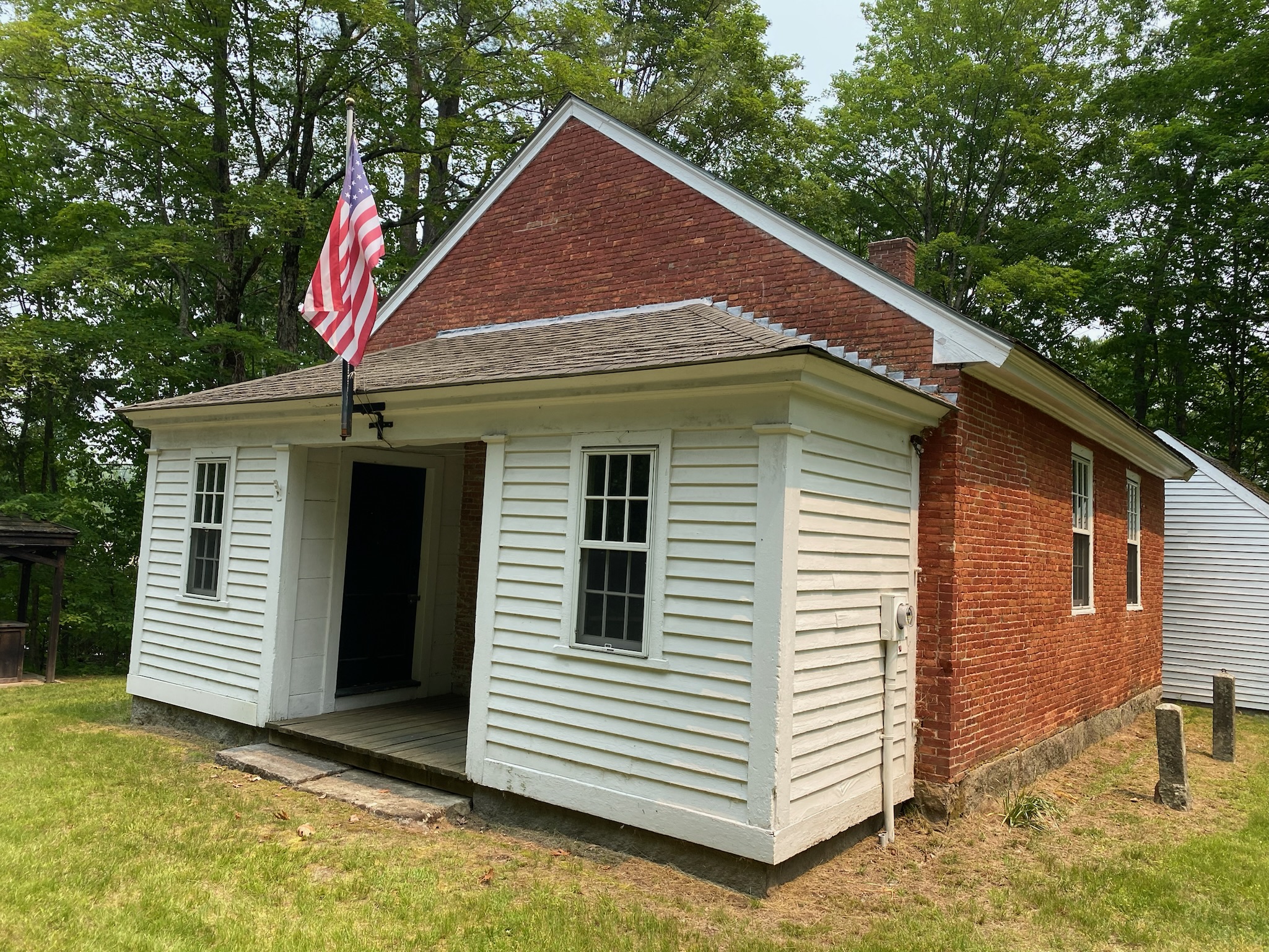
Every year, third graders in Groton, Massachusetts take a field trip to the old one-room schoolhouse, the Sawtelle School. It’s living history, and that’s just how children should learn history.
I get to be their teacher. Lucky me.
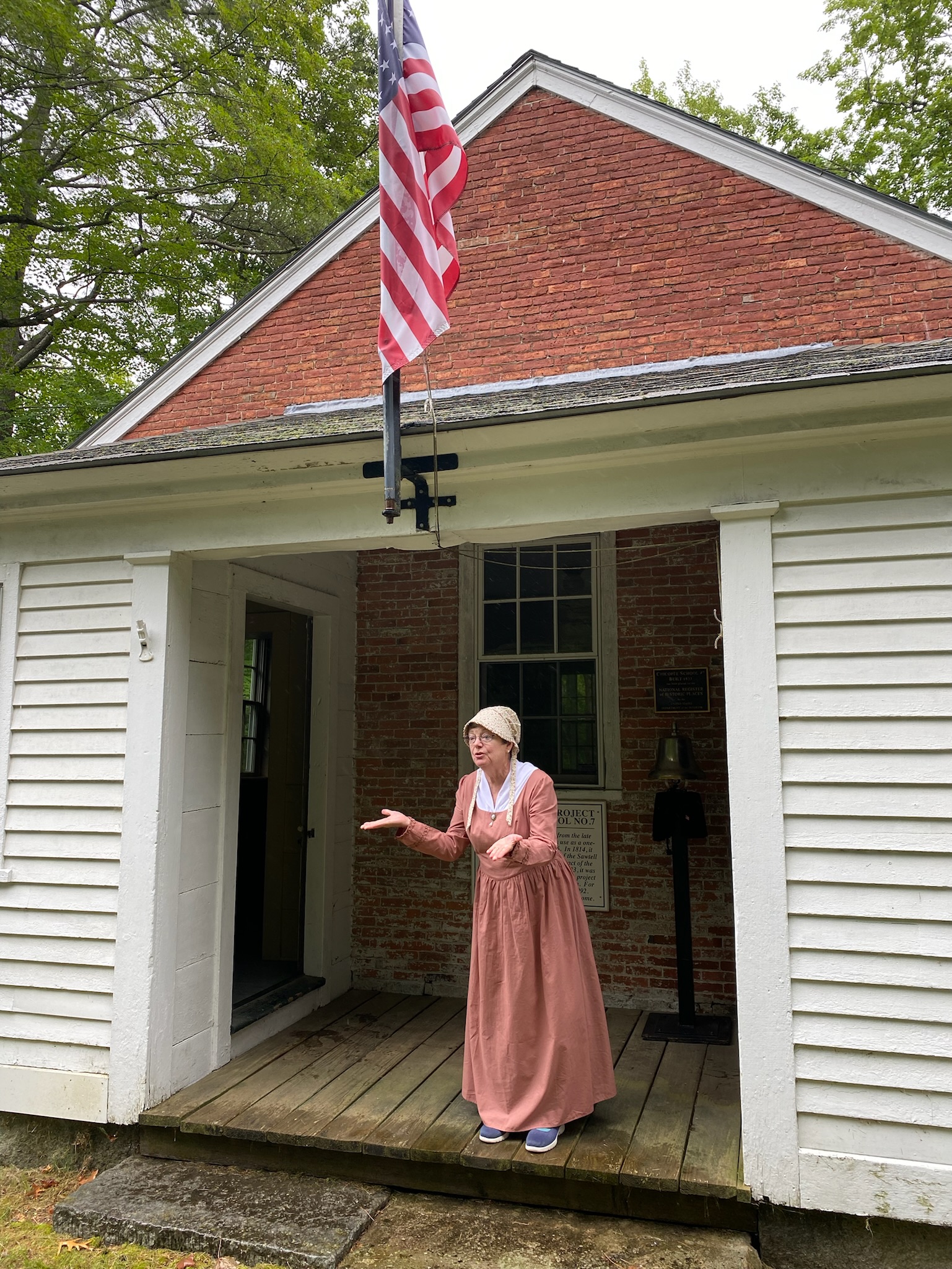
Groton is an old New England town, settled in 1655. The schoolhouse dates from the late 1700’s and was in continuous use as a one-room schoolhouse until 1916. It served as a school for nearly 125 years and is on the National Register of Historic Places.
In 1833 it was converted from wood to brick. That’s the year in which I am the schoolmarm, and where this story begins…
I ring the big brass bell to call the scholars to school. In 1833, children who attended school were ‘scholars’, not students. “Welcome, scholars! This is the old schoolhouse in Groton.”

Before I had a chance to say any more, a few children recognized me and ‘broke the line’ to run forward and give me a hug.
“Let’s look at the outside before we go inside.”
I showed children the well (yes the real well is still there), the only source of water at school. I asked plenty of questions to get them thinking:
How do you get the water out of the well?
How do you drink the water?
What else was water used for?
Next I said, “There were no toilets. Do you want to see where you had to pee and poo?”
Of course they did! Taking children to the outhouses was fun. I told them with great animation what it was like in an outhouse:
There is a thick, long board with a hole in the middle. You sit on the hole and do your business. No toilet paper.
Silence and wide eyes.
School was summer and winter, because spring and fall were farm work months. You’d be working all day. So, imagine winter here by the outhouse. It took you ‘forever’ just to walk out here.
The outhouse was a great bonding experience. They knew I wasn’t a stuffy, boring old lady. They knew I liked them. They knew I was excited about being their teacher.
I took the children inside the school. The desks (not original) were lined up and children rushed to get a desk. I watched them. They rubbed their hands over the surface, moved about, and thought. Yes, they thought. I knew they were soaking it all in, the way children do.
When you look around, you see there are no electrical lights and no heaters. Light came from this oil lamp I am holding. Heat came from this wood burning stove. Imagine fetching wood from outside in the winter to heat the schoolhouse, so your fingers wouldn’t be stiff from cold, and you could write on your slate. Paper was expensive and scarce, so you wouldn’t have that in school.
I let those thoughts sink in, then I showed children artifacts from the school- a quill pen and inkwell, a water dipper, a dinner pail (dinner was eaten at our lunchtime, and supper was eaten at our dinnertime.) We talked about farming, hard work, and how it was a privilege to go to school.
On the wall at the old schoolhouse is a life-size photo of Eva Belle Torrey, who was a scholar at the school. Alongside are excerpts from her diary. I called the children’s attention to Eva. Her decedents keep in touch and support the Sawtelle School Association.

I read aloud Eva’s three diary entries. Each started with the weather and how many scholars were at school. When she was 11, her friend died. When she was 12, she was going to study Physiology, Physical Geography and Botany this term in the place of History, Common Geography, and Language.
You could have heard a pin drop.
It was time to start school.
We stood to say the Pledge of Allegiance.

Did children know the pledge? Did they recite it daily? I wasn’t sure, but then…
Then we were ready to sing the National Anthem…but there was no National Anthem in 1833. Back then, children sang “My Country ‘Tis of Thee.” I told the children how I called my mother in disbelief when I learned America didn’t have a National Anthem until 1931. I held a pretend phone to my ear and said to children:
Mother, please tell me it isn’t true. Please tell me we had a National Anthem when you were a little girl.
No, Jennie. It’s true.
What did you sing?
“My Country ‘Tis of Thee.”
And so it was. These children stood up, and to my great surprise they belted out the song. It made me proud.
I told children the strict rules in school in 1833. I told them about the forms of discipline with great fanfare:
- Paddling. Oh, there was a paddle from the schoolhouse. My Jennie Story of teacher paddling at my elementary school was a shock.
- Bending over to touch a spot on the floor, and staying there for a long time. I called upon a teacher in the group of third graders to be the ‘victim’, and of course the children loved it.
- Wearing a Dunce Cap. I called upon a scholar to come sit on the tall stool in the corner and wear the Dunce Cap. Very popular!
- Wedging a block of wood in the mouth for whispering.
- Pegging girl’s braids onto hooks. Everyone was pretty shocked at this one. Girls who had long hair and braids instinctively covered their heads.
- Boys wearing a pink bonnet for teasing. Everyone thought this was funny.
Children copied a poem, “Good, better, best” onto their slates. That was not easy to do. When everyone finished, we recited the poem aloud, together. Poetry, reciting, reading, and reading aloud were all key elements in what children did at school. Isn’t that wonderful? Next, every child had a reader, the book that was used in 1833. Children took turns standing in front of the class and reading aloud the story. Oh, it was a great story about a boy who found a bear cub and brought it to school.
Next came Arithmetic. A few of the third graders knew that Arithmetic is math. I wrote problems on the chalkboard and children wrote answers on their slates. They could do addition and subtraction in the thousands. Mental Arithmetic was next, and it’s always tougher. I told a story of a boy who had to collect firewood for the schoolhouse, how many pieces he collected, dropped, and so on. Children wrote the answers on their slates.
Last on the agenda was singing a song from that era. I taught children “She’ll Be Comin’ Round the Mountain.” Oh my goodness, they loved it!
Finally, children asked questions:
What happened if you got sick?
If you got hurt, how would you get to a doctor?
How would they get in touch with your mom or dad?
A few days after being the schoolmarm, I received two thank you notes from children who were there as ‘scholars’. What a wonderful surprise.
Teaching history is important. Children need to know about the past in order to become good citizens in the future.
Jennie


Living history at its best!
I think so!
You make an excellent schoolmarm, Jennie. You brought history to life and those lessons will not be forgotten.
jennie – this is such an amazing experience. living history at its best, you’re the perfect person to do this
Thank you, Beth. That’s so nice. I’ve added what was happening in America at the same time, like the Statue of Liberty, and the Barnum and Bailey elephants crossing the Brooklyn Bridge. I need to add what was happening out west, something about cowboys and Indians?
some people heading west for land/homesteading and making a new life, and native americans, caretakers of the land, animals and their culture. cowboys settling towns, raising animals, ranchers, the law — and each group had a different idea of what to do with the same land, caused many fights between them. whose land was this?
Thanks, Beth!!!
In my experience kids love history when you have someone fun and knowledgeable to show them. Looks like they had a great time!
Well said, and true, if a teacher can make history ‘real’. Thanks you!
This is the best way to teach history. They will never forget this experience and the lessons learned. You make an adorable schoolmarm. xo
Thanks so much, Darlene! 🥰
I really enjoyed this post Jennie and even though I have read similar posts that you have written on this subject it’s always great to read about a new set of students joining you.
We have similar places that children visit over here some are resistantial… Usually from the Victorian era. …I remember years ago out boys enjoyed those trips . More recently our grandchildren have been on such trips.
Living history is always the best.💜💜💜
Many thanks, Willow! I’m so glad your boys and grandkids got to experience living history. It’s definitely the best!
It really is isn’t it 💜💚
Yes!
What a rich experience you orchestrated here, Jennie. We all do so need to have awareness of our history, how things change, how things stay the same.
Thank you, Tish. Yes we all need history awareness.
Nothing beats ‘living history’ to make it really come to life. And a teacher playing the part of the teacher is a win-win. No wonder they all loved that experience!
Best wishes, Pete.
Yes on both counts, Pete. Many thanks!
I would have loved this experience as a child. In fact, I’d enjoy it as an adult. It sounds like a great time was had by all with lifts of learning tool
As a child, I would have too! You would have loved this, Robbie. Many thanks!
🩷
To quote Austin, “Thank you for doing the thing with us!” What a wonderful experience you shared with the children and their teachers (including the one who agreed to bend over for a while as a punishment demonstration). Interesting that some children asked how someone would get in contact with their parents… What a different time that was! My favorite part of the one-room school house experience (from reading Laura Ingalls Wilder books, I think) is how children would be able to listen to what other (often older) children were learning and possibly jump ahead in their educational journey if they were curious/motivated. The punishments (a block of wood in one’s mouth for whispering!) were very forthright. Thank you for doing this and then writing such a great blog post for the rest of us to savor, Jennie!
I’m so glad you enjoyed this, Will. Many thanks for your wonderful comment. I’m reading aloud Little House on the Prairie to the children right now. My grandmother was born the same year as Laura’s daughter, and they both have the same name- Rose! Yes, the punishments were scary. I can’t imagine having all grades in one classroom. This year I added what was happening in America at the same time; the Statue of Liberty and the Barnum and Bailey elephants being the first to cross the Brooklyn Bridge to prove it was safe. I so enjoyed making history come alive for children.
Wonderful story of the day in a one room schoolhouse. I’ve been an educator for 47 years and my Mom taught one year at a one room schoolhouse during the war. She had just graduated from high school. I loved hearing her stories !
My goodness, how wonderful for you to hear your mother’s stories! I hope you wrote them down. What grade do you teach? I teach preschool (year 42) but do this with third graders, and have library reading groups for older children. I’m so glad you enjoyed this story. Many thanks.
Great, Jennie. Thank you. 😊
Glad you enjoyed it, John!
😀
This is so great, Jennie. Bless you for what you do!
Thank you, Anneli!
It’s tempting to think we might have gotten education right back in the day, better than now even!
Sad but true!
Thank you for sharing such a wonderful learning experience at the Sawtelle School!
I’m glad you enjoyed it, Liz!
A very interesting story and even about the old school house. I can’t believe Groton is that old 1655. That story about the child, your former student, who was worried you weren’t teaching anymore was very cute. It is amazing how much you do, and like I said before I am very grateful to you teachers for all you do for us all.
I’m glad you enjoyed this, Thomas. I know, 1655…wow. I was struck when Brooke said a big “whew.” Those are teacher moments. Many thanks for your kind words!
Yes I can image how that whew felt encouraging. I guess moments like that are great rewards for being a teacher.
They are.
Thank you Jennie for shaping a better future for all of us
That is so nice, Thomas. You are welcome.
When a child shows a teacher how important they are/were to them it makes it all worth it. ♥️
Yes, very much so!
I look forward to your annual post regarding the one-room schoolhouse. It’s such a great way to bring history to life. I’ll bet your former students were thrilled to see you again.
Hi Pete, I’m so glad you enjoy this annual post. I should have left off the last two old thank you note videos and written what I added this year – what was happening in America at the same time. I so enjoyed telling children that nobody would cross the new Brooklyn Bridge because they didn’t think it was safe. Mr. Barnum of Barnum and Bailey Circus had his elephants cross the bridge to prove it was safe. Yes, my former students were thrilled to see me, and I was thrilled to see them.
I love hearing about Jennie the Schoolmarm each year. so much fun “doing the thing” with those students. It’s always wonderful to see the students you taught in the past as they grow up. They will remember this experience.
Thanks so much, Carla. It really is wonderful.
This is absolutely fascinating. And what a wonderful teacher/tour guide you are. I sat here entranced while reading just as your visiting children were. What a different life our ancestors lived, and yet, when you think about it in the scheme of time, it wasn’t that long ago. We’ve come a long way, but then not in some respects. However, I will say I was rather shocked at the punishment for children. Grateful we don’t do that these days. You’re a magical star, Jennie.
Thank you for your lovely words, Pam. I think their education was stellar, yet their punishment was horrible. I so enjoyed doing this event for children.
And they obviously enjoyed it just as much!!!
Yes!
That’s the greatest way to teach. What a fabulous experience for everyone.
I think it is. Thank you, Deborah.
My goodness! You are a gift to the field of teaching! I’ve seen teachers who don’t seem to like the kids they teach. Your love for children is so evident.
#1 is loving the children, and the children knowing that you love them. Many thanks for your kind words!
This is such a great experience for children to see how education has changed through the years.
It really is. I’m glad to do it ‘live’.
This was all very interesting but my favourite thing is that so many kids rushed up to hug you. That’s saying a lot about you, ma’am! A beloved teacher, and they aren’t all, are they.
That was my favorite, too. When the hugs come spontaneously from the children, that says a lot. I wish all teachers were this way.
I loved this Jennie! What a way to teach history. Those young ones surely got an earful! Lol 🧡
I feel the same way. Thank you, Debby. Today we had a year-end family event at school, so siblings were there. You should have sen me drop to my knees to tell the siblings that will be third-graders next hear what will happen!
I love how excited you get to do this with the kids. You’re a legend Jennie! xx
I do get excited! Thank you for your kind words, Debby.
💜
Jennie you are a wonderful and loving teacher to all your children and they love you. Such a gorgeous post. So much to learn and what days those were. Today we are all lucky we have got everything. Thanks.
That is so nice, Kamal. Thank you. I’m glad you enjoyed this, and yes there is so much to learn about yesteryear. We are very lucky today.
Hi Jennie! Wow! This is simply wonderful!
Thank you, Charles!
What a nice experience for the children. This is memorable. I used to love doing stuff like this when I was a kid. I enjoyed the re-enactments as an adult to but I haven’t been to one in about 13 years.
Thank you, Jennifer. The children loved it! I think adults like this as much as the children do. I know I do! I hope you get to go to one soon.
You are always welcome dear Jennie. Have a great day ❤️❤️❤️❤️
Thank you, Kamal!
Fabulous post, Jennie, thank you!
A+
I love history. I always have, and always will.
Thank you, Resa. Me, too!
What a brilliant experience for everyone Jennie and such an eye-opener for the children as far as comparisons go and I am sure they look on their own classrooms and ‘conveniences’ with much more delight! I am sure their visit will stay with them always… ♥
Thank you, Sally. It was definitely an eye-opener, in a fun way. I think they’ll remember some parts.
Great post. Maybe if we called the kids “scholars” again, they’d take their roles a little more seriously.
I think that was a big reason they were called scholars back in the day. Many thanks, Mike.
Always welcome dear Jennie ❤️
Thank you, Kamal!
Loved this post and what a make history come alive and such inspired teaching
It was a joy to be the schoolmarm and make history come alive. I’m so glad you liked this, Yvette.