The Real ‘Teddy’ Story, and More

This weekend I cleaned my office; the yearly organization and the game of ‘keep or toss’.  Every year I take great care with three stories that are worn and torn, written long before computers and the internet.  Those stories are my inspiration, and I will keep them long after they are yellowed and the folds are worn.  I am not a ‘fluff’ teacher; I don’t depend on, or look for feel-good stories.  I am so tuned-in to children that I instinctively follow their interest, and that makes my teaching become incredibly meaningful, for the topic and for the child.  So, why do I keep these three stories?  They just hit my heart.

One is ‘Teddy’.  Recently people on Facebook have been circulating the ‘Teddy’ story.  Unfortunately it is abbreviated.  It’s one of the stories that I keep for inspiration, even though it is probably a story drawn from a collection of the author’s many years of teaching.  I think it’s important to tell the whole Teddy story.  Yes, it is dated, yet still a wonderful story.  Here it is, and it’s a great read:

“As she stood in front of her 5th grade class on the very first day of school, she told the children an untruth.  Like most teachers, she looked at her students said that she loved them all the same.  However, that was impossible, because there in the front row, slumped in his seat, was a little boy named Teddy Stoddard.

Mrs. Thompson had watched Teddy the year before and noticed that he did not play well with other children, that his clothes were messy and that he constantly needed a bath.  In addition, Teddy could be unpleasant.  It got to the point where Mrs. Thompson would actually take delight in marking his papers with a broad red pen, making bold X’s and then putting a big fat “F” at the top of his papers.

At the school where Mrs. Thompson taught, she was required to review each child’s past records and she put Teddy’s off until last.  However, when she reviewed his file, she was in for a surprise.

Teddy’s first grade teacher wrote, “Teddy is a bright child with a ready laugh.  He does his work neatly and has good manners… he is a joy to be around.”

His second grade teacher wrote, “Teddy is an excellent student, well liked by his classmates, but he is troubled because his mother has a terminal illness and life at home must be a struggle.”

His third grade teacher wrote, “His mother’s death has been hard on him.  He tries to do his best, but his father doesn’t show much interest, and his home life will soon affect him if steps aren’t taken.”

Teddy’s fourth grade teacher wrote, “Teddy is withdrawn and doesn’t show much interest in school.  He doesn’t have many friends and he sometimes sleeps in class.”

By now, Mrs. Thompson realized the problem and she was ashamed of herself.  She felt even worse when her students brought her Christmas presents, wrapped in beautiful ribbons and bright paper, except for Teddy’s.  His present was clumsily wrapped in the heavy, brown paper that he got from a grocery bag.  Mrs. Thompson took pains to open it in the middle of the other presents.  Some of the children started to laugh when she found a rhinestone bracelet with some of the stones missing, and a bottle that was one-quarter full of perfume.  But she stifled the children’s laughter when she exclaimed how pretty the bracelet was, putting it on, and dabbing some of the perfume on her wrist.  Teddy Stoddard stayed after school that day just long enough to say, “Mrs. Thompson, today you smelled just like my Mom used to.”

After the children left, she cried for at least an hour.  On that very day, she quit teaching reading, writing and arithmetic.  Instead she began to teach children.  Mrs. Thompson paid particular attention to Teddy.  As she worked with him, his mind seemed to come alive.  The more she encouraged him, the faster he responded.  By the end of the year, Teddy had become one of the smartest children in the class and, despite her lie that she would love all the children the same, Teddy became one of her “teacher’s pets.”

A year later, she found a note under her door, from Teddy, telling her that she was the best teacher he ever had in his whole life.

Six years went by before she got another note from Teddy.  He then wrote that he had finished high school, third in his class, and she was still the best teacher he ever had in life.

Four years after that, she got another letter, saying that while things had been tough at times, he’d stayed in school, had stuck with it, and would soon graduate from college with the highest of honors.  He assured Mrs. Thompson that she was still the best and favorite teacher he had ever had in his whole life.

Then four more years passed and yet another letter came.  This time he explained that after he got his bachelor’s degree, he decided to go a little further.  The letter explained that she was still the best and favorite teacher he ever had.  But now his name was a little longer… The letter was signed, Theodore F. Stoddard, MD.

The story does not end there.  You see, there was yet another letter that spring.  Teddy said he had met this girl and was going to be married.  He explained that his father had died a couple of years ago and he was wondering if Mrs. Thompson might agree to to sit at the wedding in the place that was usually reserved for the mother of the groom.  Of course, Mrs. Thompson did.  And guess what?  She wore that bracelet, the one with several rhinestones missing.  Moreover, she made sure she was wearing the perfume that Teddy remembered his mother wearing on their last Christmas together.

They hugged each other, and Dr. Stoddard whispered in Mrs. Thompson’s ear, “Thank you Mrs. Thompson for believing in me.  Thank you so much for making me feel important and showing me that I could make a difference.”

Mrs. Thompson, with tears in her eyes, whispered back.  She said, “Teddy, you have it all wrong.  You were the one who taught me that I could make a difference.  I didn’t know how to teach until I met you.”

(For you that don’t know, Teddy Stoddard is the Dr. at Iowa Methodist in Des Moines that has the Stoddard Cancer Wing).

I will share my other two stories with you over the summer.  They are really good!

Jennie

Posted in Teaching young children, Uncategorized | Tagged , , , , , | 4 Comments

When Children Bring the Music

Colin and his mother came into school looking happy and half-humming, half-singing something very familiar.  Their whole presence and attitude was atypical, because they behaved as if they were actually part of the song.  I realized they were singing “Oh What a Beautiful Morning” from the musical “Oklahoma”.

Now, that was a surprise.  Of all the music I introduce to young children from Beethoven and Vivaldi, to jazz, the Beatles, and everything in between, I haven’t introduced musicals, with the exception of “Mary Poppins”.  When I was ten-years-old I was given two choices for my birthday party: a group of friends to the big amusement park, or one friend to “Oklahoma”.  Fortunately I picked “Oklahoma”, and I have never looked back.  It was my ‘golden door’ to good, live music.  It was also my awakening to music that makes you feel, laugh, and cry.  Fast forward twenty years, and I became a teacher.  Those songs opened a big door in my heart, and that is what I share and do when I teach.  It was only natural that I brought plenty of music into my classroom, as music is the soul of emotions, and therefore the foundation for children to develop goodness.  It’s much like reading the best fiction, such as Charlotte’s Web.  Both play a big role in positive character development.

When Colin and his mother came bounding into school singing “Oh What a Beautiful Morning” I joined in.  Colin is a singer and loves every song he hears.  As the day went on, we sang on the playground, in the hallway, and in the bathroom.  Other children joined in, and by lunch time we had a party of singers.  Singing is contagious!

Claire came to school wearing red, white, and blue after our Memorial Day Remembrance.  I could tell she was bursting to tell us something.  She was puffed out like a mama bird who had taught her babies how to fly.  She stood tall in front of her classmates and sang, “You’re a Grand Old Flag”.  She was so proud!  Of course we all wanted to sing along, and we did.  That contagious, infectious element crept in, as it always does with music, and we spent most of the day singing parts of the song.  Outside we marched as we sang, in the bathroom we made-up hand movements to the song.  Whenever a child started to hum or sing part of the song, I picked up the ball and ran.

When children bring music into the classroom, it’s a golden opportunity to sing.  A song from a child is a home run for a teacher, simply because the song and interest came from the child.  It is a natural way to teach values and goodness, because children learn best in a hands-on, indirect way.  Did I ask Colin if his song made him feel happy?   Did I ask Claire if her song made her feel proud?  Those questions were best answered by embracing the songs and acting upon them.  Actions speak louder than words.  This is emergent curriculum, and the learning that follows is the ‘stuff that sticks’.  How do I know?  Thirty years of children who return to visit recall what they remember and what made a difference.  Often it is music and singing.

Sing, even if it is humming or phrases.  Sing what filled your heart.  And, if children come to you singing what fills their heart, that’s as good as it gets.

Jennie

Posted in Teaching young children, Uncategorized | Tagged , , , , , | Leave a comment

Doctor Dave, and Art

Art can sneak up on you when you least expect it.  When that happens, open your mind and be ready.  It’s a thrilling experience.

I sliced my finger badly with a hedge trimmer…ouch!  Off to the ER after pouring a bottle of rubbing alcohol on the big flap of skin.  Not pretty.  Doctor Dave was the weekend guy at the hospital.  He was chatty and so was I.  I think he just liked talking to people, while I was probably overcompensating from fear.

I asked if he had seen the art display in the main hallway.  I had collected the best pieces of children’s art (with permission from parents) over many years.  It was a long term, lofty goal to have children’s art displayed in a central, busy location at a hospital.  Why?  Art can be one of the most soothing and peaceful things for someone at a hospital.  It can make you smile and forget your worries of the moment.  Then, there’s children’s art, which brings all those feelings to a new level.  Children’s art is pure; what is in their mind goes into their heart, and out their fingers.  At a hospital, looking at children’s art can wash away a patient’s worry.

I was at the hospital for a routine check-up a few weeks earlier.  I made a point of stopping by the hallway to see the art display.  I hadn’t seen it in some time.  Wow!  I couldn’t believe how much it surprised me; Grady’s intricate lines and coloring, Mason’s Eric Carle starfish, Troy’s American flag, Maggie’s painting on wood, and Hannah’s marker drawing on an envelope that looks like it should go onto Antiques Roadshow.  Looking at all the art was as good as it was the first time.

I always had in my mind how this would help patients.  Then, a hospital director told me, “Jennie, you have no idea how much this will do for the nurses.”  I hadn’t thought about that!  My perspective was from a patient.  When I had surgery at UMass Memorial many years ago, the waiting room was filled with children’s art, beautifully framed and titled.  That was my inspiration!  I knew I had to do the same thing at my local hospital.

Doctor Dave had not seen the art display.  He told me his wife was an art teacher, and he would definitely look at it, because art was important to both his wife and to him.  Then he told me a story:

“Jennie, when I was twelve years old I won the Boston Globe art contest.  I drew a dragon over the city.  It was eating things.  The drawing was really detailed and good.  I knew I was good at art when I was younger.  I could tell.  I loved art and drew all the time.  After I won the contest my Mom wanted me to go to art school.  She never stopped encouraging me to live that dream because she knew I was good, too.  Yet, I wanted to become a doctor.  Still, my Mom wished I would put those dreams aside and go to art school.”  What a remarkable story.

So, Doctor Dave decided to forgo art and pursue medicine.  As he stitched my finger, I told him about art education for young children, and how it impacts math and science.  The creativity and engineering that comes from the minds and hands of artists is similar to a doctor and a surgeon.  I told him that many of the best surgeons often had more childhood experiences playing outside with sticks and rocks, rather than playing on computers.  His art was his groundwork, and I can say that firsthand looking at his stitches on my finger.

Art is everywhere.

Jennie

Posted in Teaching young children, Uncategorized | Tagged , , , , | 1 Comment

Chapter Reading

Chapter reading is one of our treasured moments of the day. We bring to life the imagination, the world, and the past. The anticipation of ‘what happens next’ stirs excitement every day. Children listen and think. They ask questions. Ask your child, “At chapter reading where do you make the pictures?” You will hear your child say, “In your head.”

When we finish a good book and then start a new one, emotions run high and low. The end of a good book is so satisfying and pleasant, yet…it is over. That is the wonderful roller coaster of reading. And, with each chapter book we read, we ride that roller coaster again and again.

We have just finished Little House on the Prairie, and it was thrilling; from Jack the dog getting lost in the rising creek, to building a house, to fever and watermelons, and Indians, and fire on the prairie. If your child wants to continue the series the next one, Farmer Boy is about Laura’s husband when he was a little boy. I recommend the following one, On the Banks of Plum Creek, which begins their next journey after the prairie.

The constant favorite chapter reading book is Charlotte’s Web. I hear this from former students all the time, most recently from a high school senior.  I couldn’t agree more.

These are the chapter books we have read this year. Good books are meant to be read over and over again. We encourage you to revisit these wonderful books with your child:

Charlotte’s Web by E.B. White

My Father’s Dragon by Ruth Stiles

The Story of Doctor Dolittle by Hugh Lofting

Doctor Dolittle’s Journey by Hugh Lofting

Mr. Popper’s Penguins by Florence and Richard Atwater

Little House in the Big Woods by Laura Ingalls Wilder

Little House on the Prairie by Laura Ingalls Wilder

The fundamental constant that gives children the tools to succeed in school is language. The more words that children hear, the better they will do in school. Reading aloud to children is far more than an enjoyable experience. It increases their language development! In kindergarten through grade four, the primary source of instruction is oral. The more words that a child has heard, the better s/he will understand the instruction, and the better s/he will perform in school, in all subjects. Therefore, we will always campaign to read aloud.

A wonderful guide to book recommendations and to understanding the importance of reading aloud is the million-copy bestseller book, The Read-Aloud Handbook. I have used the book since my children were little. The author, Jim Trelease, visited my classroom, the Aqua Room, and Groton Community School. We are featured in the new seventh edition of the book.

Jennie

P.S. Classroom teachers ride the roller coaster of chapter reading, too.  We are just as involved and attached as the children.  I think that’s wonderful!  Jackson sobbed when Jack the dog was lost, and I did, too.  Together we had to leave the classroom and read aloud the next chapter, where Jack finds his way home.  We had a great talk about dogs, and life in the eyes of a four-year-old.  I will always campaign for reading aloud, because I know first-hand the difference it makes.

Posted in Teaching young children, Uncategorized | Tagged , , , , , , , , , | Leave a comment

Teaching Patriotism and Singing, Part II

Singing and music are powerful and universal.  Is there a part of “The Star Spangled Banner” that gives you a lump in your throat?  When I sing, “…gave proof through the night”, that does it for me.  We all hold dear parts of songs that empower us.  Patriotic songs seem to do that ten-fold, and for a good reason.

Patriotic songs are about appreciating our land, freedom, peace, and hard-fought battles.  I teach these songs to children in a multitude of ways.  Of course, I use books such as The Star Spangled Banner by Peter Spier to give a powerful visual to the words.  I also tell stories about our country and use a big map of the United States to illustrate words such as purple mountain’s majesty, and mountains and prairies and oceans.

We often sing “This Land is Your Land”, and we sing all six versus of the song (did you know there are six?).  Typically we hold up the book by Kathy Jakobsen that illustrates the song, and the children want to stand up, much like holding the American flag.  When the children’s interest signals to me that something is popular, it means I need to do more.  A few years ago I created an ‘I Spy’ of many of the items illustrated in the book.  It’s a popular take-home for the children.

In my previous post on teaching patriotism, I described the opening ceremony of the Shriners Circus.  That event became my ‘wake-up call’ to teach patriotism to young children.  We learned about the American flag, and the events in the battle that became our National Anthem.  We fell in love with “God Bless America”, to the point that it is a mainstay in the classroom.  Soldiers came to hear us sing.  We made a “God Bless America” book and then we designed a quilt from all the words in the song.  Milly the master quilter worked with the children to make a quilt that is so remarkable, it hangs in the Massachusetts Fisher House.  But first, it traveled to the Intrepid Museum in New York city.  What an honor.

Think about what children learn with these many different ways I teach songs about our great country and patriotism.  I don’t wait until Memorial Day to sing patriotic songs.  Then, when Memorial Day rolls around it feels prideful to belt out these songs.  We have a Memorial Day Remembrance at school every year, with my class holding the flag and leading the school in songs.  Often we have a guest soldier speak to the children.

My two most memorable events of that day were planting flags in our Memory Garden for Greg and Travis, soldiers who had died.  A child visited those flags the following day and asked if we could sing “The Star Song”.  I knew he meant “The Star Spangled Banner”.  We sang the song together, and other children joined in.  One child told us his Uncle Jack had died in the war and asked if we could sing for him.  We did.  Then another child told us that his neighbor old Mr. Wyatt had died, and could we sing for him.  We did.  By the time we finished we had sung five times and had drawn in most of the children from the playground.  That was a wonderful day.

The second memorable Memorial Day event happened when the kindergarteners were singing, “Proud to Be an American”.  Troy was singing his heart out.  Soldier Paul, our guest at the Remembrance, was so moved that he knelt beside Troy and finished singing the song with him.  When the song was over he presented Troy with a Command Coin.  There wasn’t a dry eye in the house.

Sing, and sing often.

Jennie

Posted in Teaching young children, Uncategorized | Tagged , , , , , , | 3 Comments

Teaching Patriotism

It all started with our field trip to the Shriners Circus years ago.  This circus is a perfect event for preschoolers as it’s grand but not overwhelming.  My class was seated and ready.  The circus began with lowering a big American flag and singing our National Anthem.  I had no idea this would happen.  So, of course I stood, put my hand over my heart, and began to sing.

I looked at the children and they were playing.  I looked at the parents and they were chatting away.  I was horrified.  Immediately I began rushing to each child and showing them how to stand and placing their little hands over their hearts.  I must have looked like someone who was frantically putting out fires, because that’s exactly what I was doing.  I was desperately trying to stop the ambivalence.

I knew I had plenty of teaching to do ahead.  My first step was to teach the children about our flag, since that was what they remembered from the circus.  I had a parent who was retired from the Navy bring a flag to school and tell the children all about it.  It was wonderful!  Why had I not thought about doing this before?  Seeing, touching, and learning about the flag shouldn’t wait until elementary school.  I learned along with the children.  Do you know the nickname of our flag?  I do.

My next step was our National Anthem, and there is no better book than Peter Spier’s The Star Spangled Banner to teach this to young children.  Each line in the song is a full color illustration, which ignites plenty of questions and conversation.  We poured through this book, and ended up getting a piece of American history.  We talked about how the rockets were the only source of light to see the flag.  Then we talked about battles, and flying the flag showed who was winning.  One child looked at an illustration and said, “That must be a towering steep.”  She was right!  The book includes the second and third versus, all with full illustrations.  I was surprised that I could still sing those by heart, and the children were surprised, too.

Singing; that was the next part of teaching.  We needed to sing patriotic songs.  Singing is universal when it comes to expressing the heart and soul of how you feel.  The children loved singing “God Bless America”.  After we learned the song, they decided to sing it amongst themselves and then for other classes on the playground.  They couldn’t get enough, so I arranged for soldiers to visit on Veteran’s Day so we could sing for them.  It was a wonderful event, yet the children wanted more.  I could tell.  We made a “God Bless America” book where we wrote all the words and drew the pictures.  What a treasure!  Still, this love for the song and the underlying passion for patriotism was not satisfied.

Patriotism continued to grow in the classroom.  It exploded in the best of ways.  Stay tuned!

Jennie

Posted in Teaching young children, Uncategorized | Tagged , , , , , , , , , | Leave a comment

Teaching: it’s The Cake and the Frosting

Our everyday learning in the classroom reminds me of a big cake. The necessary ingredients are science, math, reading, writing, language, geography and the arts. A cake is mixed by hand, just as our learning is hands-on.

And, the frosting? That’s our unit of study. It’s the fun, the glorious way to encase and show off our cake. Italy is a beautiful frosting. So was the Rainforest, and Hawaii, and India, and Jan Brett. Regardless of the frosting, or our unit of study, there is always a cake and the important learning that happens.

I thought you might like to taste some of the recent ‘cake batter’:

Reading and letter recognition, a daily constant, had an “ah-hah moment” when we read the book Froggy goes to Hawaii. The word ‘Froggy’ is in big letters on many of the pages, followed by an exclamation mark which we had just learned about. That sparked a huge interest in recognizing letters and actually sounding out words. Since then, every time we read a book that has some of the words in large print, such as Toot, Toot, Zoom or My Truck is Stuck (Literacy Tree books); we are obsessed with both recognizing the letters and sounding out the words. We then find rhyming words and sound them out.

Writing has become a popular activity. We use ‘Handwriting Without Tears’ with emphasis on the terminology of ‘lines’ and ‘curves’ and using those shapes to create letters. September introduced Mat Man, and last week our Italy writing activity had children so ready, it looked like the line at the deli counter. Children practice writing their name on paper with three lines, therefore three practices. We used a vertical surface to make the map of Italy and a pizza parlor tablecloth, and our paintings for the Art Show are done at an easel. All of these activities on a vertical surface are developing the muscles needed for writing.

Geography is highlighted so many times with studying different countries. The best part is, every time we pull out our Big Book Atlas, we become sidetracked and learn even more. We have learned about the equator, the poles, and the oceans. Children are always drawn to the map of the United States, and the learning keeps flowing. We have used the atlas to track the travels of Dr. Dolittle, and we’ll be tracking the travels of Laura Ingalls Wilder.

Math and Science has been exciting with the hatching of twenty baby chicks in the kindergarten.  The circle of life is in full glory.  Our favorite science fair activity was using a hair blow dryer to blow ping pong balls into the air and keep them steady.

Of course you know that Art and Music has been a major contributor to our ‘cake batter’ as the children made significant pieces of art, inspired by music, for our annual art show.  I bumped into a former student (now going into kindergarten) who told me she was in Washington DC last week and visited the National Gallery of Art.  I was there, too!  We marveled at the coincidence.  Then she said, “I saw the Mary Cassatt”.  I did, too!  She said, “Jennie, I saw the flower painting we learned about.”  Wow!

My classroom makes the best cakes and frostings!

Jennie

Posted in Uncategorized | Tagged , , , , , , , , | 17 Comments

“The Art Show” S.T.E.M. + Art = S.T.E.A.M

The Art Show is on display at last.  Thanks to science, technology, engineering and math (STEM), and plenty of inspiration, the children did it!  They created remarkable works of art, worthy of a real Art Show.

Aqua STEAM

When I look at the paintings, first I feel thunderstruck and then I step back and think about how all this happened.  I can’t help but smile as my mind goes back to a cold winter day at the Eric Carle Museum in Amherst, Massachusetts looking at abstract art, and learning about the artists that inspired Eric Carle (Picasso, Matisse, and Kandinsky).  Carle was one of the few who was allowed to view this ‘forbidden art’ when he was an art student in Germany in the late 1930’s.  It changed his life.

Back at school, I showed children pictures of major pieces of art.  They were fascinated and curious.  We talked about the brush strokes of Vincent van Gogh and how light was painted in “The Milkmaid” by Vermeer.  We found all the geometric shapes in Picasso’s “Three Musicians”.  Looking at art was fun!  Talking about it it was intense.  Every question was a pathway to learning.  We were constantly sidetracked, in the best of ways.  Emergent curriculum was brewing, and I was stirring the pot.

Then, I introduced music with my record player.  Well, first I introduced my record player which was the most fascinating piece of technology that children had seen (and heard).  Music is inspirational, and certainly inspires art.  I told the children, “The music goes into your ears, then into your heart, then out your fingers.”  They loved Beethoven, Vivaldi, and the Beatles.  Hans Christian Anderson was spot on when he said, “Where words fail, music speaks.”  The sounds of the violin and cello, oboe and clarinet, trumpet and french horn were all distinguishable.  Each sound, each instrument, each song gave children a thrill and the courage to paint.

IMG_0139

We started painting.  We had real tools and real paints, on palettes.  Learning the science and math behind mixing colors was not simple. Thick brush strokes or a lighter color required trial and error, and patience.  Children decided on the music they wanted to hear and they painted.  Often the painting took a long time or was revisited over many days.  After all, a masterpiece isn’t created in a day.  The finale was naming the art, and that gave children such pride.  All masterpieces have a real title. I was amazed at the scope of titles, from “Beautiful Train of New York” to “Houses in Town” to “Polka Dots” to “Mommy”.

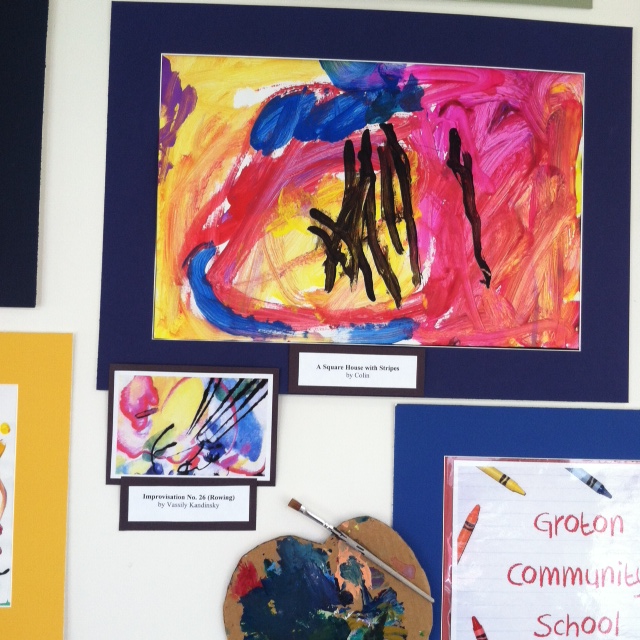
A few children wanted to recreate one of the works of art we had seen and learned about.  Jackson was fascinated by “The Large Blue Horses” by Franz Marc.  Colin liked Vassily Kandinsky’s “Improvisation No. 26 (Rowing)”.  Look at Colin’s version alongside Kandinsky’s.  I find this remarkable.  Colin is a typical three-year-old.  He decided to name his piece “A Square House With Stripes.”

Aqua KadinskyChildren need to explore.  That’s how they learn.  Art is but one medium.  Think of the possibilities that can make a difference; nature discovery, hands-on math, reading aloud, science experiments, dramatic play.  We need to give children multiple opportunities to explore.  Then, when they want to learn more, be there and seize the moment.

Jennie

Posted in Teaching young children, Uncategorized | Tagged , , , , , , , , , , | 2 Comments

A Spontaneous and Emergent Conversation

Transition times are tricky for both teachers and children, especially when spring arrives. Children seem to ‘feel it in their bones’, and are constantly on the move. Spring is definitely an awakening. Teachers observe this every year and foster all the discoveries and exploring that transpires, typically with movement. Yesterday we were transitioning from the Big Room to our classroom. I noticed a few children looking sad or hurt. I stopped. This was the result of children being too wiggly, and not being aware of others around them. Feelings had been hurt. I gathered the children together on the tiny rug, the one by the French doors with sunlight streaming in.

Once we sat down I said, “Do you know what happens when you’re born?” in a voice that was holding a BIG secret answer. Every child wants to know what happens when they’re born.

“You think about you. You love you. It’s wonderful.”  Pause

“Then you grow. And you think about you and your Mom and your Dad. It’s wonderful.” Pause

“Then you grow again. And you think about you, your Mom and Dad, and your brothers and sisters. It’s wonderful.” Pause

At every pause I raise my hands higher, as if I am demonstrating a flower growing. I hug myself each time I say it’s wonderful. The anticipation of what comes next has the children completely focused.

“Then you grow again. And you think about you, your Mom and Dad, your brothers and sisters, and your grandparents, aunts, uncles, cousins, and your whole family. It’s wonderful.” Pause

“Then you even grow again! And now you think about your Mom and Dad, everybody in your family…and you start school and think about your friends. It’s wonderful.” Long pause

“I want to tell you something wonderful about you.”

I did just that, looking directly at each child. From, “You have the best smile in the whole world” to “You will make the best big sister in the whole world.” each statement was true and heartfelt. The children knew that. I even stopped at my co-teacher to tell her she was one of the best teachers I’ve had the privilege working with. There was something special about every child, and I announced that to everyone.

So, what happened here? The affirmations were more than pleasurable for children. They were grounding. Much like a spring seed, those words were the sun and the rain to help them grow. Hearing the words aloud also helped children step outside of themselves and recognize that their classmates are pretty terrific, too. We all have something special, and I was able to capture a moment that could have turned into a difficult transition.

The little things are far more important than the big things. Often it’s the little things that are really the big things. This conversation was better than anything I could have planned. Spontaneity and emergent curriculum at its best.

Jennie

Posted in Teaching young children, Uncategorized | Tagged , , , , , | 2 Comments

Periods of Disequilibrium

Posted in Uncategorized | Leave a comment