Reading Aloud Makes a Big Difference. Here’s Proof.

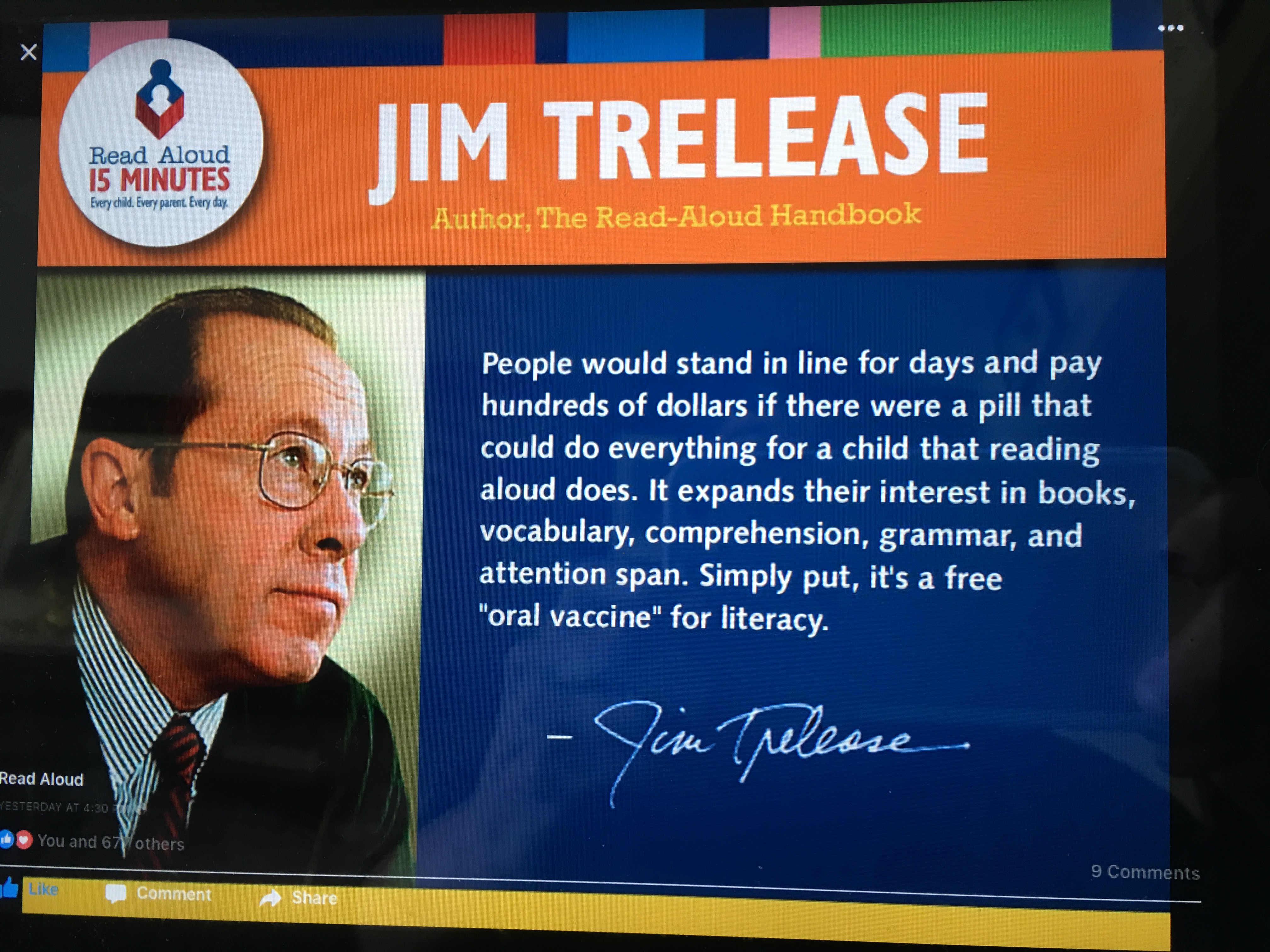
I love a good story, especially one that involves reading aloud and the stunning difference it makes with children.  Here is a favorite story of mine, from the million-copy best selling book, The Read-Aloud Handbook by Jim Trelease:

“During his ten years as principal of Boston’s Solomon Lewenberg Middle School, Thomas P. O’Neill Jr. and his faculty proved it.  The pride of Boston’s junior high schools during the 1950s and early 1960s, Lewenberg subsequently suffered the ravages of urban decay, and by 1984, with the lowest academic record and Boston teachers calling it the “looney bin” instead of Lewenberg, the school was earmarked for closing.  But first, Boston officials would give it one last chance.

The reins were handed over to O’Neill, an upbeat, first-year principal and former high school English teacher whose experience there had taught him to “sell” the pleasures and importance of reading.

The first thing he did was abolish the school’s intercom system.  (“As a teacher I’d always sworn someday I’d rip the thing off the wall.  Now I could do it legally.”)  He then set about establishing structure, routine, and discipline.  “That’s the easy part.  What happens after is the important part–reading.  It’s the key element in the curriculum.  IBM can teach our graduates to work the machine, but we have to teach them how to read the manual.”  In O’Neill’s first year, sustained silent reading (see chapter 5) was instituted for nearly four hundred pupils and faculty for the last ten minutes of the day, during which everyone in the school read for pleasure.  Each teacher (and administrator) was assigned a room–much to the consternation of some who felt those last ten minutes could be better used to clean up the shop or gym.  “Prove to me on paper,” O’Neill challenged them, “that you are busier than I am, and I’ll give you back the ten minutes to clean.”  He had no takers.

Within a year, critics became supporters and the school was relishing the quiet time that ended the day.  The books that had been started during SSR were often still being read by students filing out to buses–in stark contrast to former dismissal scenes that bordered on chaos.

The next challenge was to ensure that each sixth-, seventh-, and eighth-grade student not only saw an adult reading each day but also heard one.  Faculty members were assigned a classroom and the school day began with ten minutes of reading aloud, to complement the silent ending at the end of the day.  Soon reading aloud began to inspire awareness, and new titles sprouted during SSR.  In effect, the faculty was doing what the great art schools have always done: providing life models from which to draw.

In the first year, Lewenberg’s scores were up; in the second year, not only did the scores climb but so, too, did student enrollment in response to the school’s new reputation.

Three years later, in 1988, Lewenberg’s 570 students had the highest reading scores in the city of Boston, there was a fifteen page waiting list of children who wanted to attend, and O’Neill was portrayed in Time as a viable alternative to physical force in its cover story on Joe Clark, the bullhorn- and bat-toting principal from Paterson, New Jersey.

Today, Tom O’Neill is retired, but the ripple effect of his work has reached shores that not even his great optimism would have anticipated.  In the early 1990s, a junior high school civics teacher in Japan, Hiroshi Hayashi, read the Japanese edition of The Read-Aloud Handbook.  Intrigued by the concept of SSR and Tom O’Neill’s example, he immediately decided to apply it to his own school.  (Contrary to what most Americans believe, not all Japanese public school students are single-minded overachievers, and many are rebellious or reluctant readers–if they are readers at all.)  Although SSR was a foreign concept to Japanese secondary education, Hayashi saw quick results in his junior high school with just ten minutes at the start of the morning.  Unwilling to keep his enthusiasm to himself, he spent the next two years sending forty thousand handwritten postcards to administrators in Japanese public schools, urging them to visit his school and adopt the concept.  His personal crusade has won accolades from even faculty skeptics:  By 2006, more than 3,500 Japanese schools were using SSR to begin their day.”

Used by permission of the author, Jim Trelease, 2013, The Read-Aloud Handbook (Penguin)

These are the stories that make me continue to read aloud to children.  It is THE single most important thing I do in my classroom.  Children love it, read on their own throughout the day, and excel in school.  Not only am I growing readers, I’m opening the door to the world for them.  And, they jump in with both feet.

Jennie

Posted in Teaching young children, Uncategorized | Tagged , , , , , , , , | 5 Comments

Cooperative Play

Human beings have persevered on this planet by figuring out how to work together.  We gather information, work hard, learn by trial and error, and enlist the help of others.  That’s how it works.  And, that’s just what is happening in my classroom.  I’m watching the same evolution through the children as they play together.  For children, play is their work, and it is hard work.

Play begins independently, then includes others.  For quite a while play is simple, but it becomes complicated when children are in school and surrounded by so many different children, and (gulp!) have to work together.  Bottom line; this is the heart and soul of developing life skills.

Here is what I said today to the families in my class:

Over the past month teachers have been watching your children play together. The operative word is ‘together’, because we are witnessing a huge shift from playing with classmates to working with classmates. This can only happen when children feel connected, like a family. Recently we have stepped back and watched our family in action.

On the playground, children figured out how to use sandbox shovels, one in each hand, as big leaf scoopers. Some children wanted to scoop the leaves into the windows of the play houses on the playground, while other children wanted to collect the scooped leaves inside the house. Other children wanted to use the pretend lawnmower to disperse of the leaves in the house, therefore starting the leaf cycle over again. This was hard work. This was cooperative work.

We watched children riding in the big wagon. Two children were inside and two were outside. Not only did they figure out how to take turns, they had to problem-solve what to do if the wagon went off the path and into the bark mulch. It took more children to move that wagon, and we watched as children enlisted the help of their classmates, negotiated, and brainstormed. Together, they figured this out.

Your children are pushing their friends on the swings. A month ago, children wanted teachers to do this.

In the classroom children created a doctor’s office for ‘Gloria’ on the housekeeping table. They used the grocery store items to nurture her, and they made sure she had her blankie.

Our grocery store has opened more complex opportunities for cooperative play. We have three carts, two cash registers with money, four clipboards and pencils, and plenty of real grocery boxes and containers. Can half the class play grocery store together? You bet!

Your children love games, particularly ‘Cariboo’, and our handmade version of Memory. They ask to play every day, and this involves taking turns, following the rules of the game, and cooperative play.

We are a family, indeed!

Jennie

Posted in Teaching young children, Uncategorized | Tagged , , , , , | 1 Comment

Gloria Has the Final Word Today, Indeed

Today at school, Gloria’s journal was returned after her weekend with Claire.  Yes, she went Trick-or-Treating in a full pink bunny costume.  She also helped the family make soup, and went to church with them.  The photo and journal entry were heartfelt and very genuine.  Actually, all of Gloria’s journal entries are just like that.

As I read the journal entry to the class, it struck me that I have spent so much time telling the world the whole evolution of Gloria and all she has done;  I have not told the children.  The children and Gloria are all that matters.  That’s what it’s all about.  Thank goodness her journal came back to school today.

Families and teachers need to know about how Gloria became all that she is.  The children simply need to know Gloria.  Reading her journal is how we did that today.

After we read about Trick-or-Treating with Claire, we went back to the beginning of her journal.  Every page was a story and a photo, and each one was heart-stopping or funny.  We read the whole thing!  From years of Halloween costumes, to playing in the snow, to snuggling in bed, to climbing a tree… these are the children’s weekend memories.

Do you know what it’s like to have fifteen children crowding around you, pushing to get a view, interrupting to say something, and desperately wanting more?  I do.  So does Gloria.  She joined us when we read her entire journal, and she was smiling.

Jennie

Posted in Teaching young children, Uncategorized | Tagged , , , , , | 3 Comments

The Evolution of ‘Gloria’, part two.

This is a continuation of my previous post.

‘Gloria’, the classroom puppet evolved over two decades into a ‘person’ that continues to give children reasons to think about others. One early conversation (of which there are many) the children had with Gloria seems to confirm this development from pretend to real. This one was around Halloween:

A child: “Gloria, I like your blankie. Do you have a toy?”

Gloria shakes her head “no”.

A child: “Oh.” (A long pause) “Do you have a Halloween costume?”

Teacher: “I don’t think Gloria has one yet. What should she be?”

A child: “A Powder Puff Girl!”

Another child: “A Princess!”

Another child: “Thomas the Train!”

Another child: “A pumpkin!”

Teacher: “Let’s ask Gloria after rest time.”

A child: “Gloria, would you like a nap mat? You can rest with your blankie.”  The children became excited, and their questions were rapid.

Many children: “Can you have snack with us?” “Can you play outside?”  This conversation continued, with the children clearly interested and making sure Gloria had what she needed. They were really saying, “Are you ok? I care. I want to be your friend.”

Gloria Quilt To understand Gloria’s blankie we need to back a few years. The concept of a grandparent together with young children has always been part of my classroom. One example is GaGa and the role she played with Gloria. After the children were worried that Gloria did not have her own blankie, GaGa brought her sewing machine into the classroom and made a blankie for Gloria out of scraps of fabric. All of this involved the help of the children – this activity was remarkable!

The evolution from a blankie to a quilt is an explosion of the role of Gloria. Here is how it all began:

My husband and I were in Philadelphia and wanted to see Carpenter’s Hall. Across the street was the National Liberty Museum where we went next. In the main lobby was a beautiful structure, a Peace Portal. It had four legs and a striking glass canopy.

I immediately knew that this Peace Portal was something I could do in my classroom. We recreated the structure on top of our loft, and the children spent time there under the canopy of Peace, like the one at the museum.

This was a year-long project, but Gloria would have the last word.

The next fall my husband and I visited the Bennington Museum where there was a collection of Haitian peace quilts. These quilts were murals. I immediately knew that we could make one in the classroom. After all, we had just made a Peace Portal, and yet it felt as if the children needed more.

When Gloria introduced the concept, she told the class that her blankie is not a blankie; it’s a quilt. Actually, it’s her peace quilt because it makes her feel peaceful. We looked at her quilt, and she told the class all about it, and why it makes her feel peaceful. Then, with Gloria’s help, we decide to make our own Peace Quilt. If we can build a Peace Portal, we can make a Peace Quilt.

Gloria asked all the children what they felt peace was to them. Then we made a Peace Poetry Book about our ideas, and then we sketched them out onto big paper. Our artist parent was incredibly patient as the children made many changes as to how the quilt should look, all with their ideas. Gloria was looking on at every step.

Gloria NecklaceOur current class grandparent, Milly, a master quilter, joined our class with warm, welcoming arms to make the quilt. She spent months with children, letting each child select just the right fabric for the quilt. In the process, she became Gloria’s best friend. Really! The necklace that Gloria wears is a gift from Milly.

Today the magnificent quilt hangs as a permanent display at the National Liberty Museum in historic Philadelphia. They got wind of the project, knew we had recreated their Peace Portal, and asked if they could have the quilt. Gloria was the invited guest to unveil the quilt. After all, it was her idea and her support all the way along. Yes, Gloria was there!

My blog picture is the Peace Quilt, inspired by Gloria.

Jennie

Posted in Teaching young children, Uncategorized | Tagged , , , , , , , , , , | 5 Comments

The Evolution of ‘Gloria’, part one.

As I started to write this post, my husband (the observant one) told me that the single most important thing I have done for children is Gloria.  I didn’t quite know what to say, as he has never said something quite so profound about my teaching.  I said, “Steve, there is Milly and the quilts.  And, what about the Fisher House?  And Jim Trelease and The Read-Aloud Handbook“.  He gave me that all-knowing smile, and said, “Gloria has affected every child.  Every one.  She has done more for children than you have”.  Wow!

So, how did Gloria the puppet become Gloria the person?

I know puppets help teach preschoolers.  Any good teacher knows that.  When I first realized that a puppet in the classroom would be a great teaching tool, I had no idea that it could be, or would be, so powerful in teaching both the children and me.  That was twenty years ago.

When I discovered Gloria among a collection of Folkmanias puppets, I knew she would ‘work’.  I had watched other teachers use multicultural puppets, but we’re not a very diverse community.  A three-year-old back then was not likely to meet children or people from other countries or races.  BUT, they would meet old people, or people who were not beautiful, or shy people.  If my puppet represented the differences that preschoolers encountered, she would be far more effective than a multicultural puppet.  Learning is all about building blocks, and I had to start with something that was ‘different’.

For a number of years Gloria (named by the children, of course) lived in a picnic basket on top of my cabinets in the classroom.  She came out as part of our curriculum every month or so.  She was always a big hit, and very successful introducing everything from emotions, to how to count, or sing the ABC’s.  Once a month, everyone loved Gloria.

One day I forgot to put her back into the picnic basket.  She was on the little couch in the classroom.  Children walked over to talk with her.  They brought her toys and held her.  This was a big wake-up call for me.  Why had I kept her in the picnic basket, when every ‘visit’ in the classroom was so successful and important?  I was not seeing Gloria as a person, and the children were.  Gloria continued to ‘live’ on the couch.

One day I took Collin to the bathroom at rest time, and he looked very pensive.  He said, “Jennie, can Gloria come to my house for a sleepover?”  I wasn’t sure what to say, as this was a first.  “Collin, Gloria has never been on a sleepover.  I don’t know.”  He said, “I have a night light.  She won’t be scared.”  I said, “Collin, I don’t know.”  He said, “Don’t worry.  I’ll have a talk with her.”  He did!  And Gloria was fine.

I started a Gloria journal.  Now, she was living on the couch, and was spending some weekends with children.  The journal was instrumental in recording Gloria’s adventures and making a bigger connection with both children and families.  If there was a fire in the school and I could only grab one artifact, it would be Gloria and her journal.  That year Erin took Gloria Trick-or-Treating.  Really.  Gloria was Minnie Mouse.  The parents were a little annoyed that other neighborhood families Trick-or-Treating did not ‘get it’.  “Why is the witch dressed as Minnie Mouse?”, people asked them.  The family told me (with much frustration), “I kept telling them that she’s not a witch.  She’s dressed up for Trick-or-Treat as Minnie Mouse.  Why didn’t they understand?”

Ahh… Gloria is very real, indeed.  What she does next is remarkable.  Part two, next week.

Jennie

Posted in Teaching young children, Uncategorized | Tagged , , , , , , , , , | 7 Comments

Diversity, Acceptance, and ‘Gloria’

Diversity, understanding, and acceptance are an important part of our curriculum. These are not always easy concepts to teach. We weave them into our daily routine through ‘Gloria’, our classroom puppet. Gloria is just like your child; sometimes shy or silly, sometimes worried or confident, but always a kind and good friend. On the other hand, Gloria looks different. She is old, has wrinkled skin and gray hair, and likes to wear black. She is especially fond of her pointy hat and shoes. At first glance she might look like a witch, but she is not. Quite the contrary!

When we introduced Gloria this week, many of the children simply… stared at her, just as they might have done had they met a person who was very different. It did not take long for Gloria to become an accepted and welcomed member of the Aqua Room. In just a few days, here are some of the things that have transpired:

  • Children asked or volunteered to take care of Gloria, making sure she could see the book that the teacher was reading, or was comfortable on the couch
  • The children wanted Gloria to be part of our “Jack and the Beanstalk” play. She played the part of the giant’s wife. Gloria was a little nervous at first, but she did a great job.
  • Gloria fell off the couch, and a child came to a teacher, insisting that she needs an ice pack. Yes, we got Gloria an ice pack, and she was carefully monitored by three other children.
  • A child who was an Aqua Roomer last year was rather quiet when we introduced Gloria. Yet, when the children dispersed to participate in classroom activities, this child walked over to Gloria, carefully picked her up, and nuzzled her. He then found a blanket to cover her. Actions speak louder than words.

Your children are not only welcoming Gloria, they are reaching out to her. Isn’t that what kindness and acceptance is all about? This is fundamental. Learning to be kind and understanding is the first step toward giving, and that is the foundation for becoming a good friend, and ultimately a good citizen. Your children are already a step ahead, thanks to Gloria.

Gloria will always be an important part of our curriculum. When a child feels afraid, shy or upset, it is comforting for him/her to know that they are not alone. Gloria represents all of those ‘worries’ in a loving way that helps children understand and accept their own feelings. The process is twofold. First comes the wave of “I’m glad I’m not the only one”. Next comes genuine empathy for Gloria, which helps a child leave his/her own anxieties and help a friend in need.

I have documented many conversations with the children and Gloria. They have frequently been the catalyst to redirect our curriculum into a much richer, deeper learning experience. I will share those with you over the next few posts.

Jennie

Posted in Teaching young children, Uncategorized | Tagged , , , , , , , , , | 2 Comments

Emergent Curriculum… In Action

Emergent curriculum takes some ‘bravery’ from both teachers and children.  A teacher must have the foresight to scrap all those lesson plans when a genuine, worthwhile teachable moment presents itself.  A child must have the confidence and enthusiasm about the activity at hand to want more.  One week in the Aqua Room, emergent curriculum was in action.  It happened like this:

It was Morning Meeting.  We had just finished singing the days of the week.  The Helper of the Day had counted the calendar numbers and placed the correct number of the day and the weather icon onto the calendar.  We were putting a Handwriting Without Tears song into the CD player, preparing to do a singing and movement activity.

It was only thirty seconds from calendar to singing.  In that short time, Jem began singing a song we enjoy, “Building a Better World”.  The song incorporates sign language.  As Jem sang, the other children were silent, watching and listening.  He was serious.  This was different.

Jennie: “Jem, that was wonderful.  Would you like to sit in the big rocking chair and sing for all of us?”

Jem: “Yes.”

He quietly and confidently stood up, went to the chair to sit down, and sang the song.  Now, Jem is the quiet one in the class.  And singing?  I just don’t recall a time that he was a singer, much less an enthusiastic one.

Jennie: “Let’s clap for Jem.  Would anyone else like to sing a song?”

William nearly jumped out of his skin!  He went to the big rocking chair and decided to stand instead of sit down, throwing back his shoulders and puffing out his chest.  In a big voice he sang, “Five New Engines in the Shed”.  He sang that song two more times, with the same confidence and gusto.  William is typically not a singer.

The teachers all looked at each other in unison, realizing that this was IT, one of those unpredicted moments that must be preserved and nurtured.  Obviously we had to go forward and skip the planned Morning Meeting activity.  This was the ‘really good stuff”, the moment when children seem to burst forth.

After William sang, the floodgates opened!  Meera sang “Rudolph the Red Nosed Reindeer”, Halle sang “Jingle Bells”, Luke sang “Blackbird” by the Beatles and our “Halloween Song”, Sydney sang the “ABC Song”, Isabelle sang “Twinkle, Twinkle Little Star”, and Shivani sang “A Garden Song”.  Each child stood proud and tall when they sang, and commanded the respect of their classmates.

When young children are given the opportunity to express themselves, and then find success, it is an important step.  Each time this happens, over and over again, the seeds of self-esteem begin to grow and multiply.  As teachers we really don’t know when these moments will present themselves.  We do know how critical it is to ‘let it happen’, so we seize these moments.  You see, self-esteem cannot be taught; it must… happen.  And it did in my classroom.

Jennie

Posted in Uncategorized | Tagged , , , , , , , | Leave a comment

S.T.E.M. It’s the Buzz Word

Science, Technology, Engineering, and Math.  That’s what our children need to survive and succeed in today’s world.  We’re behind many other countries when it comes to successfully teaching and implementing STEM, and that means the starting point is right in my lap.  Preschoolers.  They have an insatiable appetite for anything that has real moving parts.  They want to make it work and know why.  The key word is ‘real’, because something real is always better than any toy.

How do I transfer those real experiences into STEM?  This month we have been ‘scientists’, using accurate terms like estimating, predicting, and hypothesis.  We did a classic activity of putting white carnations into colored water to see if the flowers would change colors; the difference was incorporating and learning the correct scientific language.  We have brought nature into the classroom; all the elements we discovered on the playground are on a science table, and we take time to explore, count and question everything.

Our most exciting activity was learning and demonstrating the word circumference.  We had a big apple and talked about the word circumference.  The children estimated the circumference of the apple.  Then we measured string, using a ruler.  The visual of measuring meant counting the numbers on the ruler.  We cut three different lengths of string (based on the estimations), then voted on which length, and tallied the votes.  At this point, we hadn’t measured the circumference of the apple, yet the children already had an engrossing activity of science and math.  Measuring the circumference of the apple was fun, but the ‘real deal’ was the process of learning.

Process is always better than the product.  We learn by doing.  STEM should always be about the process because learning is a hands-on journey.  It’s not about getting the right answer, it’s about understanding just how to get to the right answer.

A recent study at the University of Washington on brain activity and learning indicates that the early years are critical.  The brain has extraordinary flexibility for the first five years of children for learning about their world.  That has enormous implications and opportunities.  It reaffirms that what I do in my classroom with children has, perhaps, the biggest effect on their learning.  I have big shoes to fill every day!

Every time I read a research paper or a study on young children I say to myself, “Of course.  I already know that.”  No, I haven’t done the hard research, but I have taught and observed children for thirty years.  I like to call that ‘grass roots research’.  Thank goodness I follow my heart, my mind, and my instinct.  STEM is working in my classroom.

Jennie

Posted in Uncategorized | Tagged , , , , , , , | Leave a comment

Reading to Children

We are reading Charlotte’s Web, our first chapter reading book of the school year. In just these first weeks of school, children are already hooked on this wonderful book. The older children laugh when the goose repeats things three times. All the children now love and know the animals in the barnyard. Imagine how exciting it will be for them when we read book after book throughout the school year. With each chapter reading book, the excitement and anticipation of ‘what will happen next’ is sometimes spellbinding. The ending of each book is so satisfying, yet sad that it is over. Then the next day, we start the wonderful roller coaster of reading again, with a new book.

Today we read a sentence in the book that said Charlotte was ‘motionless’. That’s a new vocabulary word. We always stop our reading when we encounter a new word. Jackson said, “Like when Steve went (then he went into a frozen position).” He was right! Recalling an event in a different story, and then making the same connection to language in a new story is important. Claire said, “It means like a statue”. She was right! Listening comprehension comes before reading comprehension.

Reading aloud is the gift of language, and language is the most important element in a child’s development and success in school. Wow! The number of words a child knows can be directly attributed to his or her success in school; not just in English, but in Math and Science as well. I think those words are perhaps the most important words a parent can hear.  Imagine that; read aloud to your children, and they will do better in school.

People will often ask why I chapter read. After all, many of the children in my classroom are three-years-old. When we chapter read, the children don’t have an image from a picture book. They have to make the picture in their head. That requires language development. The more they hear, the more they learn. Even the youngest children will benefit enormously. They may not ‘get’ the humor of the goose, but they are still getting a huge dose of language.

We will always read picture books, at least twice a day. That is a given! As in chapter books, we stop to ask questions when we read. That’s how we learn! Remember the five W’s? Why, what, when, where, who? Those are the most important questions, because they are the foundation for language. We stop our reading all the time to ask these questions.

The ‘must have’ standard book for parents (and teachers) on reading aloud is The Read-Aloud Handbook, a national bestseller, by Jim Trelease.  If you’re looking for statistics and hard facts on the huge difference reading aloud makes in test scores and excelling in ALL areas of learning, this is your book.  If you’re looking for stories about the differences it makes (these are my favorites), this is your book.  Check out the worst performing middle school in Massachusetts, and Cuban cigars.  If you’re looking for a book list of the really good books to read aloud to children (listed by all ages and all categories), this is your book.

Reading aloud is a strong part of my classroom curriculum, and children love it! The more you do this at home, as well, adds to your child’s development. The biggest bonus is bonding together. Nothing beats snuggling with Mom or Dad, one-on-one, reading a book. Life is good!

Jennie

Posted in Uncategorized | Tagged , , , , , , , , , , | 4 Comments

Resilient Children and Behavior

It never ceases to amaze me how quickly young children adapt to their environment.  School is a perfect example.  Those first days are often filled with tears, sobbing, even clutching Mom or Dad with a grip that requires the Jaws of Life to remove.  Every year I fear that I won’t be able to help these grieving, inconsolable children.  Three days go by and it’s a different world.  The tears may still be there, but the child listens to my gentle words and accepts a hand.  Six days go by and the child is playing with other children and bonding with a teacher.

Six days!  Adults would never be able to adapt so quickly to a new environment.  While we worry to death about every little quirk or insecurity with our children, they are faring far better than us.  I know this; I see and live this every day with children.  I nurture their resiliency, understand and support their differences.  Educate the heart first and the rest flows.  That should be a Golden Rule.

Every child is different.  So is every adult.  Unfortunately, some children with differences are under a microscope down the road in public school.  I attended a recent workshop with Jeanine Fitzgerald of ‘Fitz-In’.  She’s one of the few educational presenters who has ‘walked the walk’.  She has the best understanding of young children, and how we can help teach them. Consistently, she has it nailed.  I was shocked to learn that one in 68 children in America are diagnosed with autism, while other countries diagnose one in 10,000.  That’s a big red flag for us.  Too many children are on meds they don’t need or don’t match their diagnosis.  What’s the problem?  It is not the behavior of the child, it’s the environment.  Behavior is never the problem.  It’s a symptom of an unsolved problem.  That is profound.

I see classrooms that are too colorful and stimulating.  The color and stimulation needs to be in the activity, not in the surroundings.  I see classrooms without an escape for children, a place to just go and be.  Young children are in chairs far too often.  Frankly, their work should be done standing or on the floor.  And, the biggest piece that is often missing is movement.  It gets a child’s brain into clear focus, ready to learn.  Each year is different, and this year “Uncle Jesse”, a Bev Bos song, is a huge hit.  It’s up and down, spinning, and jumping.  Boy, do we move!  Then, the rest is predictable; children with eager eyes, wanting to learn.

Resiliency and behavior are interlinked.  If my classroom is designed for the child (not for the teacher), and I’m loving, attentive and fun, then children respond.  They can adapt to school.  They’re happy and engaged.  Those first six days of school are proof of that.  What about teachers with challenging children?  In the words of Jeanine Fitzgerald, it is our responsibility to not fix the child, but to alter the environment for the child.  Thank goodness I know this and implement this in my classroom.

Jennie


Posted in Teaching young children, Uncategorized | Tagged , , , , , , , , , , | 2 Comments