Periods of Disequilibrium

Posted in Uncategorized | Leave a comment

Emergent Curriculum Through Geography

 From Grizzly Bears to George Washington.”

We read a fact book on grizzly bears, which turned into a science lesson on salmon and bald eagles, and a geography lesson on Alaska and Mount Rushmore, and a math lesson on the dollar bill, and a history lesson on George Washington. How wonderful!

When we started reading the book on grizzly bears, we needed to identify Alaska, so we opened our big map book that we dearly love and use all the time, It’s a Big, Big World Atlas, to the United States. We love geography, and always start with Massachusetts, whether we are traveling to China, or finding Alaska. We found Alaska and talked about how far away it is from Massachusetts. At this point, we hadn’t even started to read the grizzly bear story, and we spent five engrossed minutes on geography. The big map book remained propped up as we read the entire story.

Our story was about a mother grizzly bear and her three cubs, from birth in the winter, to traveling to meadows, to learning how to catch salmon, and then surviving on their own. After learning that grizzlies catch and eat salmon, we turned the page, and there was a large picture of a bald eagle. No child knew what bird this was. One child said, “A wild turkey”, and another said, “A sea gull”. Of course this was a big discussion. When I told the children that it was a bald eagle, I also told them that it was the symbol of our United States of America. You could have heard a pin drop. Then I said, “Sarah, get me my wallet!” This was exciting, and the children watched as the wallet was opened and a one-dollar bill was produced. “The bald eagle is a symbol of our country, so let’s find it on our money”. Sure enough, we found it on the back. Now it gets really interesting.

When we turned the one-dollar bill over to look at the front, I paused and asked, “How do we know that this is one dollar?” We discovered the number 1 in each corner. Then a child pointed to the center of the bill and asked, “Who is that?” Of course it is George Washington. As soon as we talked about him and presidents, a child pointed to the big map book, which had been open the entire time, and said, “There he is!” Sure enough, there was George Washington, one of the presidents on Mount Rushmore, which was one of the drawings on North Dakota.

Who knew that a book on grizzly bears and our big map book would be the catalyst to teach us so much? It was certainly a powerful way for children to learn in many different areas, all under one umbrella. Next, I’ll tell you how our geography connects to chapter reading, music, social studies and history in a concrete way.  It’s a great story!

Jennie

Posted in Teaching young children, Uncategorized | Tagged , , , , , , , , | Leave a comment

Classical Music is the Inspiration for Art

Yesterday I introduced classical music to my preschool classroom, and  it was one of my best days of teaching.  This story has added wonderful twists and turns; the art of Eric Carle and Wassily Kandinsky, and the new Caldecott Honor Book, The Noisy Paintbox: The Colors and Sounds of Kandinsky’s Abstract Art which I introduced in a previous post.

“It Happened Like This…”

I brought my old record player to school and put it in the middle of the floor during our Morning Meeting.  “What do you think this is?”, I asked.  Miles said, “It looks like a suitcase that you take on a train.”  It does look like that.  Then, I opened it up to fifteen silent, transfixed preschoolers.  We looked at the parts, moved the turntable and the arm, and then turned it on.  I lifted the arm to explain that there is a needle underneath, and then rubbed the needle so they could hear the sound.  That was exciting!

Record Player

I pulled out three old albums, explaining to the children that this was music, like a CD.  In past years I have played Vivaldi – The Four Seasons or Handel’s Water Music as an introduction to classical music.  This year I played Beethoven’s Symphony No. 9.  I’m so glad I did!  The beginning is soft, so children had to pay close attention to hear the sounds.  As soon as the music of the symphony swelled, so did the children.  They lit up like a Christmas tree, and really heard all the instruments and sounds.  Megan was the first to blurt out, “I heard violins!” in the same voice as if she had found her long lost dog.  Sammy couldn’t believe he actually heard drums.  Every time they played he yelled, “I heard drums!”  We listened and tried to classify instruments for a long time.

What is it that makes this work?  Why does classical music have such a powerful effect on young children?  Listening comprehension is a huge reservoir in a child’s brain.  I know because I fill that reservoir every day with words from picture books and chapter books when I read aloud.  Yet, this music seems to do more than fill the brain.  It fills the heart as well.  Children not only search for the sounds, they feel them.  Hans Christian Anderson said, “Where words fail, music speaks.”

I opened my album cover, and low and behold there was a panoramic photograph of an orchestra.  Sammy nearly jumped out of his skin.  We had to stop and talk about a symphony, an orchestra, an audience and a conductor.  We found the instruments.  The cello is not familiar to the children, which just fuels my fire to teach them about the cello.  Emergent curriculum, you know.

As we played Beethoven’s Symphony No. 9, children wanted to dance.  That has never happened before when I played classical music in my classroom.  I was as thrilled as the children.  When a boy decided to join the dancing with gym type moves, Esme said, “This is regular, fine dancing.”  He agreed and joined in.  I sat back and watched six children dance to Beethoven – spontaneously responding to the music they heard in their own way.  Clearly, Beethoven has become an instant hit with preschoolers.  Wow!

Listening to classical music is the first step I take in my classroom when we introduce serious art, meaning creating art that is worked on over time in order to become a ‘masterpiece’.  Music inspires art.  The two naturally go hand-in-hand.  Of course I do art and music all the time in my class, but I’m talking about a much higher, more in-depth level.  When I introduce Beethoven or Handel, I introduce Picasso or Monet.  I take the time to teach children to hear sounds and learn about instruments, and to use proper paints and brush strokes.  Our art progresses as we listen to the music.  We use real watercolors from tubes, and we work on those ‘masterpieces’ over and over again, alongside Beethoven or Mozart or Vivaldi.

The power of art and music is just as important today as it was centuries ago.  I think Beethoven would smile, and would approve of our abstract art.

Jennie

Posted in Teaching young children, Uncategorized | Tagged , , , , , , , , , , | 3 Comments

Reading Aloud = Academic Success + Pleasure

This is about more than reading; this is about academic success, learning to read, and loving to read.  It’s about young children and older children, and what happens along the way.  Here are worrisome statistics and great stories.  You should feel empowered.

Jim Trelease was spot on when he said “Reading is the heart of education.  The knowledge of almost every subject in school flows from reading.  One must be able to read the word problem in math to understand it.  If you cannot read the science or social studies chapter, how do you answer the questions at the end of the chapter?”

Parents tell me all the time about their child’s struggles in school, and it boils down to reading, whether it’s reading the homework assignment or a chapter in assigned reading.  When the parent has to step in to help with homework, it often is because of struggles with reading.  I think of how much more difficult the work must be in the classroom with the expectations of independent work.  I wish those children had been in my classroom when they were younger; I could have helped them and their parents.

Now, let’s back up from reading to reading aloud.  In order to read, and more importantly to want to read, it all starts with parents and family reading aloud to children, every day.

The statistics on reading aloud and its link to academic success in all areas is profound.  If reading is a pleasurable experience, then school work is by far easier.  Every child begins school wanting to learn to read.  In other words, we’ve got 100 percent of enthusiastic kindergarteners when they start school.  The National Report Card found that among fourth-graders, only 54 percent read for pleasure.  Among eighth graders, only 30 percent read for pleasure.  By twelfth grade, only 19 percent read anything for pleasure daily.  Yikes!  What happened?  The better question might be, what did not happen?

The seeds of not only learning to read but loving to read were not planted early.  Reading aloud to children for 30 minutes every day, starting at birth and continuing after they have learned to read, is the single best thing a parent can do to build a reader.  I know this.  When I read aloud in my classroom, it’s the time that children are totally absorbed.  Totally.  A good story, read aloud, is the best learning and pleasure experience I give to children.  It opens the door to questions and discovery.  Here is a great story from The Read-Aloud Handbook by Jim Trelease that illustrates the power of reading aloud:

We start with the family of Susan and Tad Williams and their two sons, Christopher and David.  Of the four hundred thousand students taking the ACT exam with Christopher back in 2002, only fifty-seven had perfect scores– he was the fifty-eighth.  When word got out that this kid from Russell, Kentucky (population 3,645) had scored a perfect 36, the family was besieged with questions, the most common being “What prep course did he take?  Kaplan?  Princeton Review?”  It turned out to be a course his parents enrolled him in as an infant, a free program, unlike some of the private plans that now cost up to $250 an hour.

In responding to inquiries about Christopher’s prep courses, the Williamses simply told people–including the New York Times–that he hadn’t taken any, that he did no prep work.  That, of course, wasn’t completely true.  His mother and father had been giving him and his younger brother free prep classes all through their childhood, from infancy into adolescence: They read to them for thirty minutes a night, year after year, even after they learned how to read for themselves.

Theirs was a home brimming with books but no TV Guide, Game Cube, or Hooked on Phonics.  Even though Susan Williams was a fourth generation teacher, she offered no home instruction in reading before the boys reached school age.  She and Tad just read to them—sowed the sounds and syllables and endings and blendings of language into the love of books.  Each boy easily learned to read–and loved reading, gobbling books up voraciously.  Besides being a family bonding agent, reading aloud was used not as test prep as much as an “ensurance” policy–it ensured the boys would be ready for whatever came their way in school.

By 2011, David was a University of Louisville graduate working as an engineer and Christopher was pursuing his Ph.D. in biochemistry at Duke.  Sometimes Christopher’s early reading experiences surface even in the biochemistry department, like when he remarked to his lunch mates the day after a Duke basketball loss, “I guess there’s no joy in Mudville today.”  None of the other grad students grasped the reference to Ernest Thayer’s classic sports poem.

If that story doesn’t inspire parents and teachers to read, I don’t know what will!

Jim Trelease opens his book with this wonderful quote: “We must take care that the children’s early encounters with reading are painless enough so they will cheerfully return to to the experience now and forever.  But if it’s repeatedly painful, we will end up creating a school-time reader instead of a lifetime reader.”  Beautifully said and hits the nail right on the head.

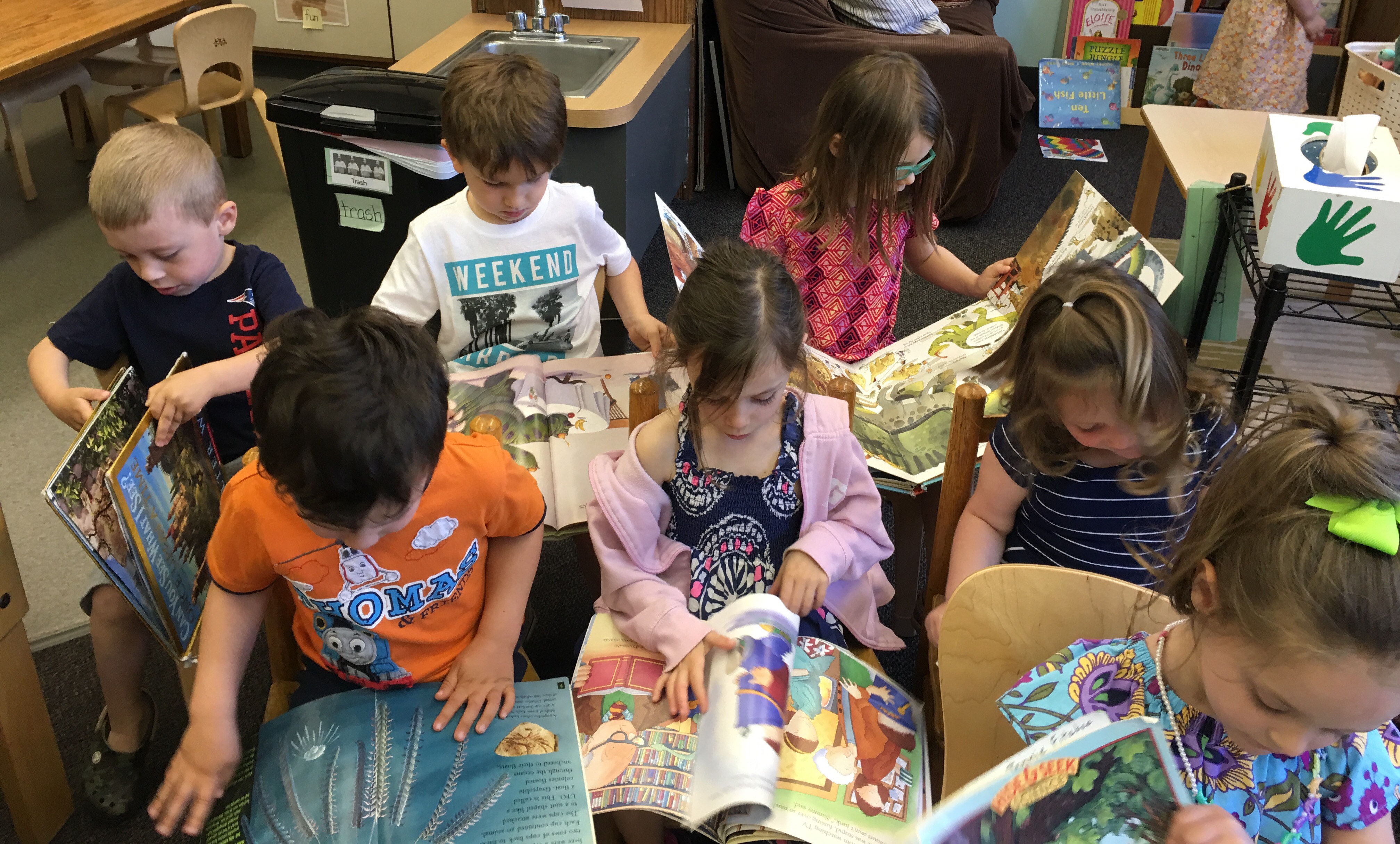
My classroom is brimming with books.  They aren’t stuffed into a basket, they’re on a front-facing shelf.  I read aloud to children twice a day and chapter read for thirty minutes every day.  Children choose to get books from our bookshelf.  They take great pleasure in looking at the pictures, turning the pages, and pointing to the words.  Looking at a book is also my classroom transitional activity.  Children leave my class with a genuine love of books and reading.  They often return to visit, and when I ask what they remember?  Reading, of course!

Used by permission of the author, Jim Trelease, 2013, The Read-Aloud Handbook (Penguin).

Jennie

Posted in Teaching young children, Uncategorized | Tagged , , , , , , , , , , | 7 Comments

The Art Show, and How Books and Music Make the Difference

Eric Carle is a well renowned children’s book author and illustrator.  His museum in Amherst, MA  draws visitors from around the world.  The museum’s focus is on picture book art, because that’s what Eric Carle does, and he does it so well.

I went to the Eric Carle Museum yesterday;  another museum trip that left me soaring, coming away with far more than I expected.  The main exhibit was “Madeline at 75”, Ludwig Bemelman’s many illustrations of the Madeline books.  Standing three inches away from the original art of books that I have read thousands of times to children was humbling.  I could see every brush stroke, every pencil line, and even the texture of the paper.  I was frozen and consumed.  My husband had the look of, “Jennie, please do not cry or fall apart.  I would be mortified.”  I did not cry, and the next part of the museum took a remarkable turn.

In order to understand, I need to back up and tell you about the ‘Art Show’.

Each year my class creates an Art Show for the entire community displayed at the post office.  Yes, just my class of preschoolers, not the entire school.  It has become monumental in its value to the children and all the people who come to see it.  When this show first started, we were studying France, and learned about the Impressionists (and so much more).  That led to a school wide display, which was so remarkable that it was displayed for the community.  Every year it grows in accolades and viewers.  The guest book is jam packed with comments.  Why is this Art Show consistently so successful and different?

I introduce children to all types of art.  Good teachers do this.  We learn that each piece of art is a masterpiece.  But, I stop with each piece to say, “Chloe, you could do this.”, and talk about it.  Piece after piece, I make it personal to a child.  It doesn’t matter the type of art nor the child; bringing art into a real world for children is opening a door.  I’m saying to them, “You can do this.”  And they do.

We use real water color paints from tubes onto pallets.  Children learn how to mix and use paints.  They replicate brush strokes and colors.  Art isn’t created in a day, so children return to their piece over and over until they like it.  We always refer to their art as a masterpiece, because it is.  They are empowered.

The final element is children naming their work of art.  All famous artists gave their paintings a title, and so should the children.  This is perhaps the most powerful part of making art.  I never underestimate the creativity and deep feelings of young children.  Many titles have left me speechless.  I stand back and nod at weeks of hard work and interest.  Giving a work of of art a title is like hitting a home run in the bottom of the ninth with the bases loaded.  Powerful stuff for children.

Then, they get to see their masterpieces on display.  This experience is beyond words.

Back to the Eric Carle Museum, and ‘what happened next’.  The new Caldecott winners for children’s books have been announced.  I had my eye on The Noisy Paintbox: The Colors and Sounds of Kandinsky’s Abstract Art.  I often use music to inspire art.  Vivaldi’s ‘Four Seasons’ has been a favorite.  I found the book at the museum bookstore, but I found much more at the museum’s exhibit of the life of Eric Carle.  He returned to Germany in 1936, and in 1939 his art teacher showed him ‘forbidden art’, the works of Matisse, Picasso… and Kandinsky.  I thought I would jump out of my skin!  Here is the painter and the book I’m looking for, and he was one of the ‘forbidden artists’ who inspired Eric Carle.

I love museums.  Learning and discovery never ends.  Now, I am fueled up to inspire my classroom as we begin to create art and prepare for the Art Show.  Kandinsky and The Noisy Paintbox will be a great introduction.  We’ll listen to classical music, watch a symphony on the iPad, and learn about instruments.  Did you know that Kandinsky named his pieces of art after music?

Books, music, and art are all intertwined.  Each one inspires the other.  Individually they are beautiful.  Collectively they make a big impression and a powerful difference in the lives of young children.  I see this and teach this.

Jennie

Posted in Teaching young children, Uncategorized | Tagged , , , , , , , , , , , , | 7 Comments

Quilting Art With Children: Milly Part II

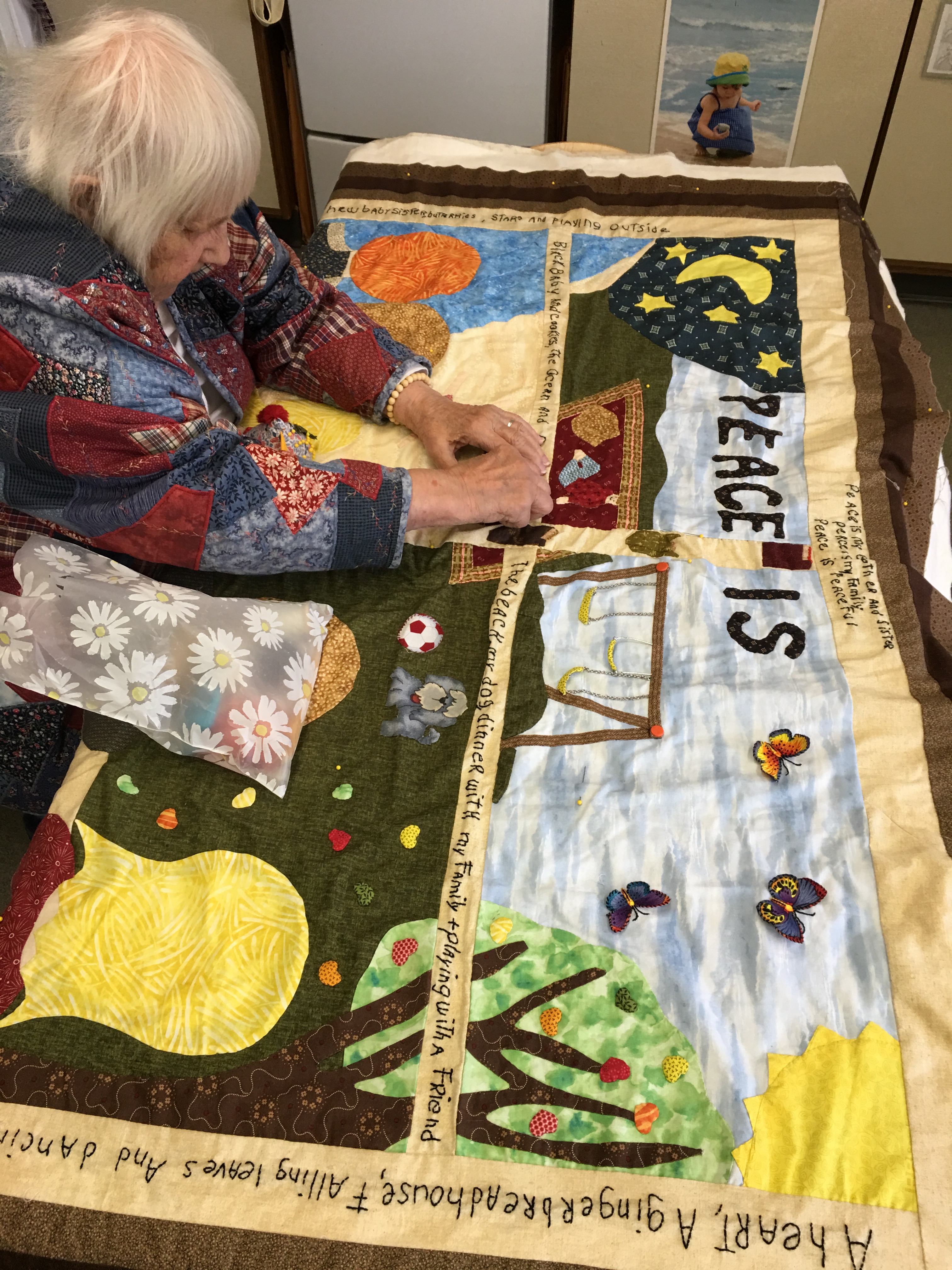
This is the story of children, a quilter, and how they connected ideas to create art that hangs in national museums.  The first story (prior post) depicts the evolution of the Peace Quilt, and this story is the next chapter.  Milly is the master quilter.  All her work and stitching is done by hand.  She is a founding figure in the New England quilting community.  When she came into my classroom, magic happened.

The story continues, as the beautiful Peace Quilt was delivered to the National Liberty Museum in historic Philadelphia in the spring.  It is a permanent display.   Six children and their families, along with friends, relatives, and of course Milly, made the trip from New England to Philadelphia.  What a welcoming reception we received.

peacequiltbenmus

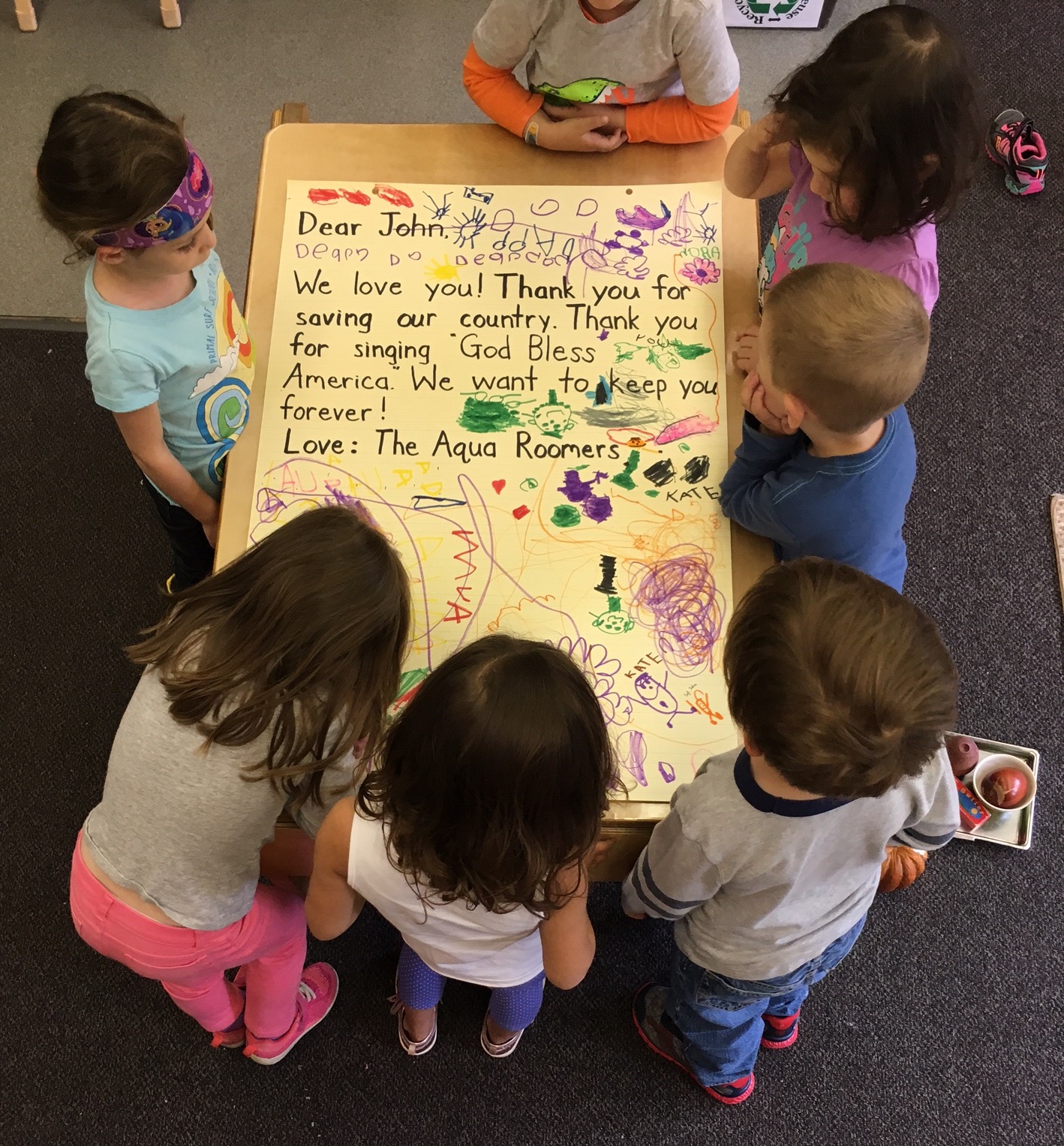
The following school year things began as usual.  Milly was now part of our class, visiting and playing with the children.  She and ‘Gloria’ bonded, to the point of trading their favorite necklaces.  Milly was often ‘Helper of the Day’, learned our calendar and weather song, and thoroughly enjoyed singing with the children.  Patriotic songs were her favorites and she gave the class a pop-up book of the song “America the Beautiful”.  We often sang “God Bless America” with Milly.  That’s where things started to change.

Children enjoy singing all types of songs and listening to a variety of music.  In my classroom, I introduce everything from Vivaldi, to show tunes, to the Beatles and in between.  We listen, sing, dance, and move.  I play a number of songs on the autoharp, including “God Bless America”.  The song quickly became a favorite!  By October many children were spontaneously singing the song in the classroom.  They began to stage themselves along the edge of the sandbox on the playground in order to sing for other classes.  Now I stepped back, watching something remarkable beginning to happen.

Children could not get enough of this song!  I had to do something.  As a proponent of emergent curriculum, I knew this was ‘a moment’,  an opportunity to bring the children into a greater learning experience.  In November we invited soldiers into the classroom for a Veteran’s Day ‘thank you’ and a chance for the children to really showcase this song.  It was successful and heartfelt, yet I knew it wasn’t enough to satisfy what the children needed.  In December we made our own classroom God Bless America book with children working together to make all the illustrations and write the words.  To this day it is my favorite classroom book.  In the words of a soldier, “Jennie, you should donate the book to the Wounded Warrior Project.”  Again, I had the strong sense that the children wanted and needed more.  This song still had a bigger job to do.

IMG_0211IMG_0210

In January Milly and the children planned a quilt, a ‘God Bless America’ quilt.  Together they studied every every word and drawing in our classroom book.  Then came the task of putting the ideas onto a big drawing.  We rolled out the butcher paper onto the floor and children decided how to illustrate mountains, prairies, home sweet home, and all the elements in the song.  It was a transformation of months of learning and work.  As the drawing came to life, I watched the children ‘find their way’, as if what they had been searching for was right in front of them at last.  Over the next few months, Milly worked her magic with the children, as she always does.  She helped them select and place all the different fabrics for the quilt.  As they watched her sew, they witnessed the remarkable evolution of a song becoming a work of art.  That’s exactly what they needed.  I knew it.

IMG_0209

The finished quilt was first displayed at our local post office for the whole community to enjoy.  Next, it traveled to New York City as a guest on the Intrepid Museum.  That was both thrilling and humbling.  Many children and their families attended, and Milly was the honored guest.  The final trip was to the Fisher House in Boston where it hangs as the focal point for families of wounded soldiers.  It was the staff at the Intrepid Museum who urged us to donate the quilt to the Fisher House.  What a fitting place of honor for the God Bless America quilt.  That summer, the quilt, children, and Milly welcomed the Fisher Foundation to Boston.  Yes, we sang “God Bless America” standing in front of the quilt to a packed house.  Milly received a command coin and a standing ovation.

Jennie

Posted in Teaching young children, Uncategorized | Tagged , , , , , , , , , , , | 3 Comments

Quilting Art With Children: The Story of Milly

I love museums.  They always inspire me, personally and professionally.  I also firmly believe in emergent curriculum in my teaching of young children.  It works!  The two together often ignite learning that transcends over months, and in some cases years.  That is exactly what happened when I visited the Bennington Museum in Vermont some years ago.  I wanted to see the Grandma Moses collection, as her art had been introduced to me by my grandmother, Nan, and was part of fond memories in my childhood.  The featured exhibit at the museum was a collection of Haitian quilts.  I was thunderstruck.  Never had I seen quilts that were such works of art.  These were magnificent murals with beautiful colors and intricate, unusual designs.  I simply stood and stared, unable to absorb all that was in front of me.

My husband said, “Jennie, I know that look”.  Yes, it was the look of ‘this is it’, and ‘I can do this with the children’.  We breezed through the Grandma Moses collection, as I was consumed with a hundred ideas about the quilts, particularly an idea about peace.  My classroom had created a Peace Portal the year before, just like the one that greets visitors in the foyer of the National Liberty Museum in Philadelphia.  Now, that was an exciting project.  Even though we had written poetry and made our own book about peace, I never felt as though the children had fully realized everything, as if I had left things undone.  Creating a Peace Quilt would be a grand way to learn more and do more.  I just knew.

On the way home my husband said, “Jennie, do you really think the children can create a quilt?  If you’re right, then it should hang in a museum”.  Well, that was a lofty thought.  Back at school I dove right into the project.  We read our Peace Poetry Book, drew pictures, painted peaceful art while listening to music, and finally talked about what peace looks like.  That is a difficult concept for young children to visualize, and it would have been much easier to prompt or suggest things, but I was determined to make this experience a true one for the children.  I took the hard route, and it worked.  Their ideas were lump-in-the-throat thoughts, straight from the heart; leaves falling from a tree, a tractor, the cow jumping over the moon, baby chicks, triangles.

Next, I needed a quilter.  Enter Milly, an eighty-something year old master quilter.  Our first meeting did not go so well.  I bounded into her quilting group, full of energy and ideas, and pictures of the Haitian quilts.  She listened to the whole story, barely saying a word, as her fellow quilters kept their heads bowed as if they knew I was trying to fit a round peg into a square hole.  At last Milly said, “I’m a traditional quilter and I’ve never quilted like that before.  This will be something new.  I’d like to do it.”  Whew!

At school we had to put our ideas onto paper.  That was fun!  We rolled out the butcher paper onto the floor and the teacher sketched out all the elements, making plenty of changes that children wanted.  Not only did the children make sure that everything was there, they designed the entire placement.  This took all morning.  Over the next few days children colored the big drawing, which reinforced their ideas of peace and how they should be represented on a quilt.

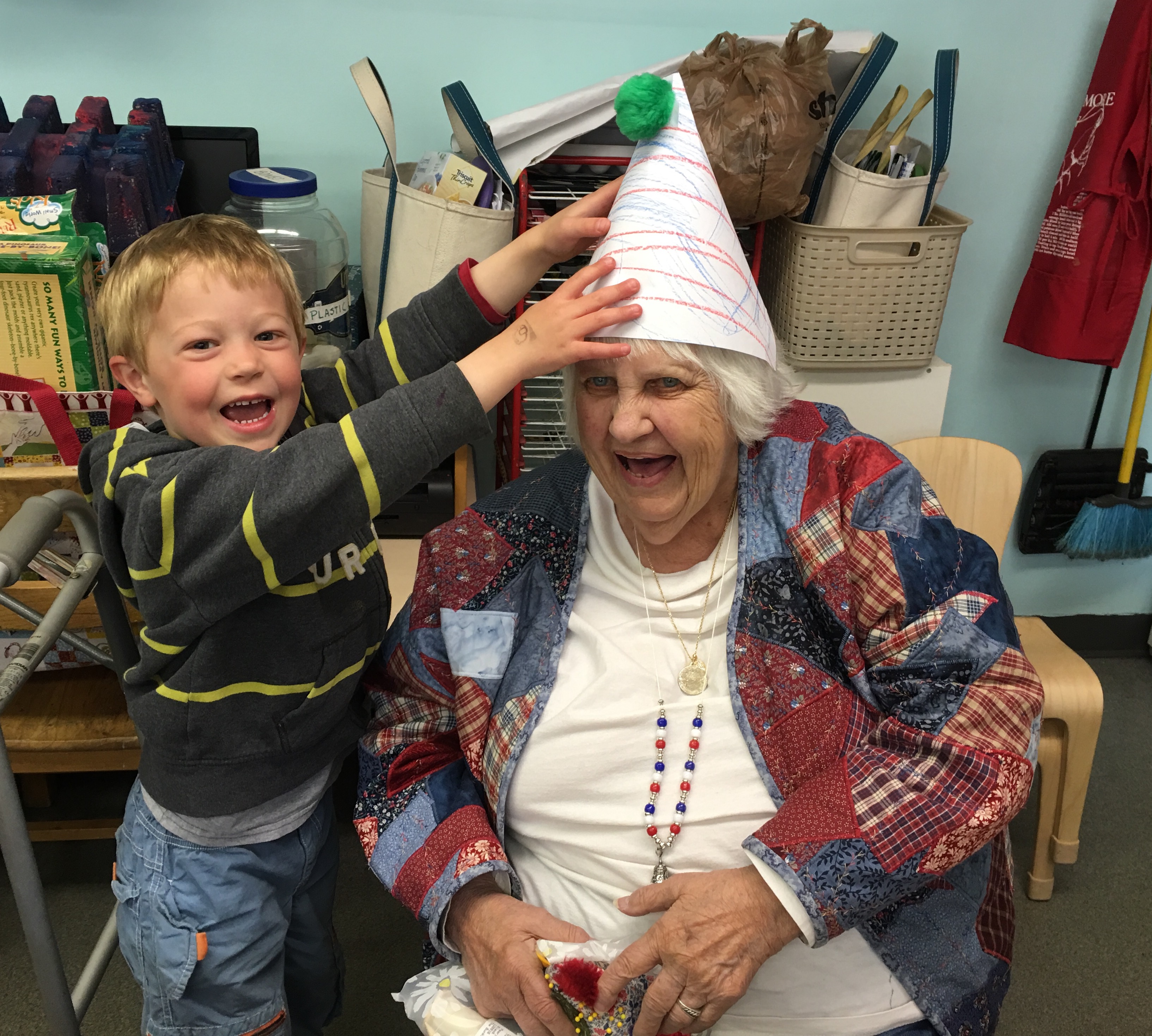
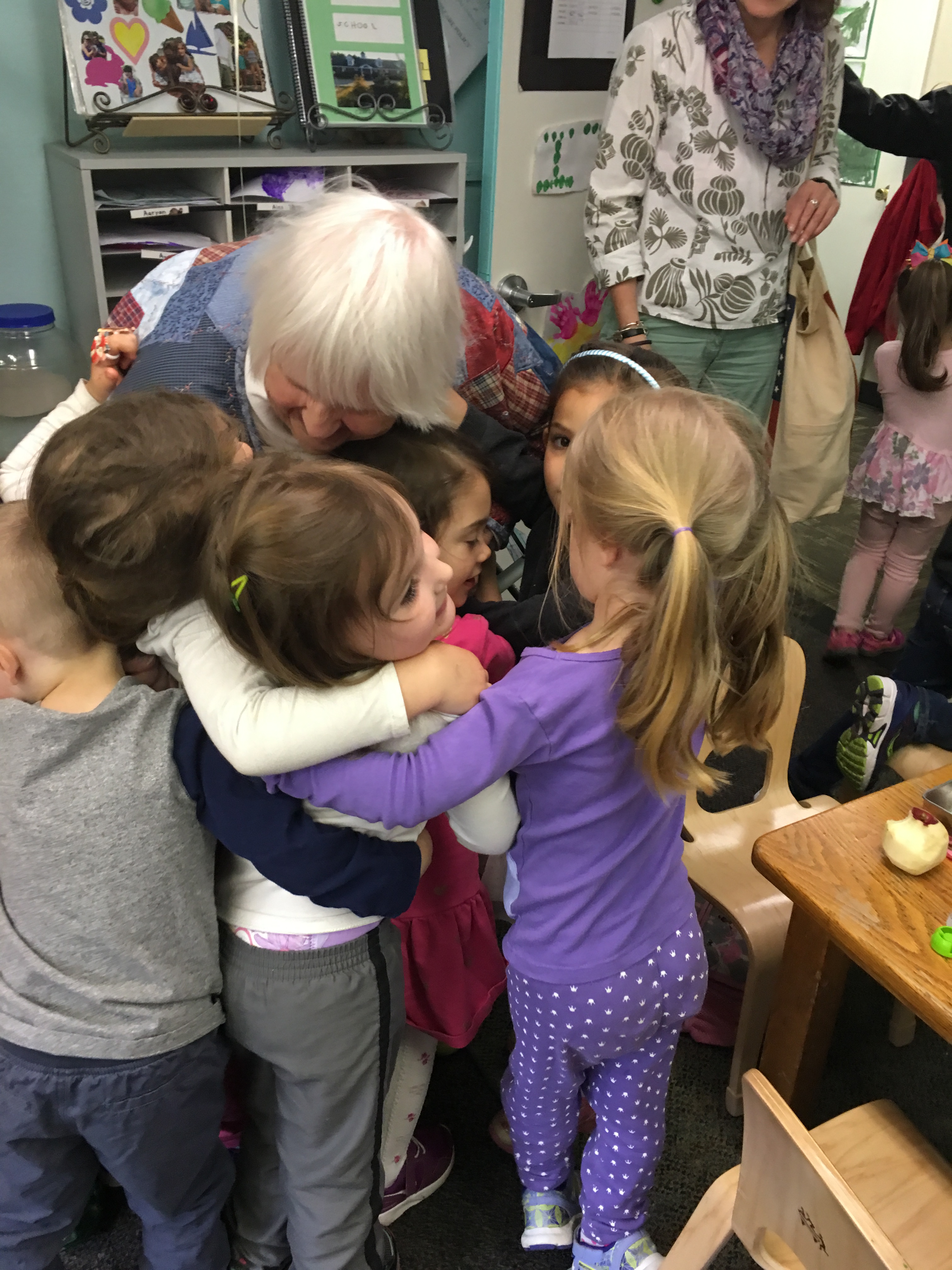
The next week Milly came into the classroom to meet the children and meet ‘Gloria’ (who had to show Milly her very own quilt).  Milly began to work with the children on fabrics from her massive collection, letting them select each different piece.  As the days and weeks went by, she sewed in front of the children.  It was wonderful to watch children come and go with Milly, developing a strong relationship.  Sometimes a child would just go over to give her a big hug.  Sometimes a child would watch her fingers as she sewed the quilt and ask her questions.  Either way, it felt good!

Months later the quilt was finished.  This was art!  It was beautiful.  It embodied the ideas of the children, stitch by stitch, with the loving hands of Milly.  Emergent curriculum allowed the process of seeing the Haitian quilts at the museum evolve into a masterpiece.  And, the lofty thought of the quilt hanging in a museum?  It does.

More next time, as this was just the beginning of quilting art, and a wonderful relationship with Milly that continues to this day.

Jennie

Posted in Uncategorized | Tagged , , , , , , , , , | 4 Comments

The New Year’s Gift

Today I received a gift for the New Year, and it was not at all what I expected.  I thought I knew pretty much everything about giving, yet I never expected to have the tables turned, where I would be the recipient.  “It Happened Like This…”

Today I visited a family whose children I taught a few years ago.  I love those children!  I have to say that because it is true.  Writing those words makes my heart pound.  Teachers love their children.  Over the past year the father has become very ill (yes, cancer), so keeping in touch with the family has been important.  And, my school has done a remarkable job at this.  I have visited twice before today, and those visits were so much fun, playing with the children.  Today was different, and not what I expected.

I played a Romanian version of ‘Sorry’ with the children.  It was intense; rolling the dice became a ritual.  Jennie: “Six, six, six” and the children chanting “No six, no six”.  It was loud with lots of belly laughing.  At one point, one of the children chanted the number she wanted me to roll, and it worked three times!  That brought the house down.

We talked about what they remembered in my class (reading and music) and making a quilt with Milly (which hangs at the Fisher House in Boston).  Then, the children talked about what they wanted on my next visit: the autoharp, reading Pinkalicious, and pictures of quilting with Milly.  I’m on it!

The oldest child made a bracelet for me, with jewels and tape.  It is a treasure, and I told her, “I will wear this on Monday, Tuesday, Wednesday, Thursday, and Friday”.  She beamed.  What she doesn’t know is that I will, indeed, do this.  The gift isn’t about my visit today.  It’s about ‘The Hundred Little Things’.  The littlest moments, those that make you feel good inside but otherwise may seem unimportant, are really big; they’re building blocks for life.  It takes a hundred little things to manifest itself as a big thing, or I should say an important thing. The bracelet is a ‘big thing’ because it was a labor of love, which could only have happened after a hundred little things.

When I left, the children were so full, and so were the adults.  The children just couldn’t get enough of playing with Jennie.  The grandmothers just couldn’t let go.  It didn’t matter that they couldn’t speak English; we communicated.  Smiles, nods, and hugs are universal.  I understood all of this when they didn’t let go.  Lucky me.

I came away from a day of giving to a day of ‘getting’.  I got so much from the children, and the grandparents.  Today was my New Year’s gift.

Jennie

IMG_0160.JPG Romana

Posted in Uncategorized | Tagged , , , , , , | 2 Comments

The Power of Books; You Have to Read It to ‘Get It’

The best part of my day as a teacher, and the most important part, is reading aloud to children.  I read picture books at least twice a day and a chapter book every day.  I always become moved and emotionally charged when I read aloud.

Let me tell you, I teach the core of all that’s really important through reading aloud.  Remember Robert Fulghum’s book,  All I Really Need to Know I Learned in Kindergarten?  My classroom reading reflects those same principals, and more.  All that my students need to know they learn through my read-aloud.  The things that matter the most are often the little things, and those little things are the building blocks for big things.  They are also the foundation of really good books.  The thread of what is important is woven into the best fiction.  And, a good book = pleasure + learning.   In the words of Eric Hoffer, “The central task of education is to implant a will and facility for learning; it should produce not learned but learning people.  The truly human society is a learning society, where grandparents, parents, and children are students together”.

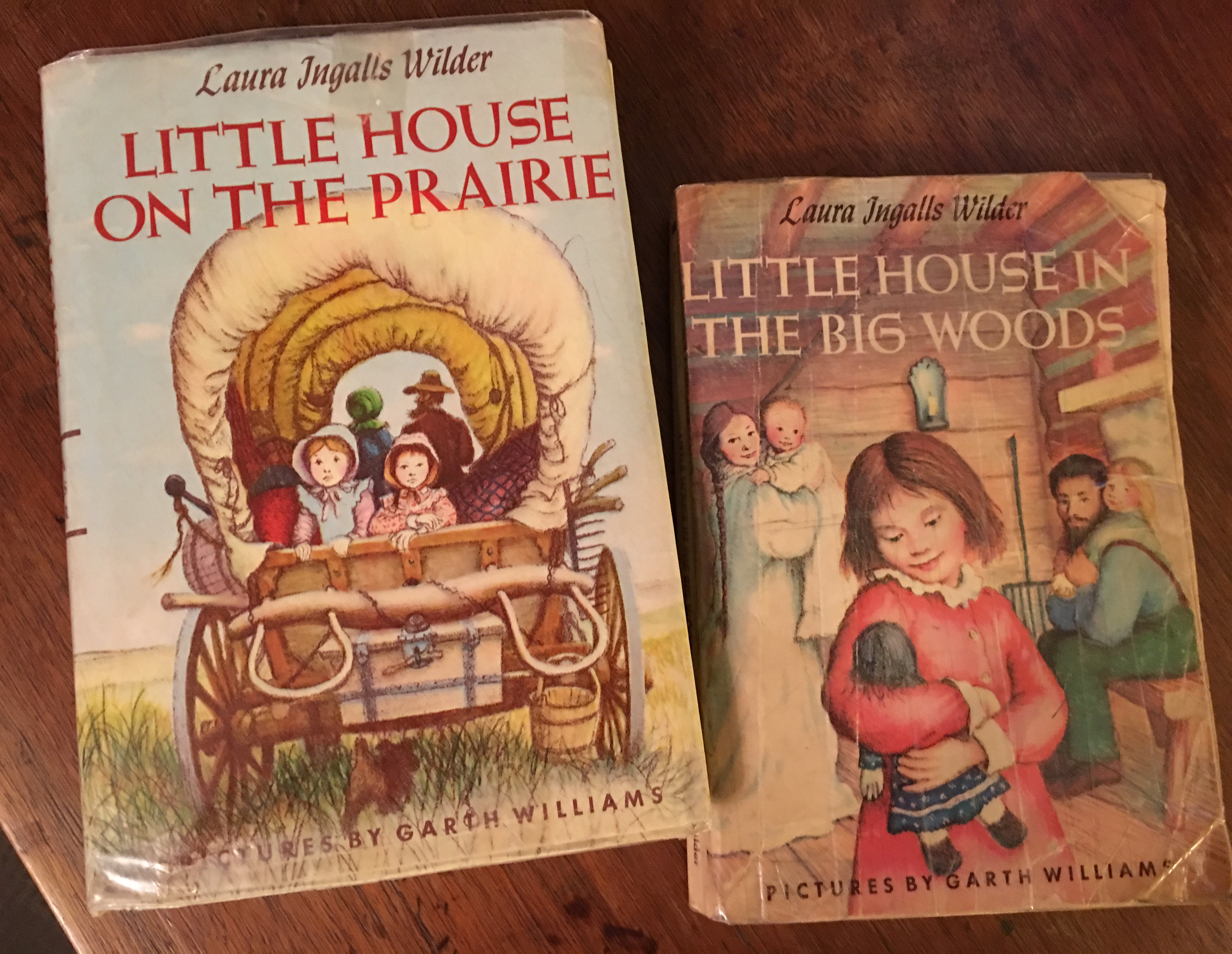
The pleasure of reading never gets old.  Every time I read aloud I have a captive audience.  We often stop, because ‘something’ has happened and we need to talk about that.  “Jennie, are Indians bad?” (from Little House on the Prairie), or “What is a freezing plant?” (from Mr. Popper’s Penguins) are typical questions.  These moments are just as exciting as the book, and an opportunity to teach math, art, or science, as well as goodness!  Together we are shaping the value system and discovering something new.  A good book = pleasure + learning, every time.

I love discovering a new book, and I just found A House in the Woods, by Inga Moore.  It is the perfect picture book, with illustrations that bring the story to life.  I have read this book at least a dozen times, and lovingly admired the illustrations (the moose has stolen my heart).  Here is what Jim Trelease says about this book in The Read-Aloud Handbook, a million copy best seller that includes all the best books:  “If there were a single book that could embody pure happiness, it would this volume.  There is no great plot here – just a group of woodland animals sharing the work of building a warm house in the woods.  No calamities to overcome, no bickering, no tears; just working, sharing, creating, and peanut butter sandwiches as reward.  And how does this add up to to one of the most comforting and beautifully illustrated bedtime stories ever written?  Read it and see.”

Used by permission of the author, Jim Trelease, 2013, The Read-Aloud Handbook (Penguin).

I think he is spot on.  His best selling book is a Pandora’s Box for teachers, parents, and grandparents.  Really.

I will always champion for reading aloud, because it works as the core of learning.

Jennie

Posted in Teaching young children, Uncategorized | Tagged , , , , , , , , , , | 6 Comments

“Starry Night”

Major pieces of art?  Masterpieces?  Introducing this to preschoolers?  It is not easy to explain to people how and why art can make a difference with young children.  A picture is worth a thousand words, and this picture was just sent to me.

IMG_1024.JPG Juliet and 'Starry Night'

Juliet the fourth grader is beaming at seeing Starry Night by Vincent van Gogh at the Museum of Modern Art in New York.  I have a story to tell.  It’s about teaching art in many ways, and about Juliet’s pathway to art.  As I say in my classroom, “It Happened Like This”…

When Juliet was a three-year-old in my class, she was thoughtful.  She played, loved stories and books, developed friendships, and drew pictures.  The next year things changed, or perhaps she just grew in her interests.  She drew pictures all the time, perfecting people figures and experimenting with color.  Children’s art adorns the classroom walls with the exception of a Starry Night poster, yet Juliet did not seem to focus on that piece of art.  Well, that’s what I thought.

And then Juliet met Milly, the master quilter.  Milly joined our class to quilt a magnificent Peace Quilt (which is now a permanent display at the National Liberty Museum in Philadelphia).  In the process of designing and creating the quilt, Juliet was a captive audience.  Making this quilt was a big deal, from sketching all the parts to selecting fabrics for each element.  She drew an exact replica of the quilt, which is my blog photo, down to every triangle in precise direction and color.

In the spring we studied France and the old masters, in preparation for our annual Art Show displayed for the entire community.  Juliet was in her element.  She was struck by Starry Night and using real paints from tubes on pallets.  She practiced brush strokes and mixing colors.  She loved simply looking at art, especially Usborne’s Children’s Book of Art.  As we worked on perfecting our pieces of art, we often played classical music.  Vivaldi’s Four Seasons became a favorite, and children would often ask for a specific piece.  “What would you like to hear today?  Winter, Spring , Summer or Fall?”, I’d ask.  Music and art go hand-in-hand.  Together, the results are impressive.  For our Art Show, Juliet drew the Mona Lisa.  It was the central piece in our exhibit.

When Juliet moved on to kindergarten her art continued to flourish.  She visited my class periodically, once to show me a winning polar bear she had drawn.  When her little sister joined my class Juliet visited more often, frequently admiring our Starry Night poster.  Now as a fourth grader, her trip to New York to see the beloved painting seems to be the pinnacle of the journey she started as a preschooler.  Perhaps, though, it is only the beginning for her.

Art makes a difference.

Jennie

Posted in Uncategorized | Tagged , , , , , , , , , , , | 6 Comments