Mason and the Rainbow Song

Yesterday I filled-in at my school’s summer camp.  When I arrived at noon, children were at lunch.  After all the hugs and hollers, they begged for a ‘Jennie Story’, especially Mason. Interestingly, Mason has never been in my class. He was a kindergartner this past year. Like many children, he has heard my Jennie Stories through the school grapevine.

Later in the day, I was in the bathroom with Mason as he changed out of his wet bathing suit.  Bear in mind that the mind of a child is far more brilliant and fascinating than we realize.  The recall of a moment or a story or a song can be spontaneous.  And that’s exactly what happened in the bathroom with Mason.

The conversation went something like this:

“Jennie, I wish we could sing the rainbow song at camp.”

“What is the rainbow song?  Can you sing some of it for me?”

“Okay.”

Then Mason sang a few words, “Red and yellow and…”

“Mason, I know that song!  I love that song.  You sang it at your kindergarten graduation.  I remember.  Can you sing it again for me?”

“Yes!”

Mason puffed up his chest with pride.  Yet, he had a somewhat worried look.  I could tell he was missing kindergarten and this song, and he wanted to be able to sing it to me.

“Mason, can I sing along with you?”

He smiled and nodded at the same time.

Together we sang “I Can Sing a Rainbow.”  It was joyous.  Mason was terrible. I was worse. We barely remembered the words.  But, that didn’t matter at all. Mason needed to sing and remember, and I was lucky to tag along and be there for him.

After singing, we smiled and headed out to the playground.  Mason stopped.

“I love you, Jennie.”

“I love you, too, Mason.”

And that was that.  Five minutes in the bathroom can be the best teaching, and an even better giving.

Jennie
Posted in Early Education, Expressing words and feelings, Inspiration, joy, self esteem, Singing, summer camp, Teaching young children, wonder | Tagged , , , , , , | 69 Comments

When Teachers Tell Their Stories – Part 2


In Part 1, I talked about storytelling, true stories, “It happened like this” stories.  I had always read aloud to children, but telling them my stories was different.  It turned out that I had discovered another pathway to language and literacy, with a bonus of children bonding with their teacher.  Children then began to tell their own stories as well.  This was big!

Part 2
Storytelling is important to young children because oral language is the key to reading readiness.  It’s also a key to academic success.  Think about it; in early elementary school the primary source of instruction is oral.  At school, I tell stories every day at lunchtime.  They are true stories from my childhood and adulthood.  Everyone knows “Jennie stories”.  Decades after children leave my class, they still remember those stories.  Over the summer, I thought I would share some of those with you, and perhaps encourage you to tell your own stories.  Yes, it matters.  This is the first story I told to children:

The Peanut Man Story

It happened like this.”  When I was in first and second and third grade, there was a man who lived in my town, Dr. Tyler.  He was really old.  He was short, heavy, and he had white hair and a white beard.  Who do you think he looked like?  Yes, Santa Claus.  I thought he was the real Santa Claus.

But, Dr. Tyler was not Santa Claus.  He was a peanut farmer.  His peanut farm was quite big, and over the summer he grew plenty of peanuts.  I’ve never seen peanuts growing.  Have you?  In the fall, he picked them all.  He had hundreds and thousands of peanuts, all in shells.  Then one day he would come to school.  No one knew when he was coming.  The principal didn’t know.  The teacher didn’t know.  He would just show up.  We could hear footsteps in the hallway and the classroom door would burst open.

This is where I stand up, pretend I have a big sack over my back, open it up, and then begin to make grand movements of scooping up and throwing giant handfuls of peanuts.

There he stood, saying nothing, carrying a big sack of peanuts over his back.  Now he really looked like Santa Claus!  He dropped the heavy sack onto the floor and the teacher yelled, “It’s the Peanut Man.  Duck”.  Everybody dove under their desks.  Then he took his big hand, scooped a huge handful of peanuts, and threw them across the classroom, hard.  We covered our ears and closed our eyes.  He did this again and again, throwing peanuts everywhere.  It sounded like pelting rain.  The peanuts were hitting the desks, the chalkboard, the lights…everything in the classroom.  Suddenly the sound stopped.  Everything was empty.  We heard footsteps, and the door slamming shut.

The teacher said, “Boys and girls, the Peanut Man is gone.  You can come out now”.  Wow!  The whole room was covered with peanuts everywhere.  The floor was so full that you stepped on peanuts wherever you walked.  They were in the lights on the ceiling, too.  We spent the rest of the afternoon picking up all the peanuts, putting them on our desks in a big mound, cracking the shells, and eating them.”

Storytelling bonds teachers, parents and grandparents to their children, passes down interesting and funny stories, and creates memories.  It’s important!  My next few posts will be the favorites of children in my classroom, such as “The Bat Story” and “The Raccoon Story”.  Summertime fun for me to tell you my stories, and for you to read them.

Stay tuned for Part 3.

Jennie

Posted in Early Education, Expressing words and feelings, Imagination, Inspiration, preschool, storytelling, Teaching young children, wonder | Tagged , , , , , | 59 Comments

Happy Birthday, America

Happy Birthday, America.
This flag was flown over the Navy Memorial
in Washington DC.
Proud to be an American,
one nation, one people,
with freedoms I will never take for granted.

A70F9F29-2148-45A2-AA9E-D66F154DB3CB

Jennie

Posted in America, American flag, Expressing words and feelings, Giving thanks, patriotism | Tagged , , , , | 20 Comments

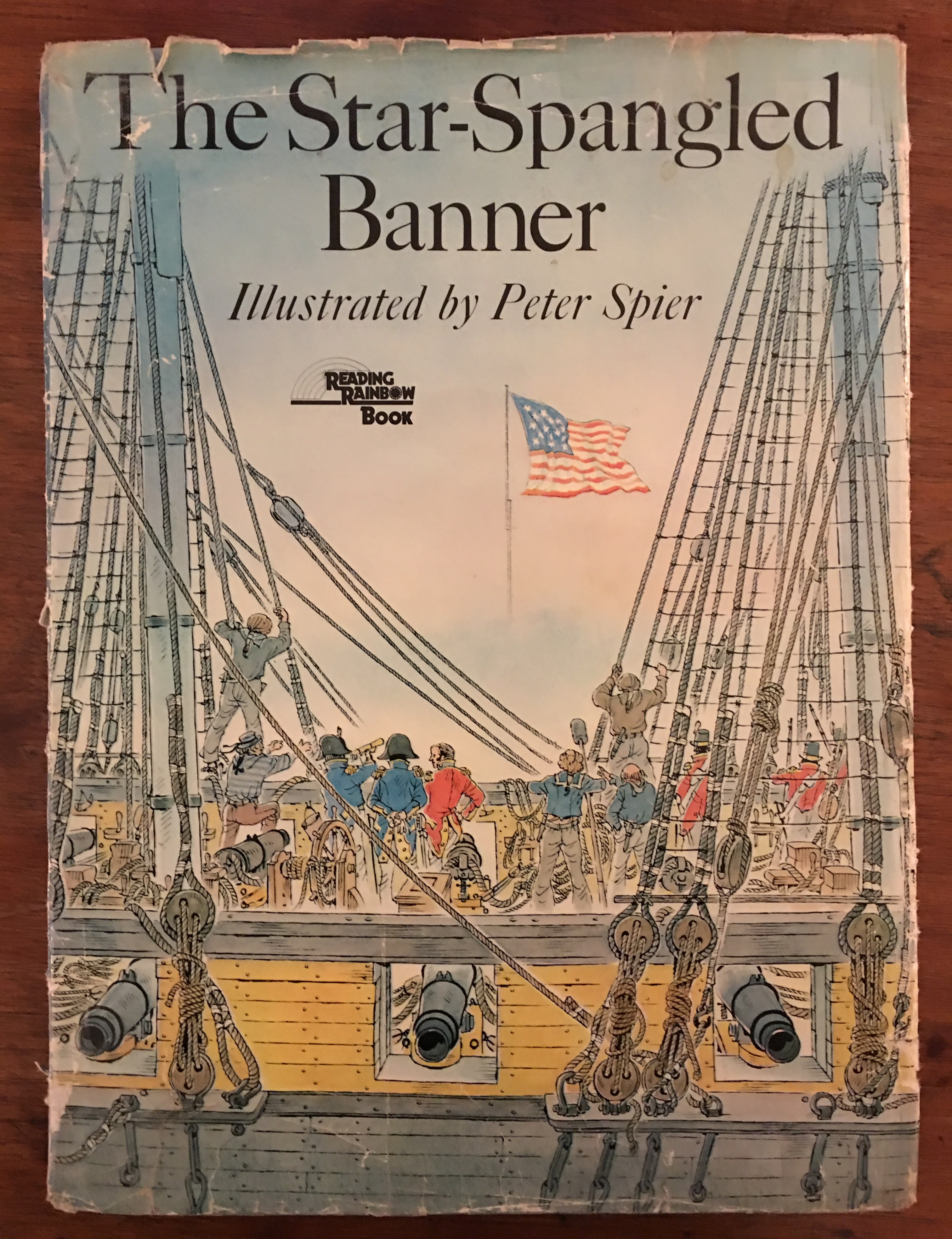
The Star-Spangled Banner

This is a repost,
one of my favorite songs and books, “The Star-Spangled Banner.”
Happy Birthday, America.

Bringing our National Anthem to Life

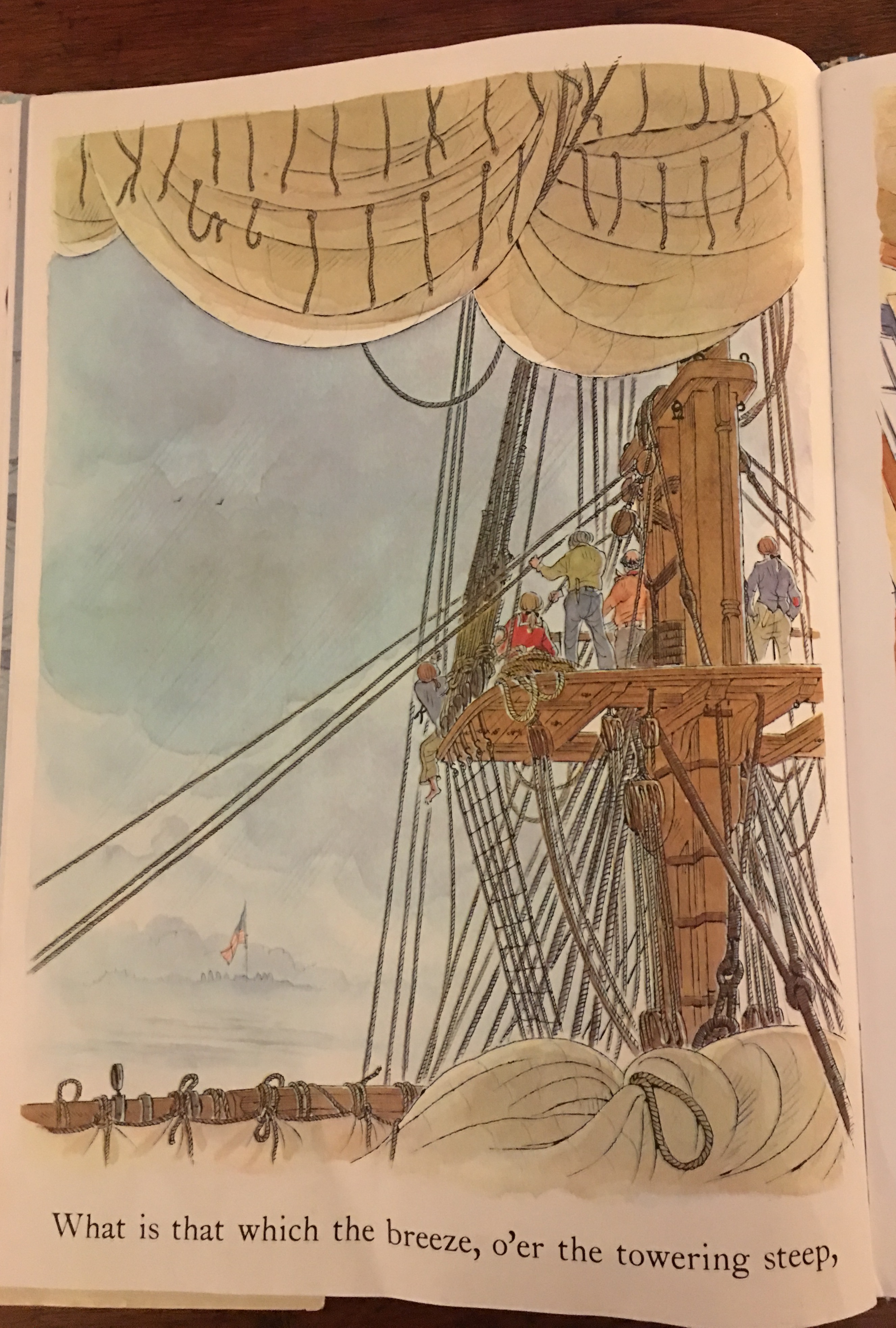
Few books have the power to move young students and make a difference; this one does. Whenever I sing our National Anthem with children, I pull out my well-loved and very worn book, The Star-Spangled Banner by Peter Spier.  Every page is a full color illustration of the words to the song.

img_1944This book makes my heart race!  Every single time I read or sing the book,  children are drawn in.  There is wonder, and there are more questions, and inevitably a crowd of children begin pushing in to see and hear, and to learn.

This is what I wrote to families on one such occasion. “It happened like this…”

“I want to tell you about early morning in the Big Room today.  It was one of the most exciting, intense, and passionate twenty minutes with children that a teacher can have.  Emergent Curriculum at it’s best.  As we say in the Aqua Room when a story is true, “It happened like this”:

Troy wanted to have a ‘show’, so he and Jill and Sam went to the top of the loft.  No, they did not want to sing Troy’s favorite song, “Proud To Be An American”.  They wanted to sing “The Star-Spangled Banner”.  Of course it was wonderful, and we all clapped.  Then I said, “Do you want to know what the song looks like and what really happened?”  I ran back to the Aqua Room (yes, I ran down the hallway and back…) and returned with Peter Spier’s book, The Star-Spangled Banner.  Before I opened the book I said, “The guy who wrote this song was on a British ship, and it was night time.  The only way he knew if we were winning was if he saw the American flag.”

By that time I had Troy, Jill, Sam, Jacob, Callie, Lily, Cooper, Lizzie, and Finn all around the book, captivated.  First I asked them what a star spangled banner was.  They knew!  Then we started to read the book.  The first page alone took forever, because we had to explain and talk about the funny hats and clothes, and the ship.  Children had been to Boston to see the Constitution.  Jill knew that ‘Old Ironsides’ meant that cannons and rockets didn’t penetrate the sides.  Once we looked at the first picture, we had to talk about how long ago this happened.  It was 1814.  Oh my, we just figured out that next year would be the two-hundredth anniversary of the song!  We planned an impromptu ceremony.

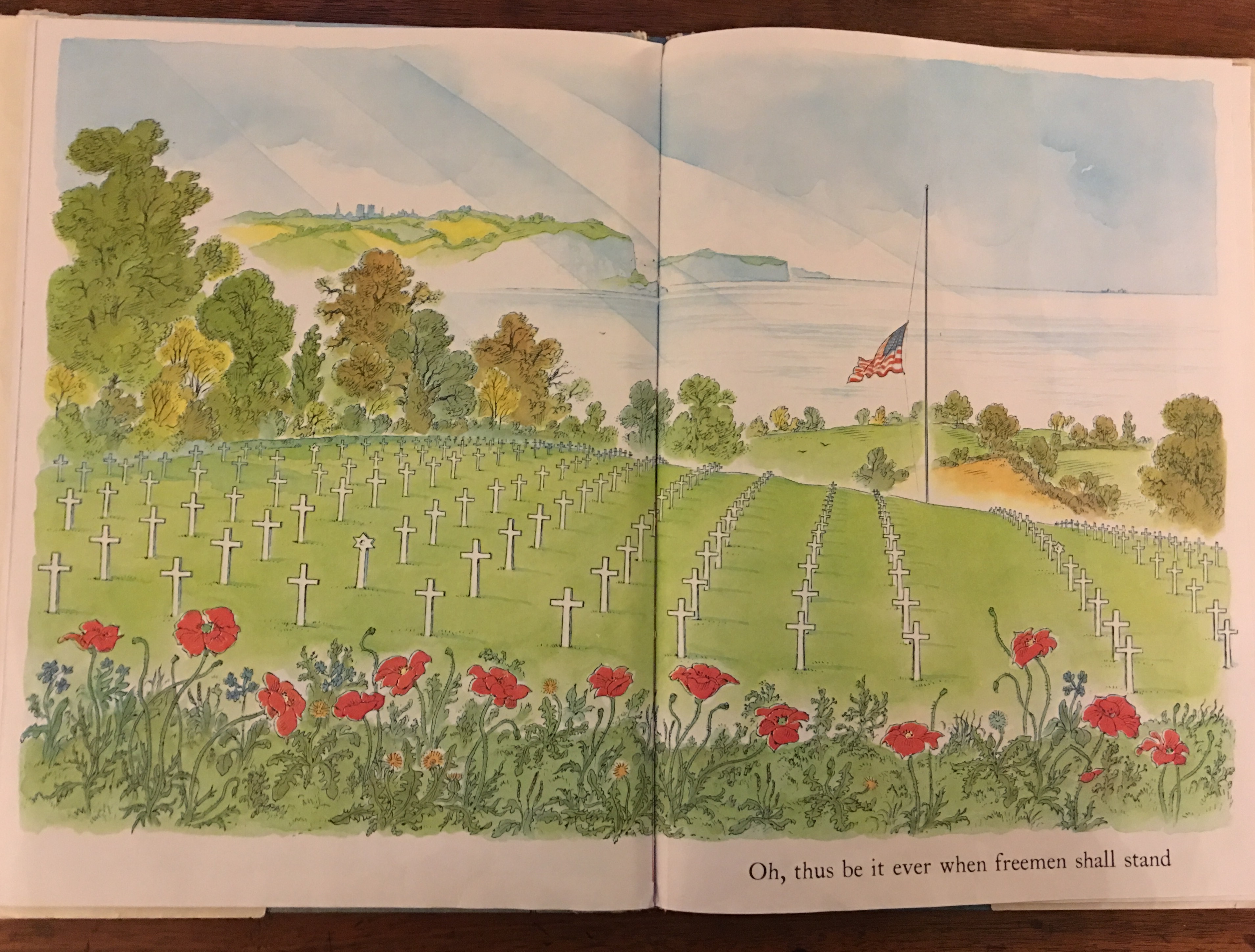
We were still on page one, and now a crowd of children came over to be there.  We started to read, but children wanted to ‘sing’ the book.  That was fun!  We found the flag on every page, through the battle.  Then, there were other things we found, like ramparts, and new vocabulary words, like ‘perilous’.  When the verse ended, the book went on.  Children were stunned to know that there were more words.  Those verses led us to learn why a flag is sometimes halfway down on the mast, and to the Statue of Liberty, the Statue of Iwo Jima, the astronauts on the moon, and different Navy ships at sea.

Honestly, the turn of each page drew more questions, and the discussions to find the answers were both intense and inspirational for the children.  Nobody interrupted, because everything was important.  It was a perfect experience.”

Do you know what a towering steep is?  The children figured it out:

img_1946When I get to this page, I stop.  I tell children this is a sad page, yet a proud page.  We talk about flying the flag at half mast, and about soldiers who have died for their country.  Children understand:

img_1945

Children can learn history, even at a young age.  This book proves that.  Thank you to Peter Spier who was born and educated in Amsterdam, and didn’t move to America until 1952 when he was an adult.  His book is a magic wand.

Jennie

Posted in America, American flag, Book Review, children's books, Early Education, history, Inspiration, patriotism, picture books, reading aloud, reading aloud, Singing, Teaching young children | Tagged , , , , , , , , , | 46 Comments

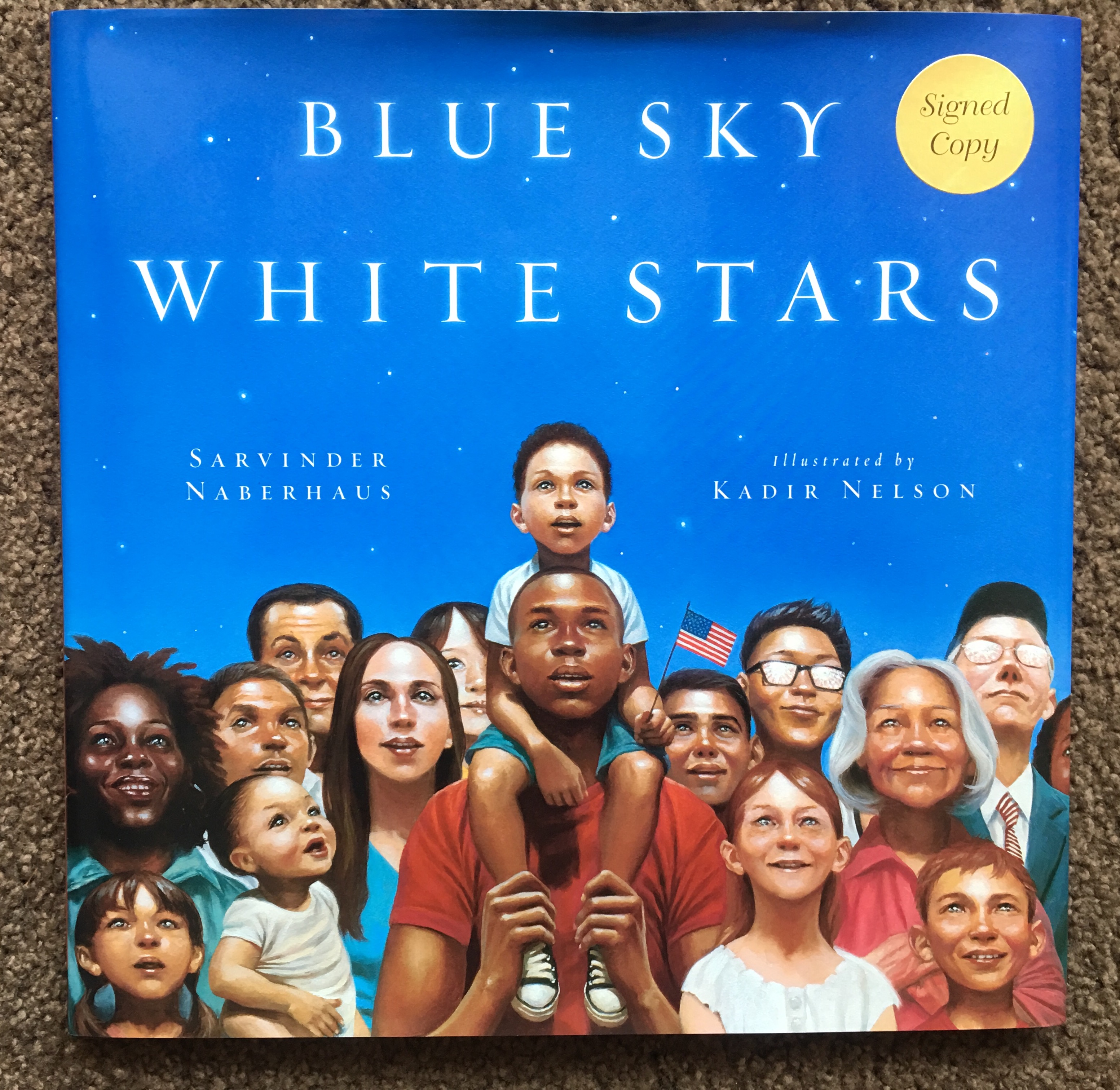
America – The True Meaning in a Children’s Book

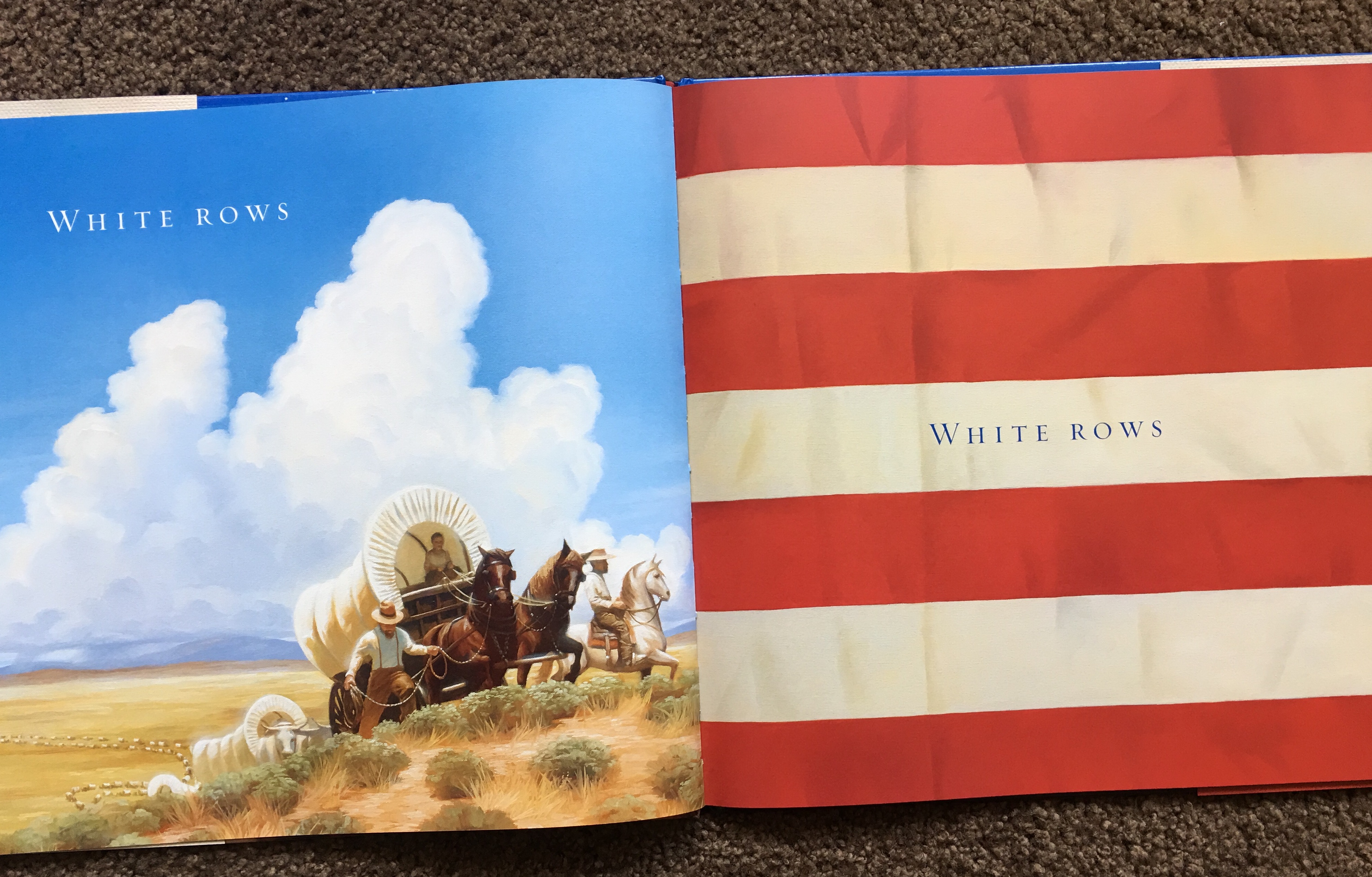
The perfect book.  Blue Sky White Stars by Sarvinder Naberhaus captures the heart of America.  The stunning illustrations by Kadir Nelson make the simple text explode with meaning.  It is history:

White Rows.  White Rows

When I turned to this page, I choked up.  Two words, and two important stories.  How can one not talk about the white rows of covered wagons traveling west?  It is a part of American history.  And, how can one not talk about the white rows on the American flag?  Purity and innocence.  It’s an open door to learn about the flag.  It is the heart of America:

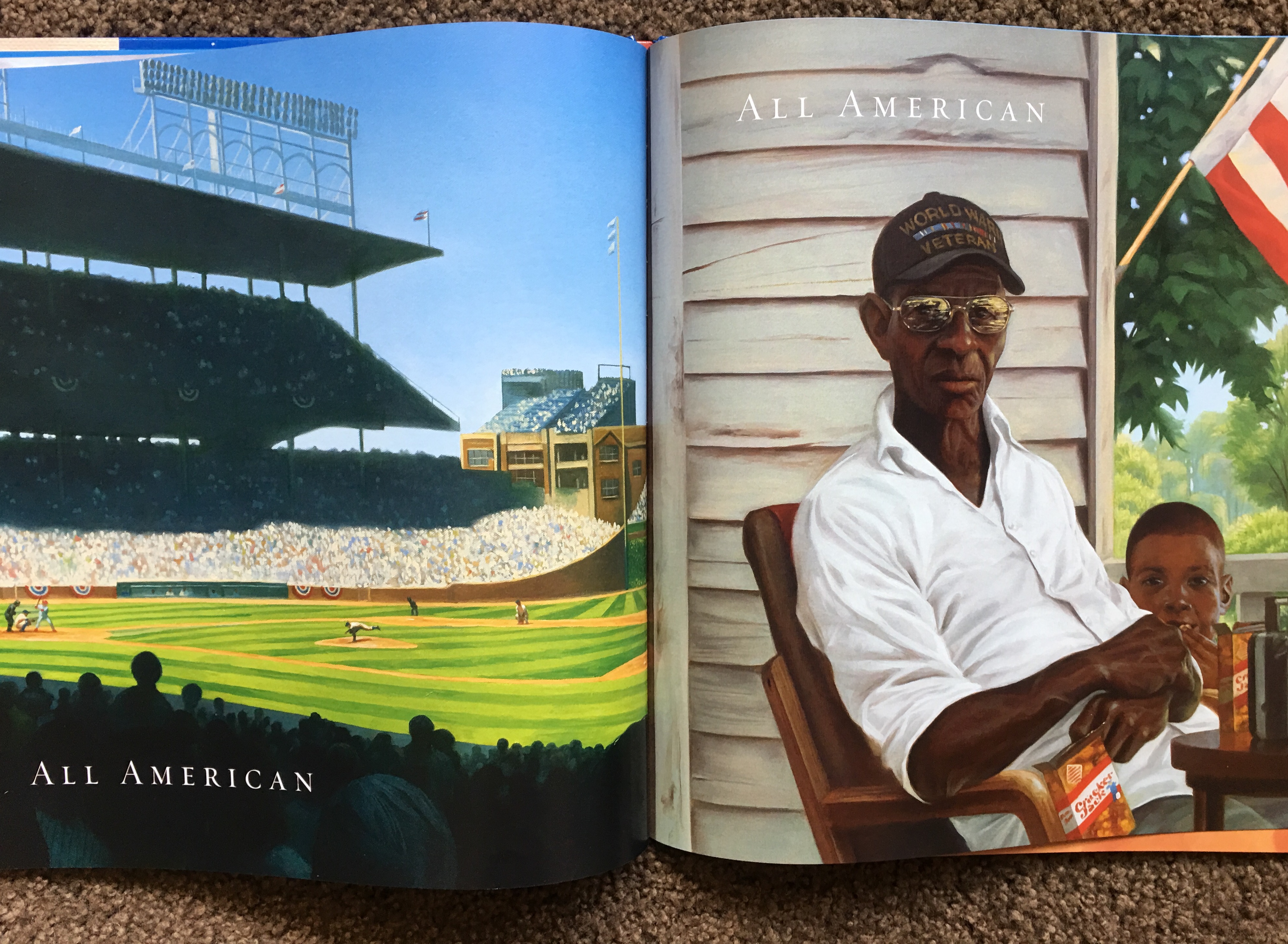
All American.  All American

Baseball, a veteran granddad with his grandson; this is “All American.”  In the words of the illustrator, “It beautifully draws parallels between the American landscape, the diversity of its people, and the symbolism stitched into the fabric.”

Yes, it does!  I like to think that the fabric encompasses far more than the flag; our foundation, our values, our community.  And, our big, wide, wonderful landscape:

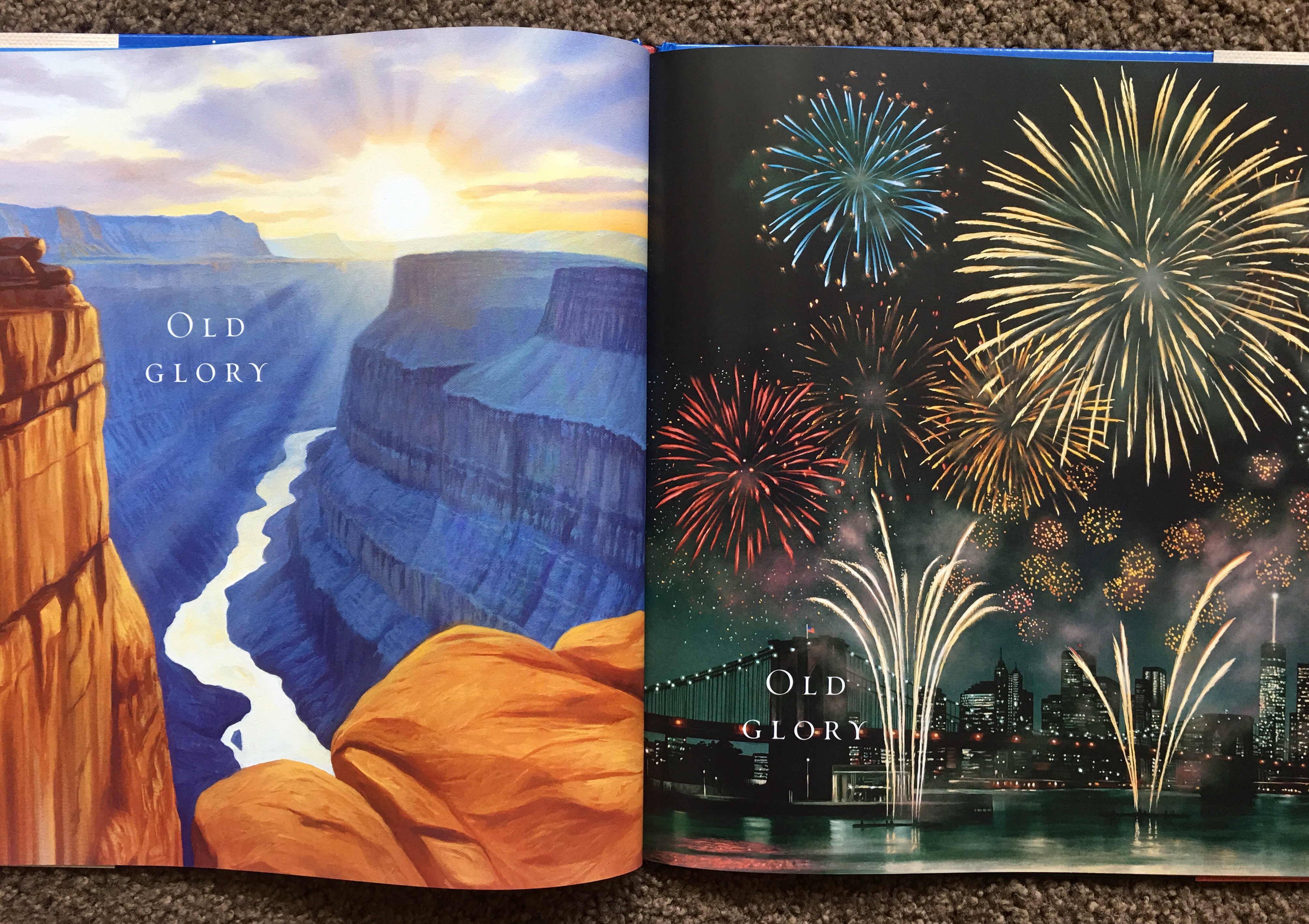
Old Glory.  Old Glory.

I hadn’t thought about the Grand Canyon as “Old Glory.”  Nor had I thought about fireworks as “Old Glory.”  As soon as I saw this page, I understood.  Those words are the nickname for the American flag, yet they are so much more.  You see, while the flag is a symbol of our country, so are many other things.  We are a nation of many people.  The author thought of the deep blue sky dotted with white stars that the early immigrants saw coming to America.  That was the inspiration for the book.  We are one nation:

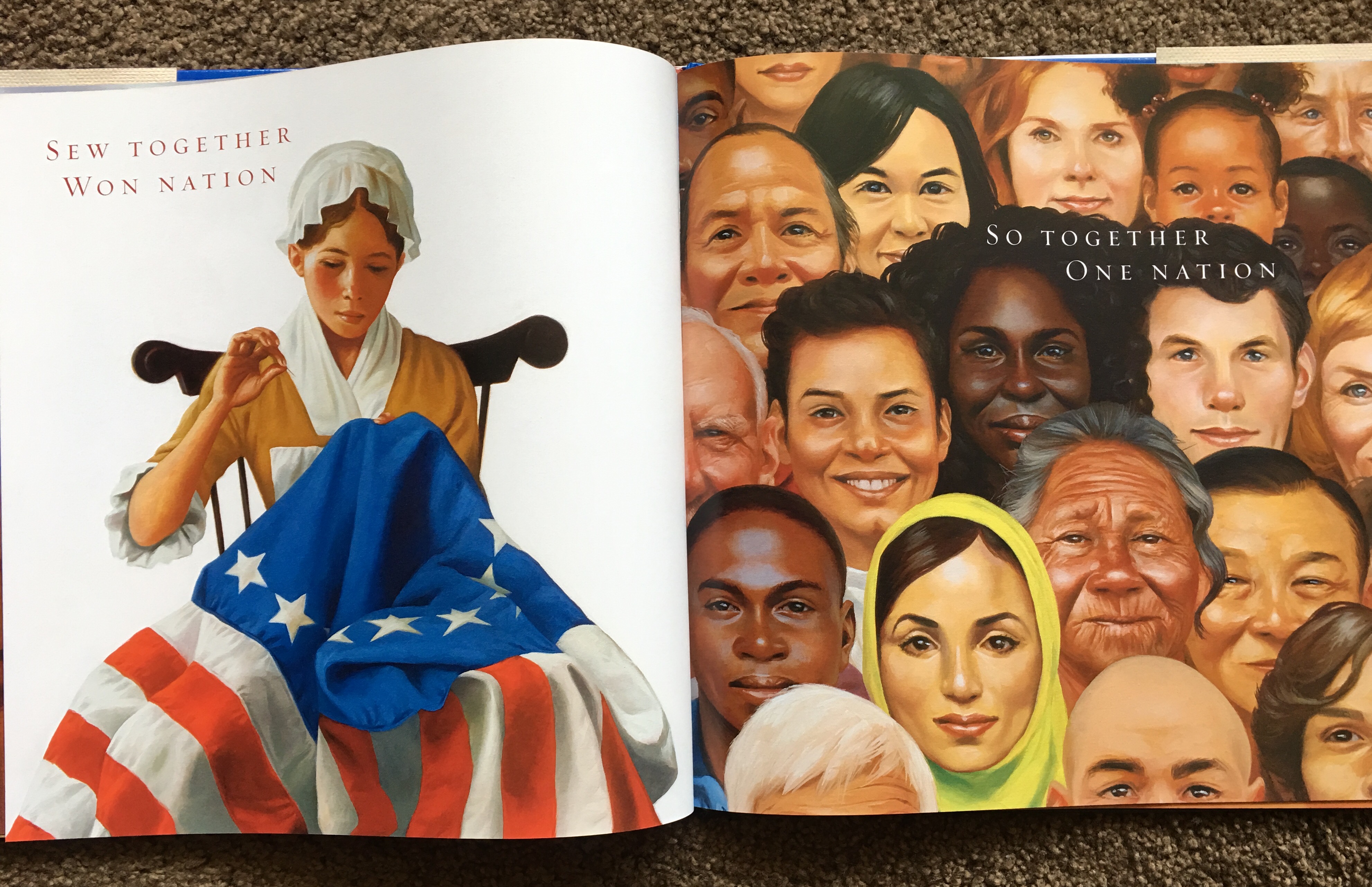
Sew together won nation.  So together one nation.

Powerful words.  Let’s remember what is most important; being one, being together.  That is the greatest strength.

Funny thing~ I teach this to my preschoolers every single day.  We are one, we are a family.  We are all different, yet we come to the table together.  When I read this book to my class of children, we stop at least a hundred times to talk.  There is so much to learn.

Jennie

Posted in America, American flag, Book Review, children's books, Diversity, Early Education, history, Inspiration, patriotism, picture books, reading aloud, Teaching young children, wonder | Tagged , , , , , , , , , | 50 Comments

When Teachers Tell Their Stories – Part 1

I remember the first story I told to children.  It happened at lunchtime.  That’s not surprising as lunchtime is perhaps our most intimate time of the day.  It is where teachers and children bond.  One day at lunch, we had talked about everything from Bruno the dog dying to debating if girls can marry girls and boys can marry boys.  A child asked me to tell a story about when I was a little girl. And I knew the best story to tell. I prefaced it with “It Happened Like This…” Children quickly learned the difference between “It Happened Like This”, a true story, and “Once Upon a Time”, a pretend story.  Let me back up, because this is important.

My first Director always made sure teachers sent newsletters to families.  And she stressed how important it was to include a paragraph to teach parents something.  Anything.  She was right.  As I wrote my dutiful newsletters, I became far more interested in that parent paragraph.  I just knew that there was much more to tell parents, the little things and the moments when learning clicked and children laughed.

And my newsletters told parents about lunchtime, storytelling, our class becoming a family, reading aloud, and chapter reading.  The most important stuff.  I wrote to parents all the time, and storytelling was often a key to their learning.  Here is a newsletter I wrote to families decades ago:

“It Happened Like This”

This is the classic line to begin a great story, and a true story.  I say this often in the classroom, as language and stories are strong building blocks.  The children are very familiar with this phrase, as I tell stories at lunchtime.  Most of my stories are true, things that happened to me as a child and an adult.  The first story I ever told to children was about Dr. Tyler, ‘the peanut man’, who grew peanuts and suddenly appeared in my classroom, to the astonishment of everyone, including the teacher.  He looked exactly like Santa Claus, and when he barged into the classroom with a big burlap bag of peanuts, he really looked like Santa Claus.  Our teacher told us to duck, and he proceeded to pelt the classroom with peanuts.  It was scary, exciting, and wonderful.  This happened when I was in 1st, 2nd, and 3rd grade.

When I first told that story to children many years ago, I realized that the power of language and literacy goes far beyond reading a book.  The children begged for more stories, and I told stories!  From a bat in my bedroom, to a raccoon in my kitchen, every lunchtime is filled with “It happened like this” stories.

Stories are more than language; they are pathways to learning.  When a teacher tells a story, especially a true story, children soak it up.  They can never get enough and always ask for more.  So, how do I address that?  My stories become riddled with questions, asked by me.  Once a story has become popular, I can stop and ask questions.  I do this all the time, and I know it works.  I ask, “How do peanuts grow?”, and “How did the bat get into my bedroom?” Those questions promote long conversations and thinking.  That’s wonderful!

It Happened Like This“… It started at 10:00 AM.  A child was fascinated with our red and sparkly dress-up shoes, prompting dialogue about “The Wizard of Oz” with classmates and teachers.  Clearly, some children wanted to do a play or performance about “The Wizard of Oz”.  Since we were close to clean up and lunchtime, we decided to revisit the idea after rest time.

After rest and snack, we talked about what we wanted to do.  We chose parts, and gathered costumes from our dress-ups.  The children then decided what we should do, and wrote their own play.  They performed it for the Big Room children.  This is what they wrote:

  The Aqua Room Wizard of Oz

“Once upon a time there was a girl named Dorothy and a dog named Toto who lived in a house in Kansas.  Two mean witches played together.  They had magic wands and turned people into things.  There was a good witch, too.  She could turn the bad witches into magic.  There was a tin man.  He had to save Dorothy.  He had to get on a horse and get to the house to save her.  Dorothy had to get on the back of the horse and giddy-up home.  Dorothy married the tin man.  She had a baby.  They will name the baby when she turns one year old.  The tin man said, “Dorothy, stay there.  I will take care of the witches.”.  And he said to the witches, “Bibbity Bobbity Boo!”

When children have been exposed to stories and storytelling, and have been allowed the opportunity to take an idea and run with it, to express themselves without constraints, and to have the support of a teacher, parent or adult, critical thinking occurs and self esteem develops.  Wow!

This is a great example of my philosophy.  Our best plans can often be overturned by eager, questioning children.  I seize those moments!

Stayed tuned for Part 2 and more Jennie storytelling.

Jennie

Posted in Expressing words and feelings, Imagination, Inspiration, play performances, preschool, storytelling, Teaching young children, wonder | Tagged , , , , , , , | 46 Comments

When Children Tell Their Stories

Stories.  That word alone is groundbreaking.  It means listening, looking, hearing, and thinking.  Stories light a fire.  That means learning.

Children have more ideas and thoughts in their heads than we realize.  Their brains are gigantic sponges; they see it all and hear it all.  The last part to develop, and the most important, is verbalizing everything that is in their brain.  In order to do that, they need words, lots of words – and then more words.

When the school year begins, I jump into reading aloud picture books and chapter reading books with both feet.  Children are constantly hearing words- oh, their brain is soaking it up.  The next step is writing picture stories, because they need to use their language and verbalize what they are thinking.

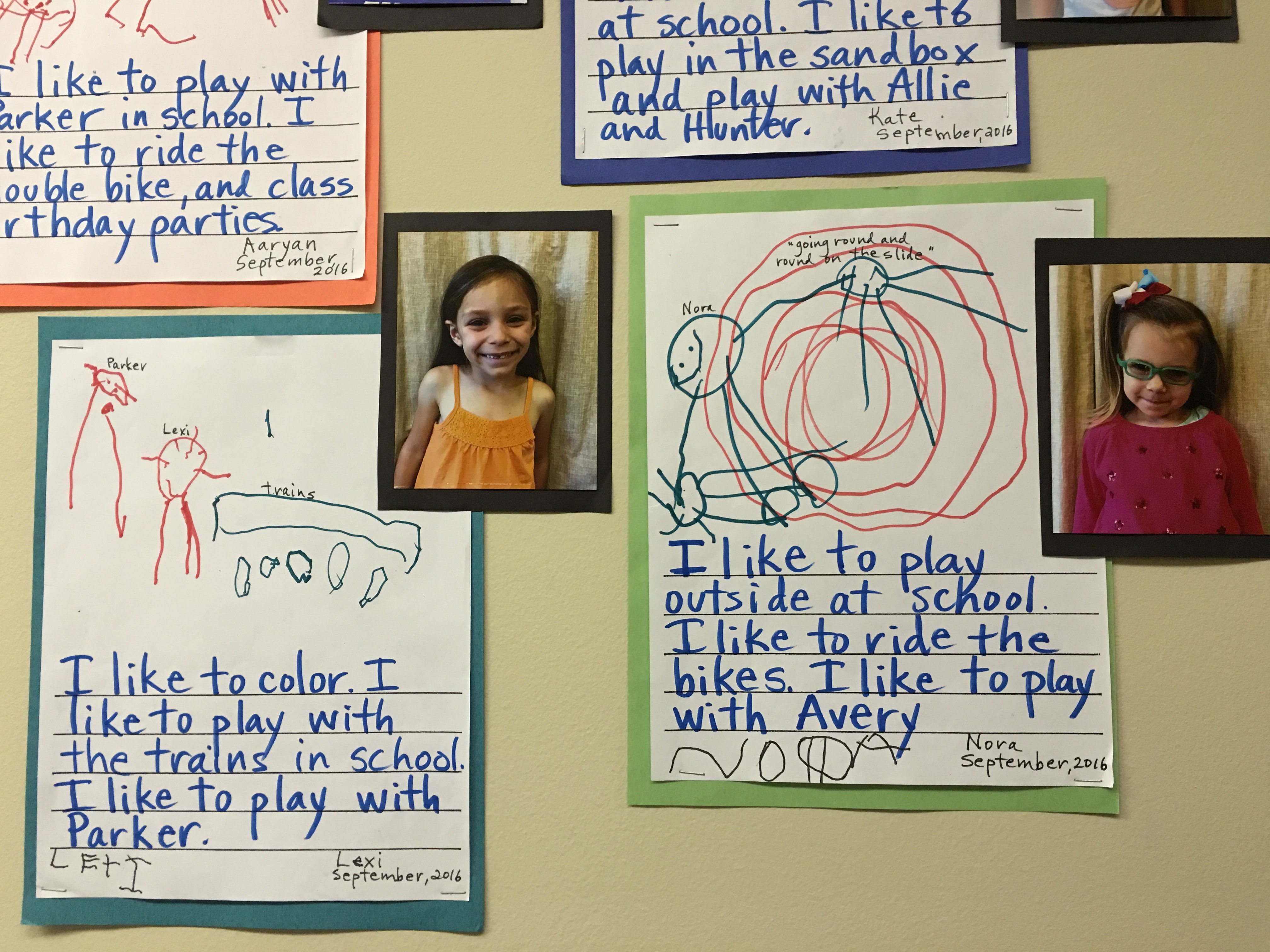
In September we write about what we like to do in school.

img_1263

Imagine being three or four years old and asked by your teacher what you like to do in school.  And then, your teacher carefully writes every word that you say.  That tells a child that words are important.  The ‘frosting on the cake’ to validate a child’s words is asking the child to illustrate what s/he has said.

Writing picture stories brings thinking and language together.  It empowers children.

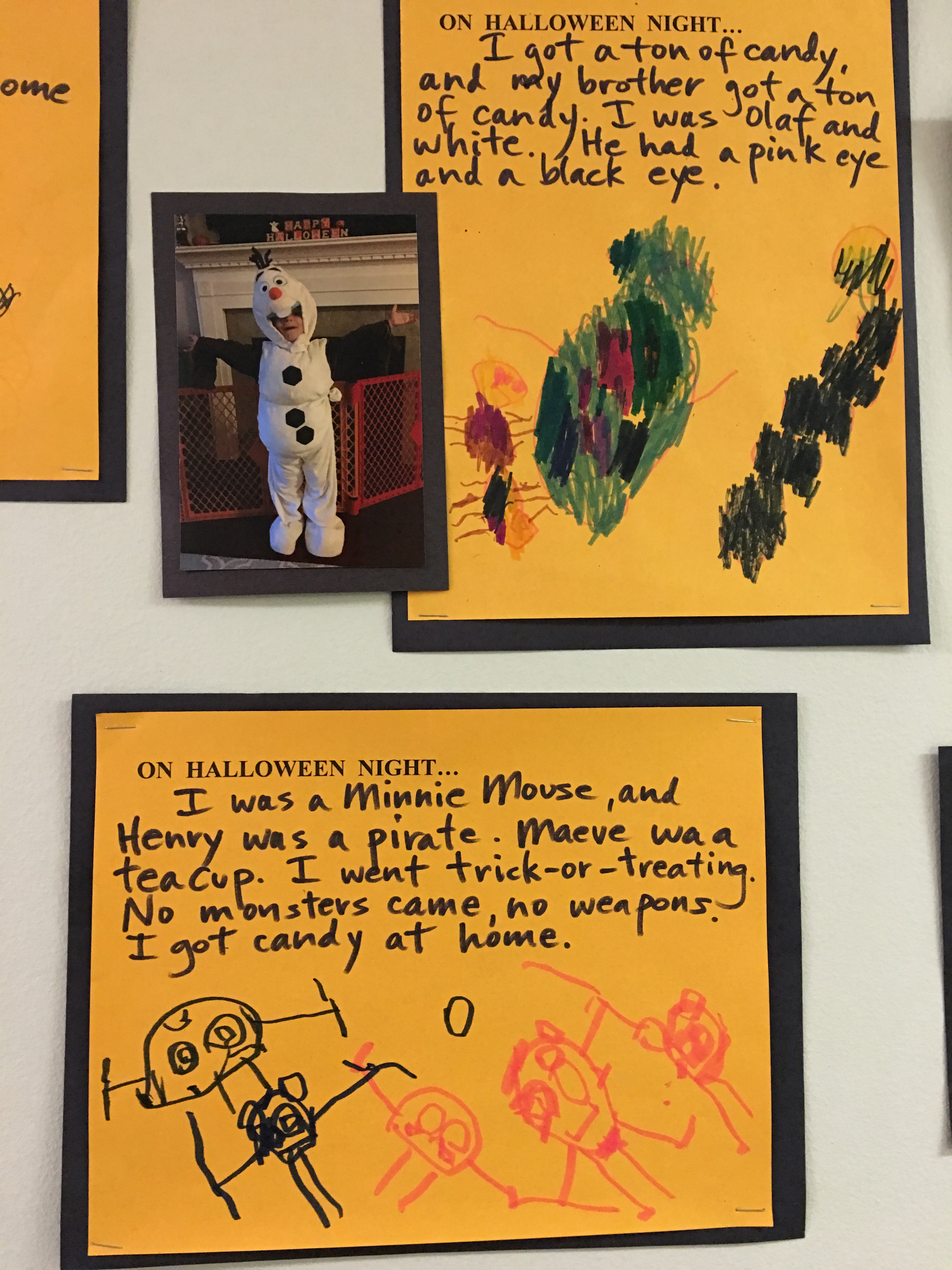
The day after Halloween we write picture stories again.  Children have many memories and thoughts.  By now, their language has become more descriptive.  Two months of reading-aloud is proof.

img_1938As the year progresses, we read, discuss, debate, write, and facilitate vocabulary.  This past week one of the words in our current chapter reading book, Little House on the Prairie, was “wavering”.  Of course that was an unfamiliar word, so we stopped to talk about it.  When we read the final chapter in Mr. Popper’s Penguins, titled “Farewell” we stopped to learn about the word.  Children at the end of the day were saying “farewell”.

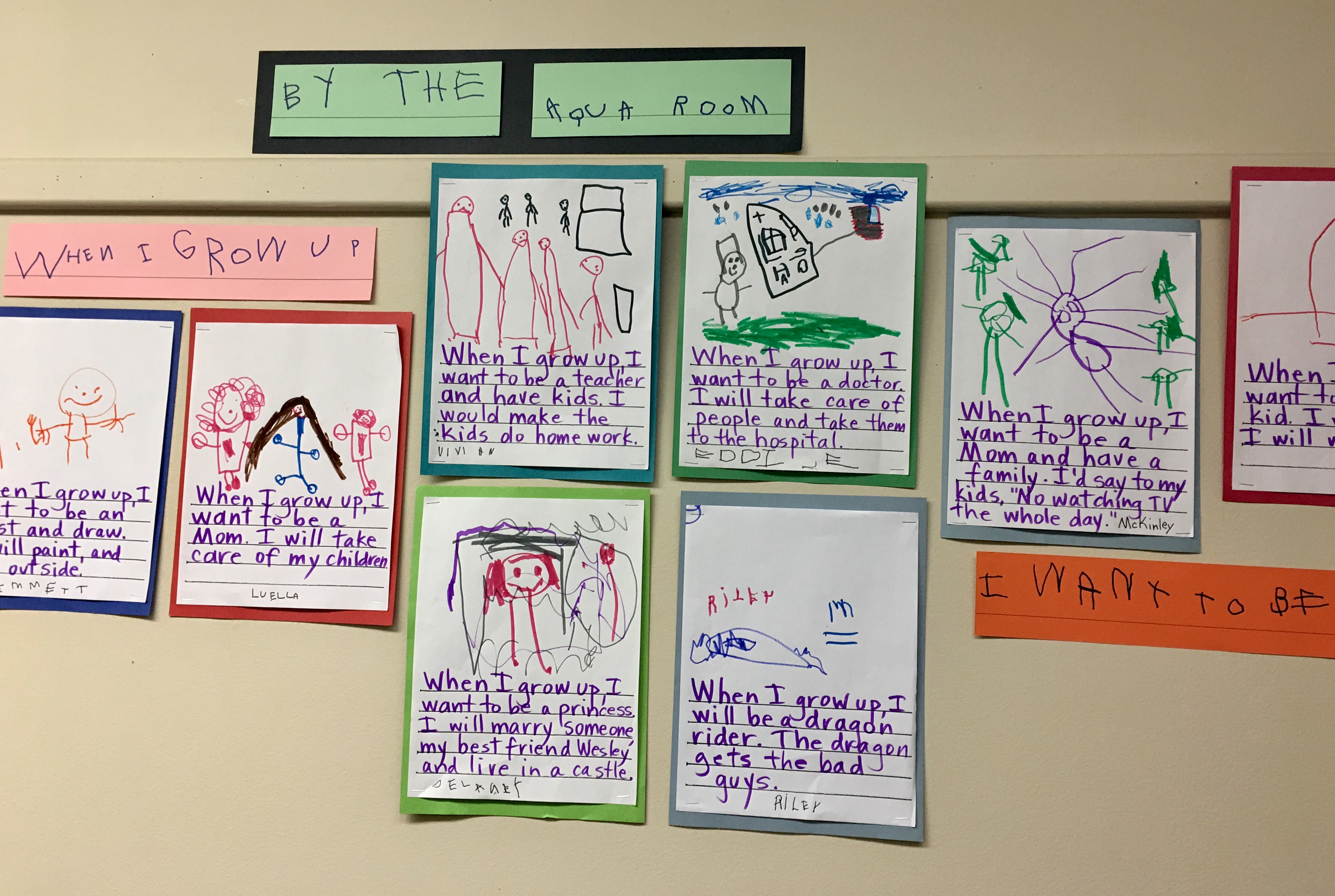
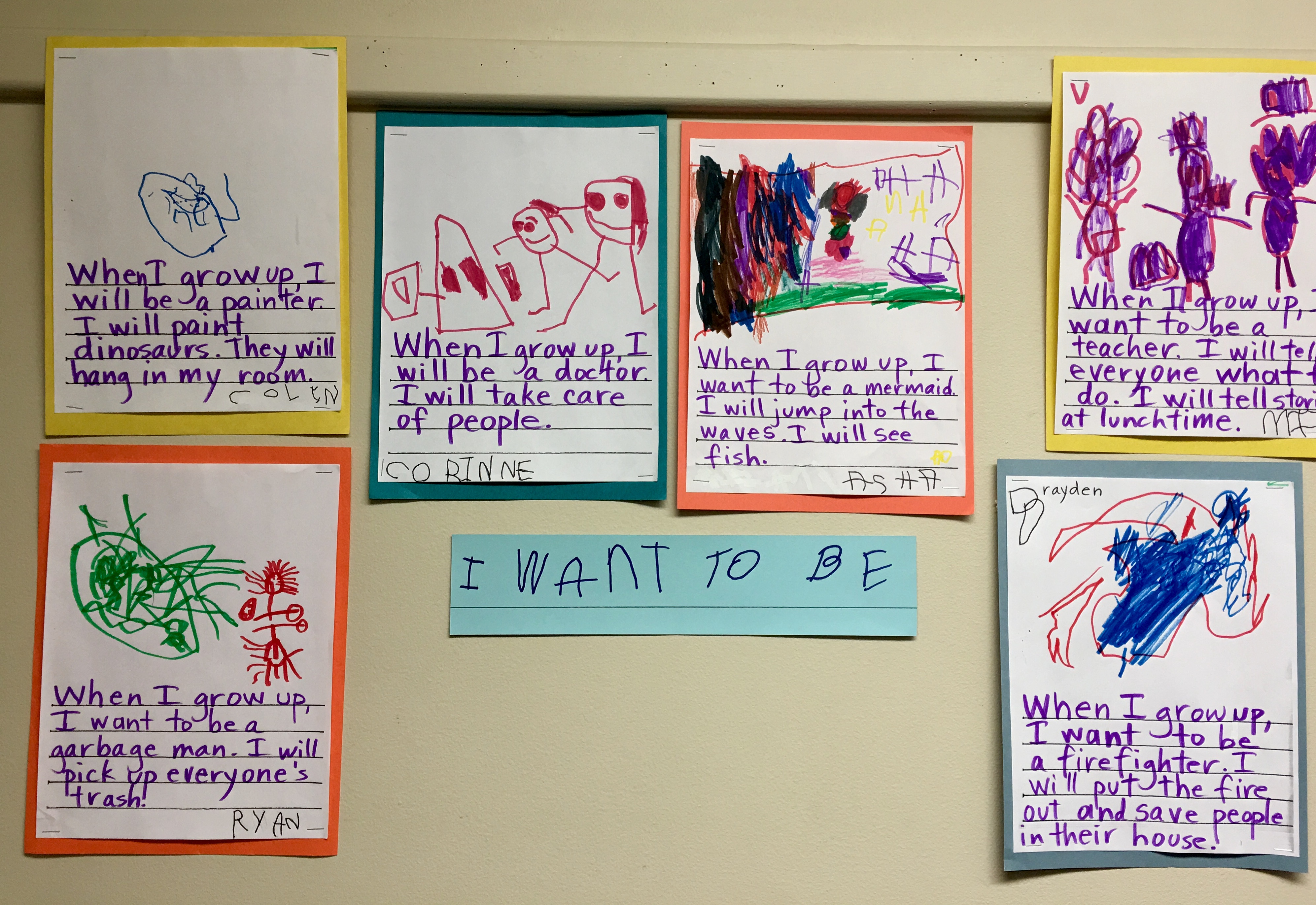
Our final picture stories for the school year were, “When I Grow Up”.  This sparked new thinking.  We were writing about the future.  Our earlier picture stories were about the recent past, or what is currently happening.

As I wrote the words, I carefully scribed and read aloud each one, word by word,  so children could connect every printed word to their own words.

It’s all about language.  The more words a child hears, the better s/he will do in school in all subject areas.  Period.  Now, if that doesn’t make every parent run to the library, and make every teacher institute multiple ways of promoting language, then I will keep shouting this loud and clear.

How simple; increase the number of words and a child does better in school.  Write about it, and the child wants to do better.  Win-win.

Jennie

Posted in Early Education, Expressing words and feelings, Imagination, Inspiration, picture stories, preschool, reading, reading aloud, reading aloud, storytelling, Teaching young children, Writing | Tagged , , , , , , , | 62 Comments

Home Is Where the Heart Is

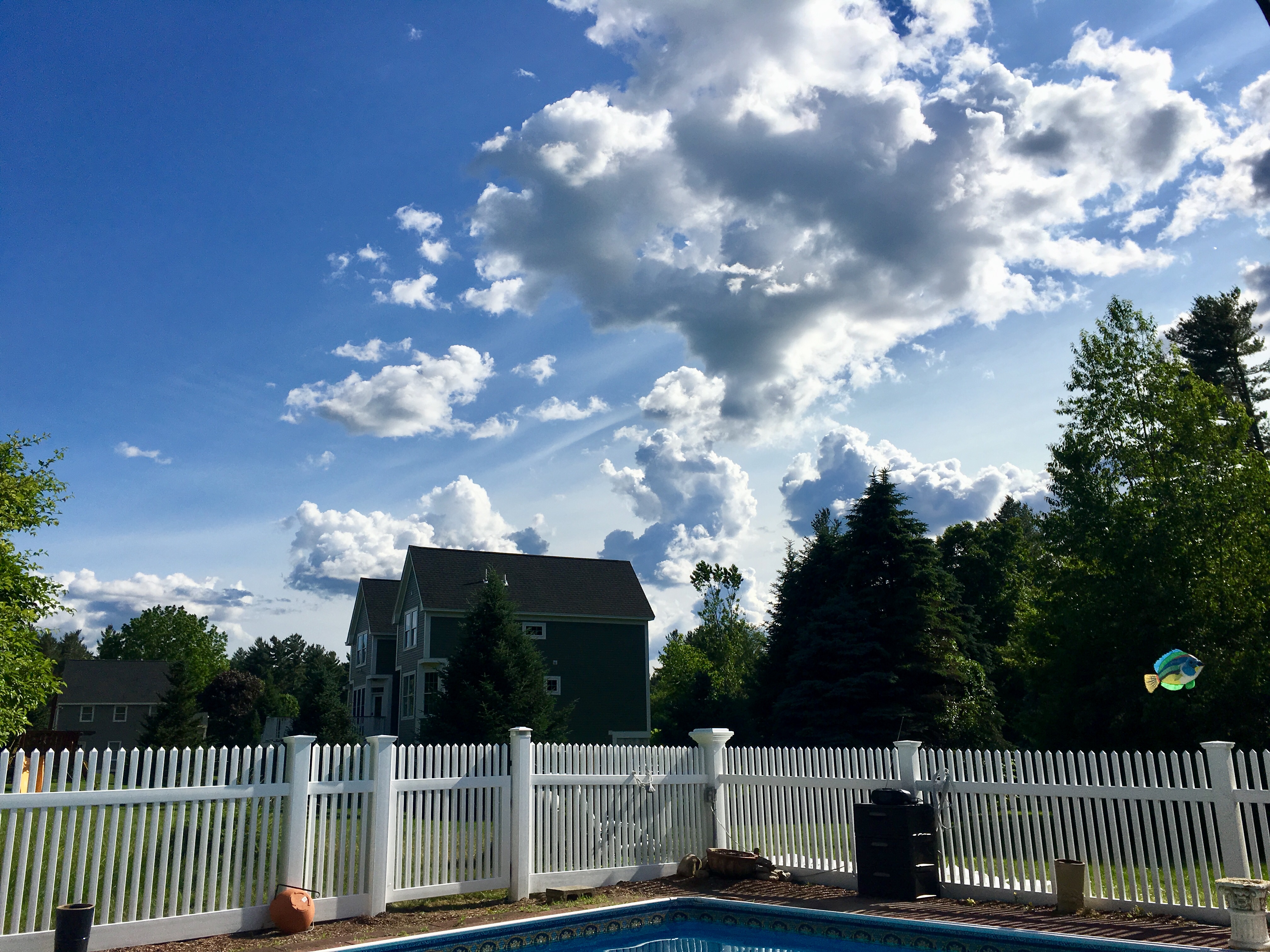
A new pool fence.
Today we started the work to hang fish and plant flowers.
Thank goodness we took the time to look up.
Clouds were putting on a show.
They were saying hello,
and thank you for being outside.
We waved and smiled.
Lots of work to do, and we’ll be back outside tomorrow.

Nope, I never want to go inside.
Home is where the heart is.

Tomorrow is another beautiful day.

Jennie

Posted in Inspiration, joy, Mother Nature, Nature, wonder | Tagged , , , , | 85 Comments

The ‘Curbside Classroom’ – Year End

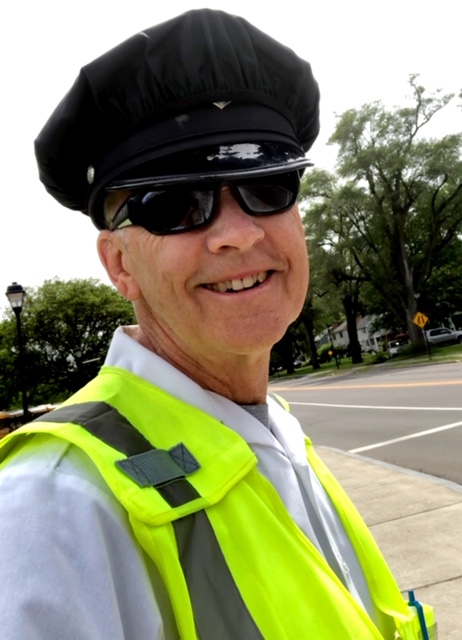
Steve the Crossing Guard posted about the final days at school this year.  Can you imagine being at his crosswalk – aka, ‘Curbside Classroom’ and hearing him burst into song, singing “Oh What a Beautiful Morning?”  Yes, he really did, and children joined in.  Ah, the power and joy of music.

Oh, there’s more.  He handed out certificates of sorts to the Seniors, 50  tips (lifelong lessons, really) from the bestselling book, How to Start a Conversation & Make Friends and also affirmations from Just For Today.  So, read on about the Curbside Classroom:

The Crossing Guard Chronicles #4, ‘Oh What a Beautiful Morning’  his June 9th blog post.

The ‘chorus’ joined in, the ‘maestros’ led, the ‘audience’ smiled and a good time was had by all. We’re the ‘pretenders’, middle and high school students and a crossing guard, letting our joyful, if off key voices be heard while waiting to make our way across four lanes of busy blacktop on the way to begin the last school day of the week.

“Oh, what a beautiful morning,

Oh, what a beautiful day.

I’ve got a beautiful feeling,

Everything’s going my way!”

Whatever the reason, a Friday, a beautiful daybreak for a change, or the last few weeks of school, it was a morning to sing, and we did. Well, I did. A few kids knew the words from the Broadway show, ‘Oklahoma’, and accompanied me. The more we sang, the louder we sang.

This magnificent morning, with its cloudless blue sky, was a time to break out in big smiles and we did that, too, even the ‘sophisticated’ Seniors joined. Some early rising real ‘seniors’ from the neighborhood, who were beginning their daily ‘10,000 steps’, showed some spirit by singing along as they crossed and mingled with students.

What a glorious way to end the school year. And quite a year it’s been at the ‘curbside classroom’. From quizzes to quotes, word games and jokes, anagrams and acronyms, new words and old history, inventions and inventors, we learned a lot of ‘stuff’ from each other. I hope some of it sticks.

But what I really hope is that our mornings, which began with ‘have a great day’, helped these youngsters to really have a great day.

I’ve enjoyed their company and camaraderie on sunny days, on cold snowy and rainy days. I wish the best of success and happiness to those who are graduating and look forward to seeing returning and new students next September.

I’ll be there, at the ‘curbside classroom’ with more facts, new challenges, brain teasers and general conversation. Look for the guy in bright yellow.

Steve (June ’19)

To all the students of the ‘curbside classroom’. Continued successes!

***********************************************************************

Here is an email I got from Steve this week, with the graduation  certificate momentos for the Seniors from How to Start a Conversation & Make Friends and Just For Today affirmations:

Jennie,

I printed 25 copies of these and gave them to Seniors as a ‘graduation’ momento from the ‘Curbside Classroom’. They liked it. Figured they would, it’s a highly motivated group of kids and these are good tips for Life as they join the adult world.

I write my last ‘Crossing Guard Chronicle’ story, ‘Oh, What a Beautiful Morning’,  a couple of weeks ago. It’s been quite a year. They’re all taking finals this week and next Tuesday is the last day.

Time off in the summer. What to do?  I know, ‘lesson plans’…….

Have a wonderful summer, Jennie. You’re terrific.

 Way to go, Steve.

You can follow Steve at http://srbottch.com

Posted in behavior, Expressing words and feelings, Giving, Imagination, Inspiration, joy, Kindness, music, self esteem, teaching | Tagged , , , , , , , , | 60 Comments

Smorgasbord Posts from Your Archives – #PotLuck – Teaching: it’s The Cake and the Frosting by Jennie Fitzkee

How is teaching much like making a big cake, and then adding frosting? Read on! Thank you, Sally Cronin, for sharing my stories.

Posted in Uncategorized | 14 Comments