
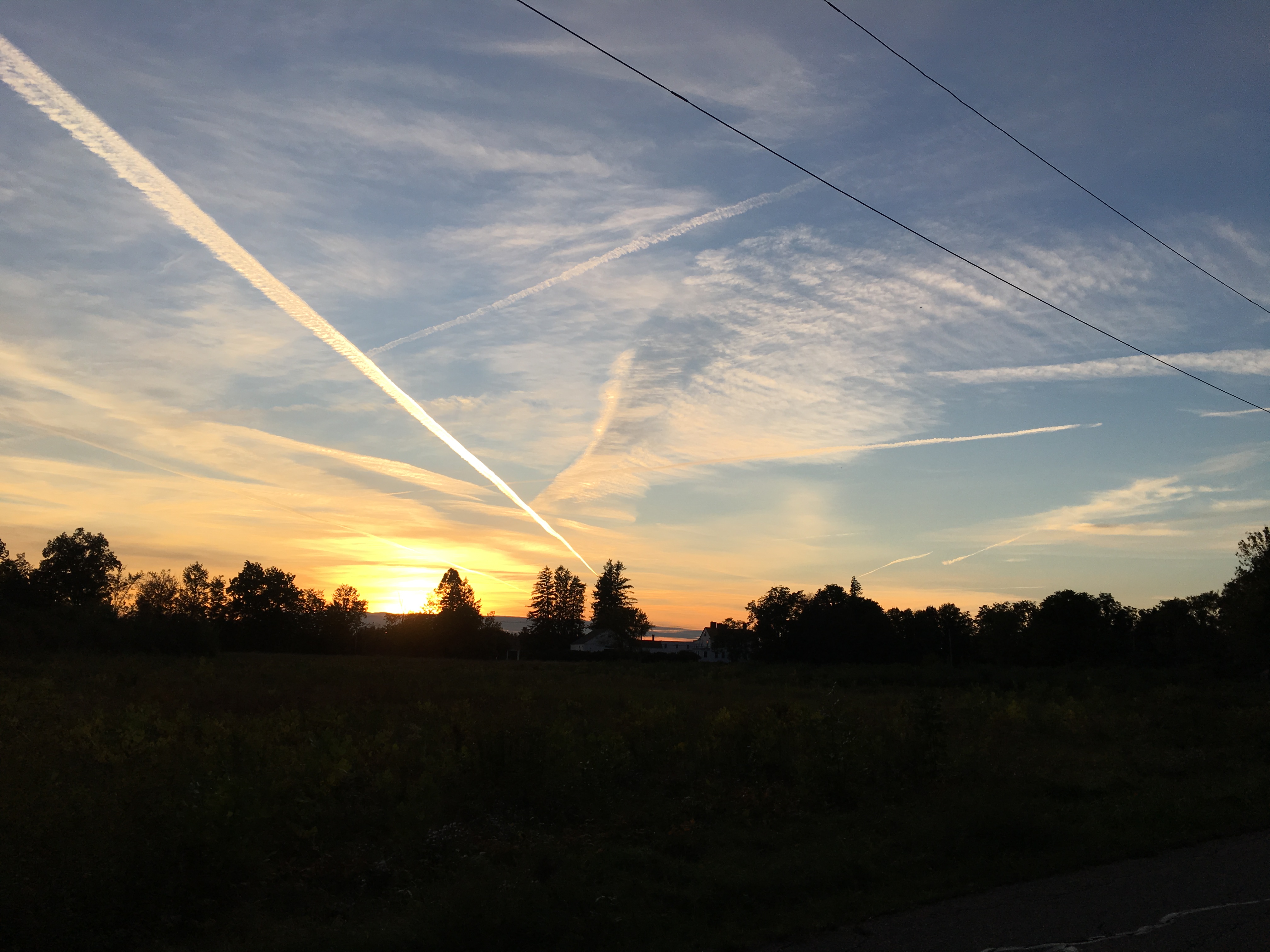
Thank you, Mother Nature.
Your evening sky is glorious.
Tomorrow I will show the children in my class.
We will count your colors and talk about the sky.
I wonder what the questions and stories will be.
Jennie
Thank you, Mother Nature.
Your evening sky is glorious.
Tomorrow I will show the children in my class.
We will count your colors and talk about the sky.
I wonder what the questions and stories will be.
Jennie
As a teacher, I want to grow readers. I want to help children develop a sense of understanding. I want children to become curious, and eager to discover. I learned early on that in order to do this, it all begins with language and hearing words. Fact: a child’s success in school in all areas, not just reading, is directly attributed to the number of words s/he hears. As a parent of young children, that fact alone made me want to run to the public library. And I did. As a teacher, I became an advocate for reading to children. I just knew that pouring all those words into their brains was filling the learning reservoir. It happens in this order – listening, speaking, reading, then writing.
Reading aloud became a passion and a constant in my classroom. The guru of reading aloud, Jim Trelease, visited my classroom to hear me read. He was curious that I read chapter books to preschoolers, and that they were glued to the story. He was also writing the latest edition of his million-copy bestselling book, The Read-Aloud Handbook. I am fortunate to be included in the book.

At chapter reading, children know that they make the pictures in their heads. This week I said,
“The words go into your ears, and then into your brain and into your heart. When that happens, you can see the picture in your head. Can’t you just see Wilbur standing under Charlotte’s web? Can’t you just see the morning dew making SOME PIG stand out?”
Oh, we had a wonderful, rich conversation! Language and literacy. Yes, it starts with language. But, I felt pulled to do more, to help children cross over, to give them the tools to be a bigger part of it all. I wanted children to use their own thinking – their own language. Here is what happened:
I read our first “fact” picture book of the year, Humphrey The Lost Whale, by Wendy Tokuda and Richard Hall.
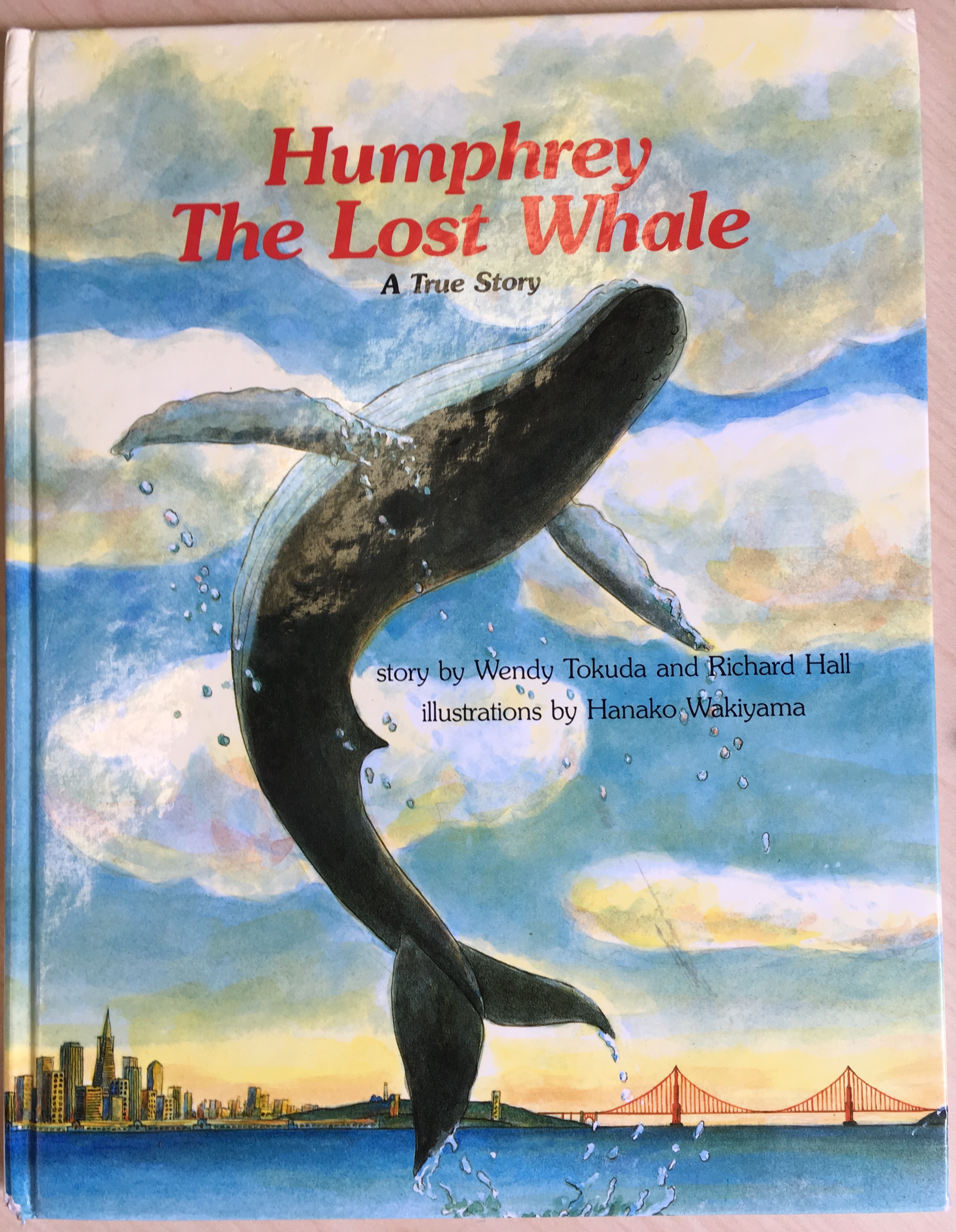
It is the story of a whale who goes into the San Francisco bay and gets lost. He turns the wrong way and travels up the Sacramento River. It took an entire day to look at and talk about the inside cover alone. Geography at its best!
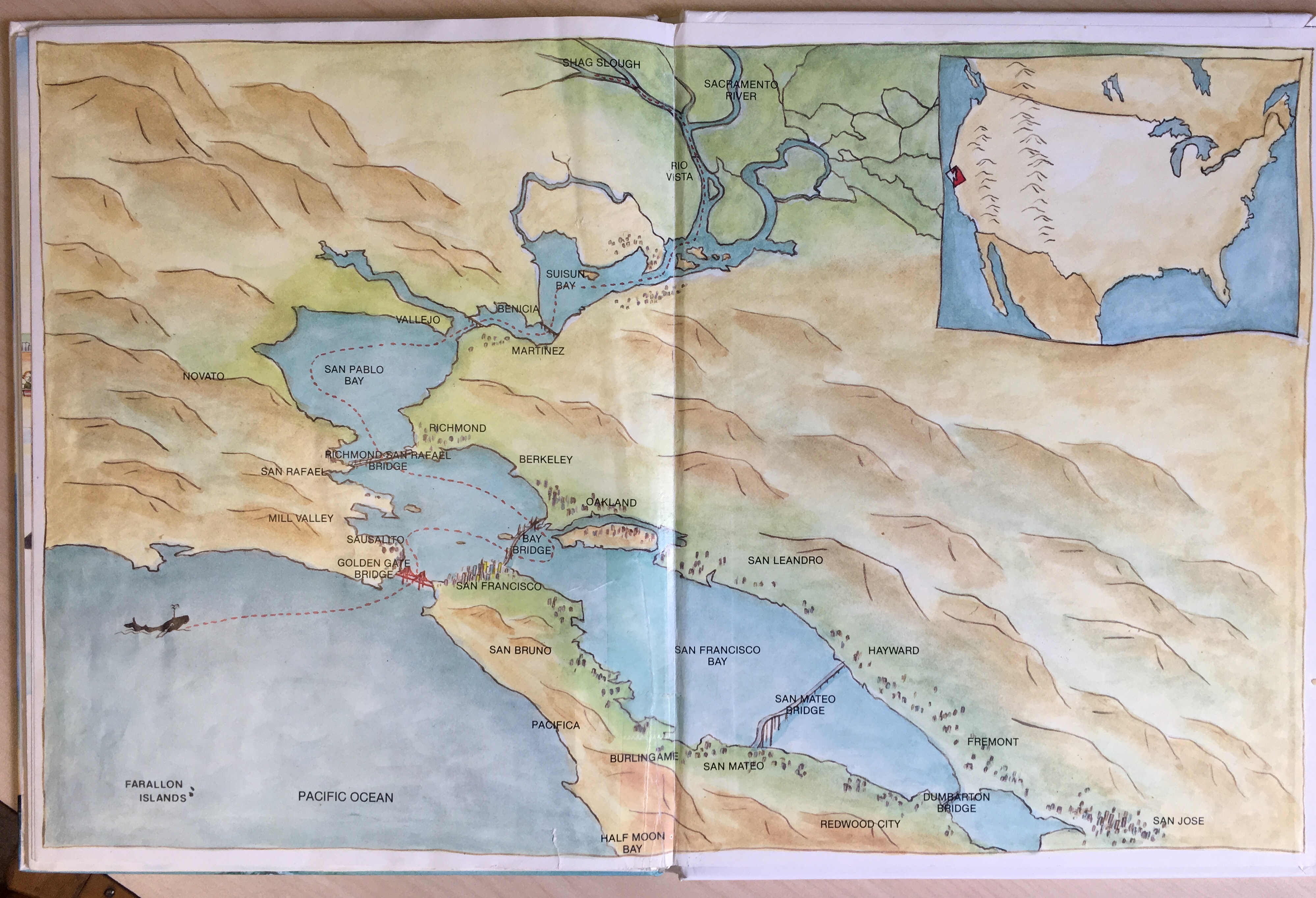
The small map is the United States. Note the small red area. That depicts the location of the large map. We could see the ocean, the Golden Gate Bridge, the bay, and Humphrey’s path up the river – which got smaller and smaller. Questions and curiosity and conversations were abundant. Plus, it was so cool that it was a true story.
The next day I read the book to the children. We often stopped to talk about what was happening. When we hit this page, I showed the illustration and just said, “Oh, no.”
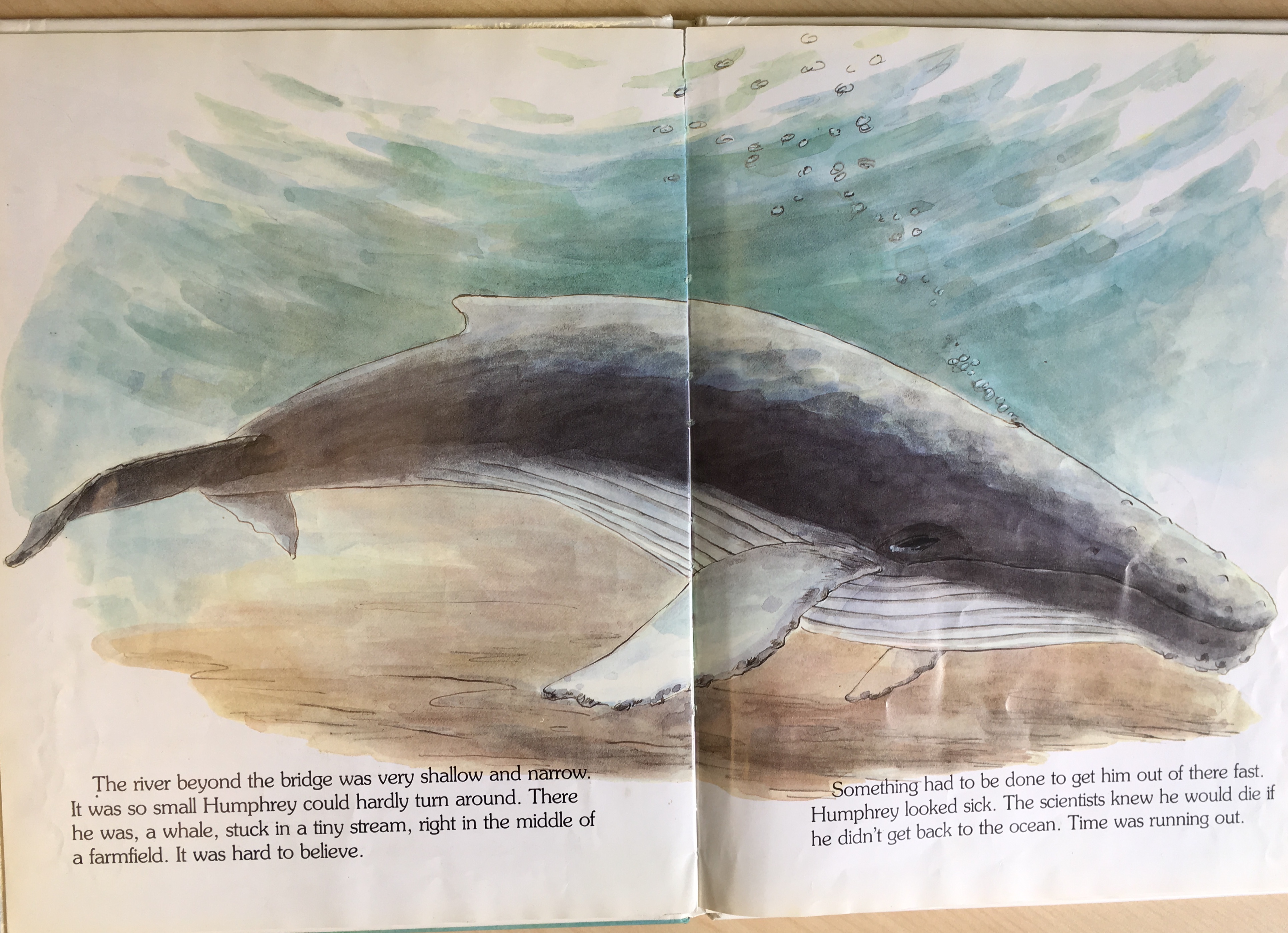
Silence. Big eyes. Worried eyes. We talked for a long time. This was a meeting and a marriage of the mind and the heart. This was also where children expanded on their language. And so, they told their own story:
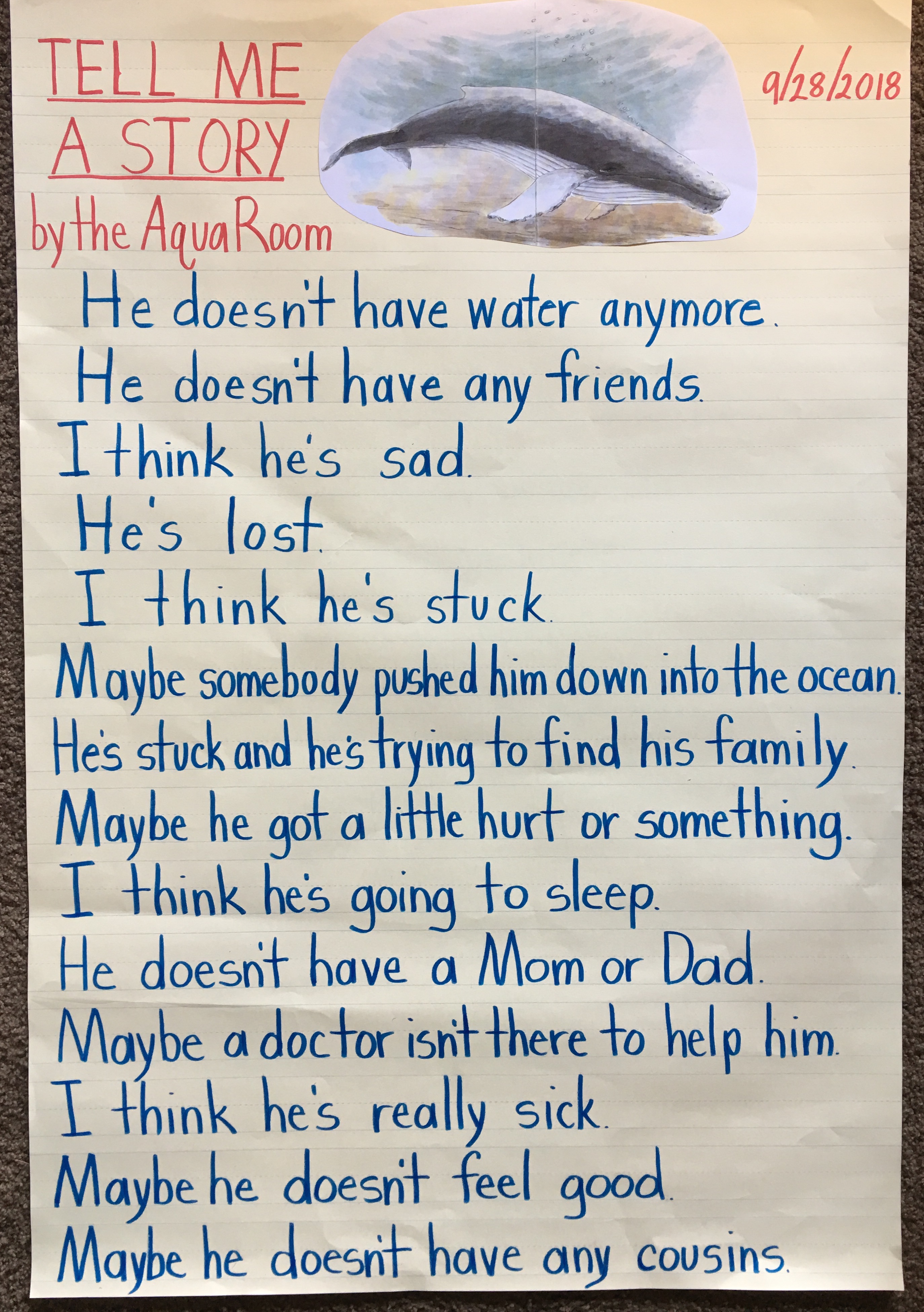
“Education is not filling a pail but the lighting of a fire.”
-William Butler Yeats-
Stay tuned for Part 2.
Jennie
Children’s reading is growing! Last week my preschool children began to read independently. It was wonderful. The photo of children on the rug with their books spoke to the power of reading aloud good books, and children modeling what they love.
And look what happened today:
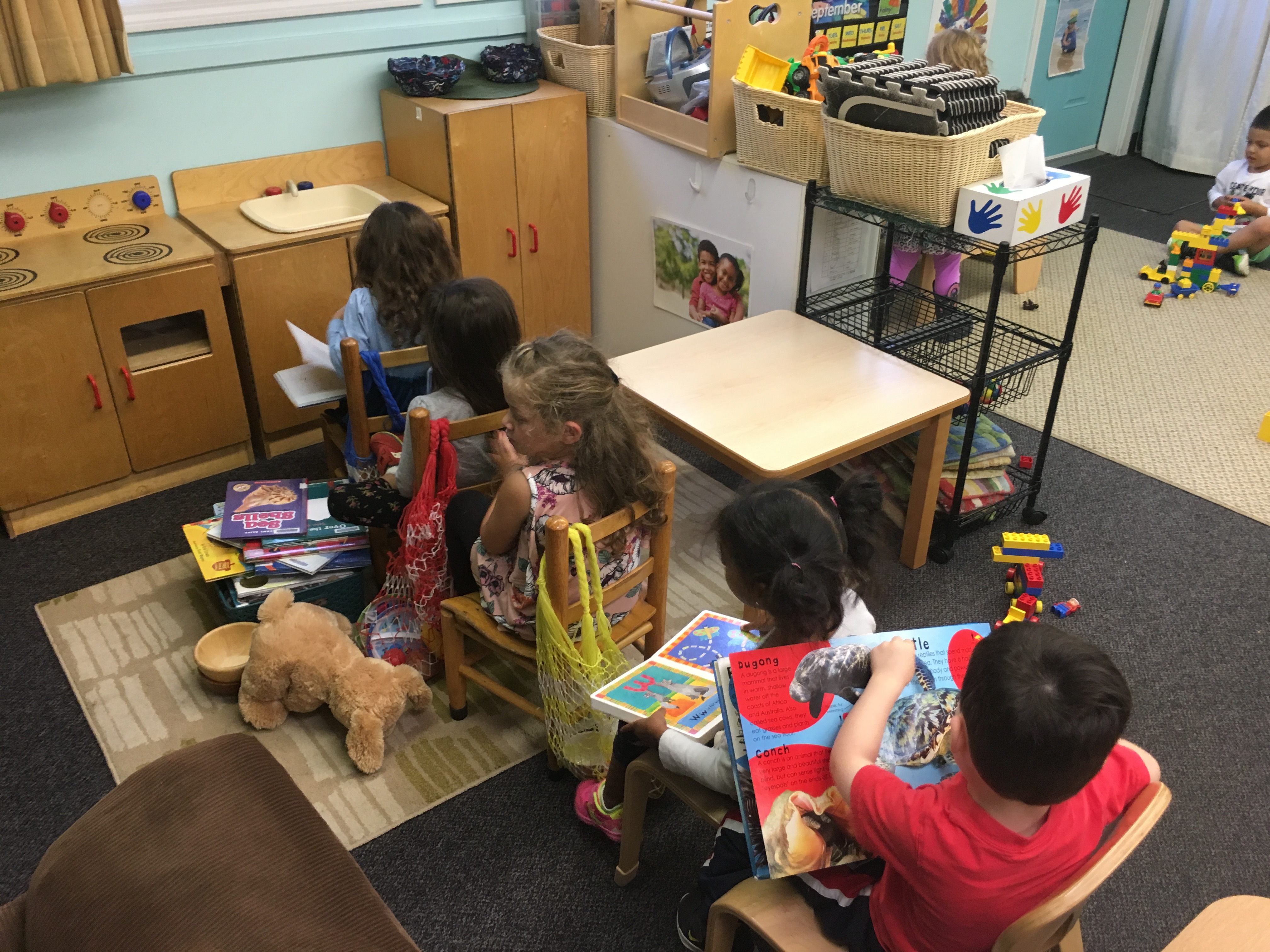
Children decided to line up the chairs like a train, with every child reading a book. Teachers stood back and smiled, watching all that was happening. All aboard!
Jennie

Every year I start chapter reading with my preschool class on ‘day one’. And, the first book I read is Charlotte’s Web. We have barely had three weeks of school and children are totally hooked. They adore Wilbur and laugh at the goose repeating words three times. They trust Charlotte. They have met Templeton the rat, and learned of Wilbur’s fate. When Charlotte’s demise looked imminent in the hands of Avery’s big stick, there were gasps.
I am reading to three and four-year-olds about the beauty of life and the fear of death, about morals (and lack thereof), and about friendships (and lack thereof). That sounds pretty sophisticated for preschoolers, but leave it to the beautifully crafted words of E.B. White.
Twilight settled over Zuckerman’s barn, and a feeling of peace. Fern knew it was almost suppertime but she couldn’t bear to leave. Swallows passed on silent wings, in and out of the doorways, bringing food to their young ones. From across the road a bird sang “Whippoorwill, whippoorwill!” Lurvy sat down under an apple tree and lit his pipe; the animals sniffed the familiar smell of strong tobacco. Wilbur heard the trill of a tree toad and the occasional slamming of the kitchen door. All these sounds made him feel comfortable and happy, for he loved life, and loved to be part of the world on a summer evening.
We often underestimate children. Their brains are absorbing the world around them like a giant sponge. Let’s give them the world through words, the best words written. I tell the children – with great fanfare and passion – “The words in the story go into your ears and then into your brain, and you make the pictures in your head.”
That’s just what happens, every day at chapter reading.
The beauty of Charlotte’s Web comes from learning about the world, and about every feeling that is important in order to grow into a good person. Goodness and knowledge, all on a farm.
I had a pleasant surprise; my hardcopy of Charlotte’s Web is of course at school. As I typed this post, I needed a copy of the book in order to type E.B. White’s words from page 62. Surely I had another copy of the book here at home. I did! As I opened the book, this is what I saw:
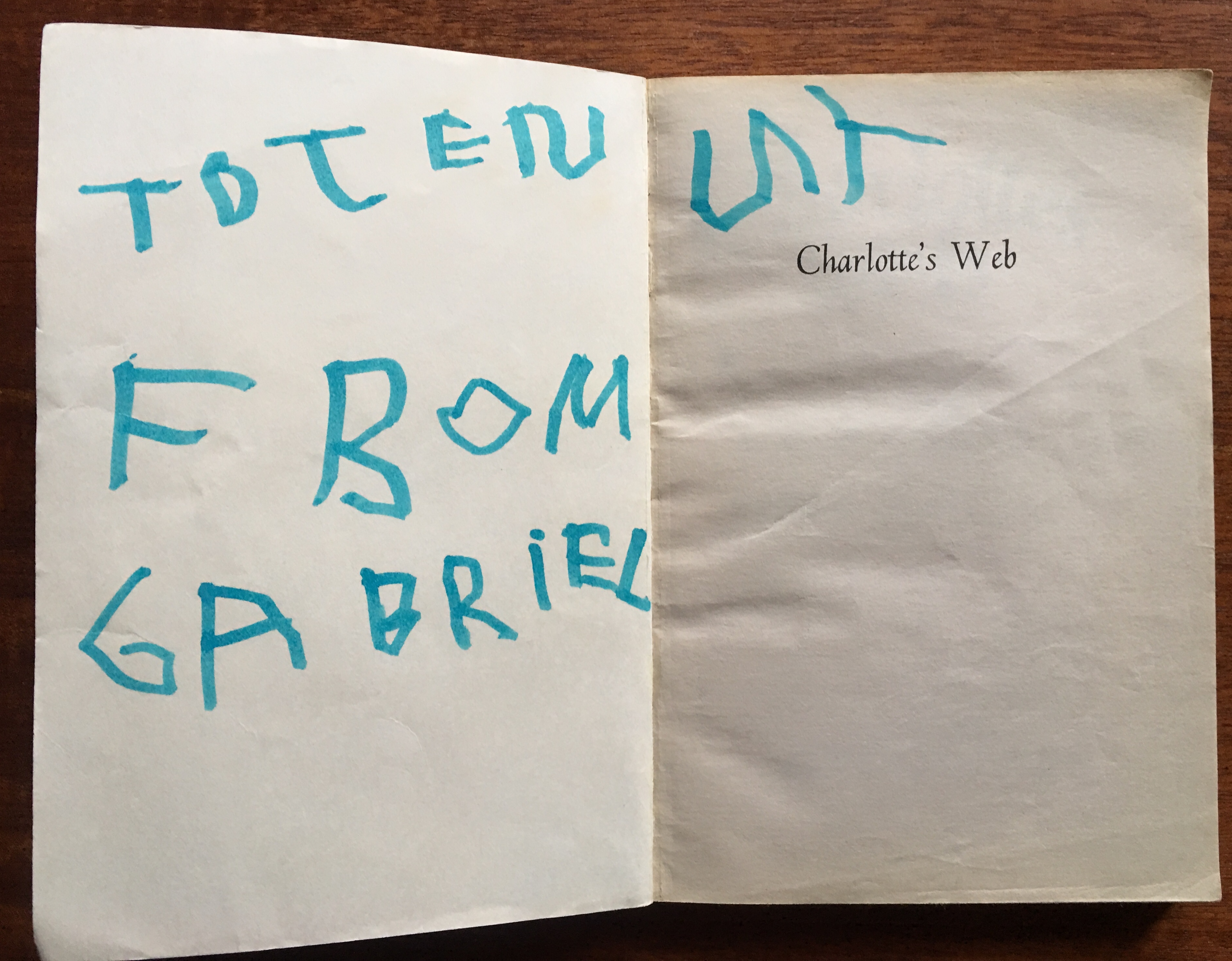
Thank you, Gabriel. You are now in high school, doing very well. Whenever you visit (once or twice a year), it means the world to me. And today I found the book you gave me. You loved Charlotte’s Web. That book went straight to your heart, and I know your heart wanted to give me something when you left my class and moved on to kindergarten. From my heart to yours, thank you!
Jennie
Teachers read aloud to children – all the time.
Children model what they see.
Reading is pleasure.
Jennie
I was tenth on the waiting list to hear Eric Carle – the man himself – speak to a packed audience. It is the 50th anniversary of The Very Hungry Caterpillar. Can you imagine this childhood favorite book has been in print and a perennial favorite for children, parents, and teachers for fifty years? I crossed my fingers, took a chance, and made the long drive to western Massachusetts. The worst thing that could happen would be I’d tour the exhibits, the art studio, and the bookstore. And that was fine with me.
I arrived early and was warmly greeted, but I simply had to wait till just before the event to see if I ‘made it’. So, I decided to tour the new exhibit celebrating the book and its artwork over the past fifty years. And it did not disappoint! Everything was there.
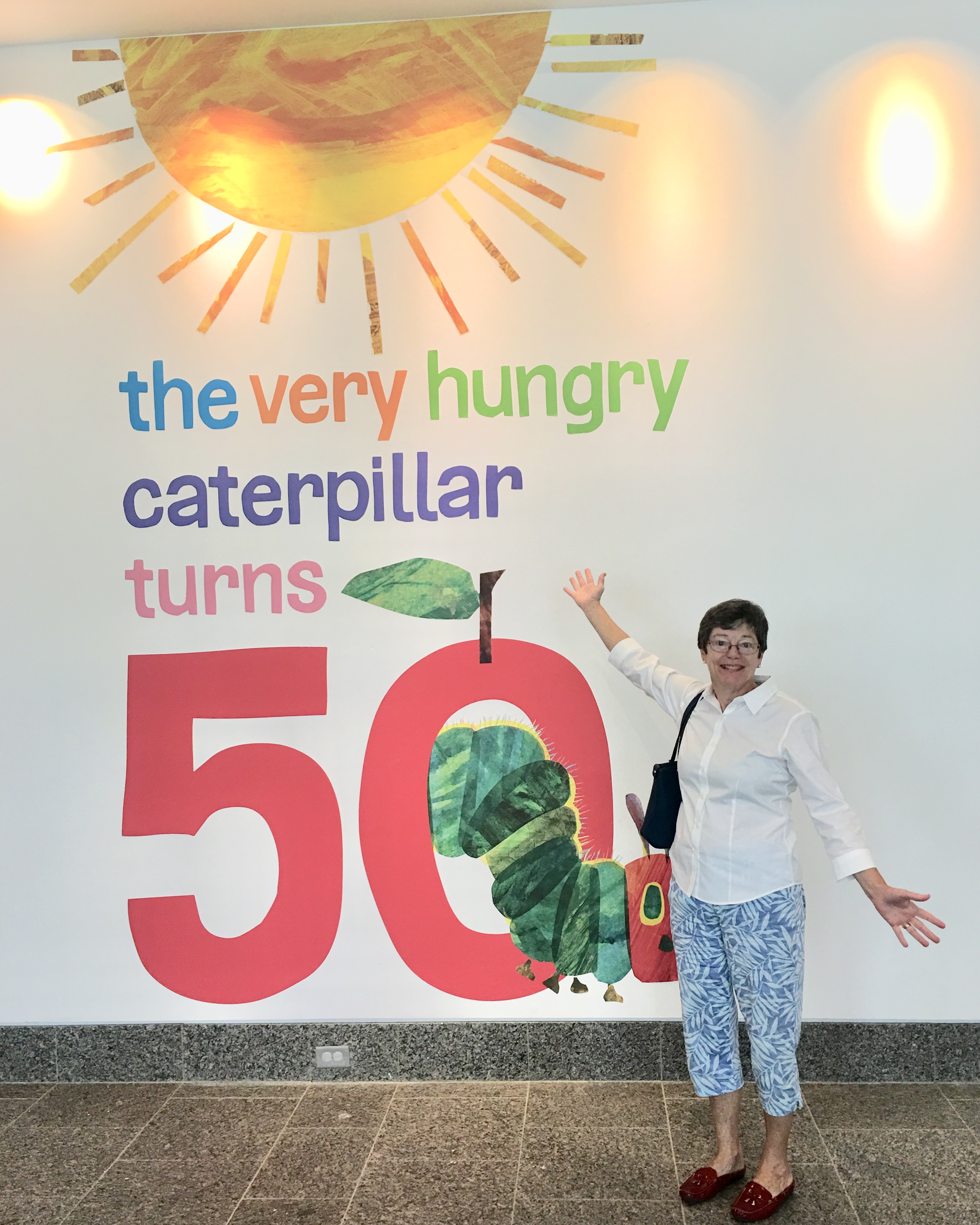
I have said it before, there’s nothing like seeing the real deal. When it comes to art, being inches away and seeing brushstrokes is something you have to experience. And I was experiencing just that, along with a man and a mother and her young boy. Nobody else was at the exhibit. I guess they were all in the auditorium waiting to hear Eric Carle speak. I had the floor to explore. Lucky me!

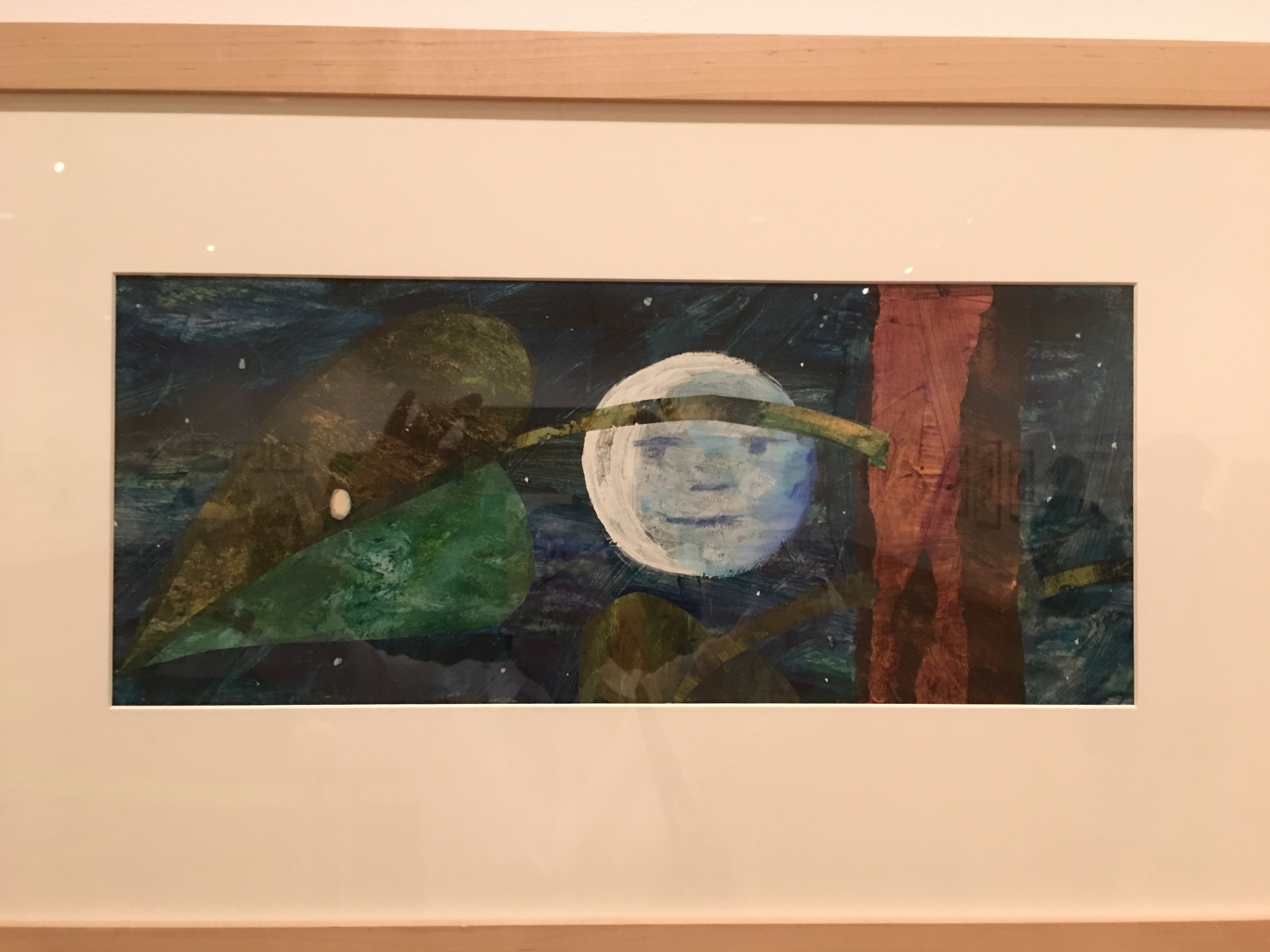
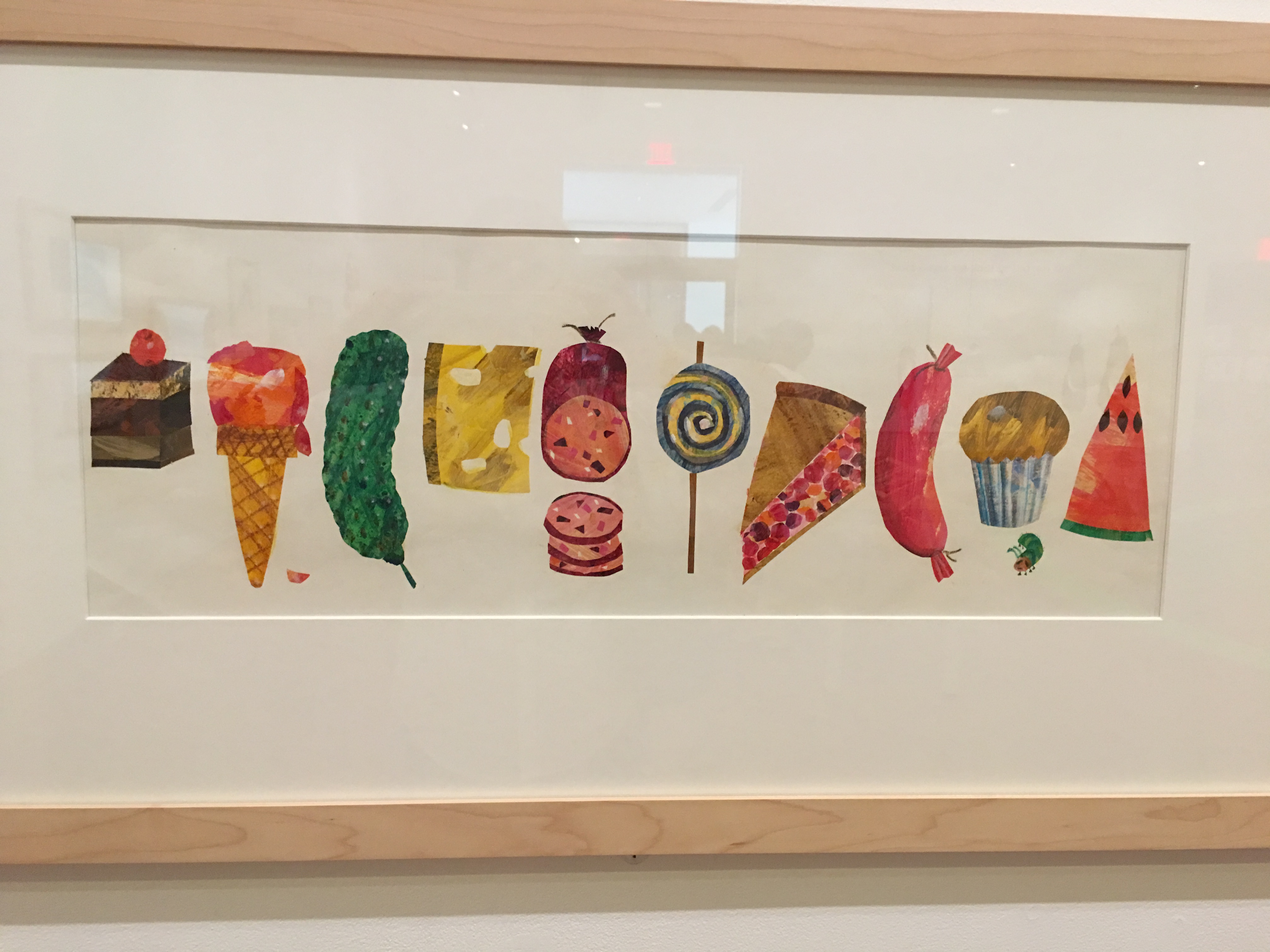

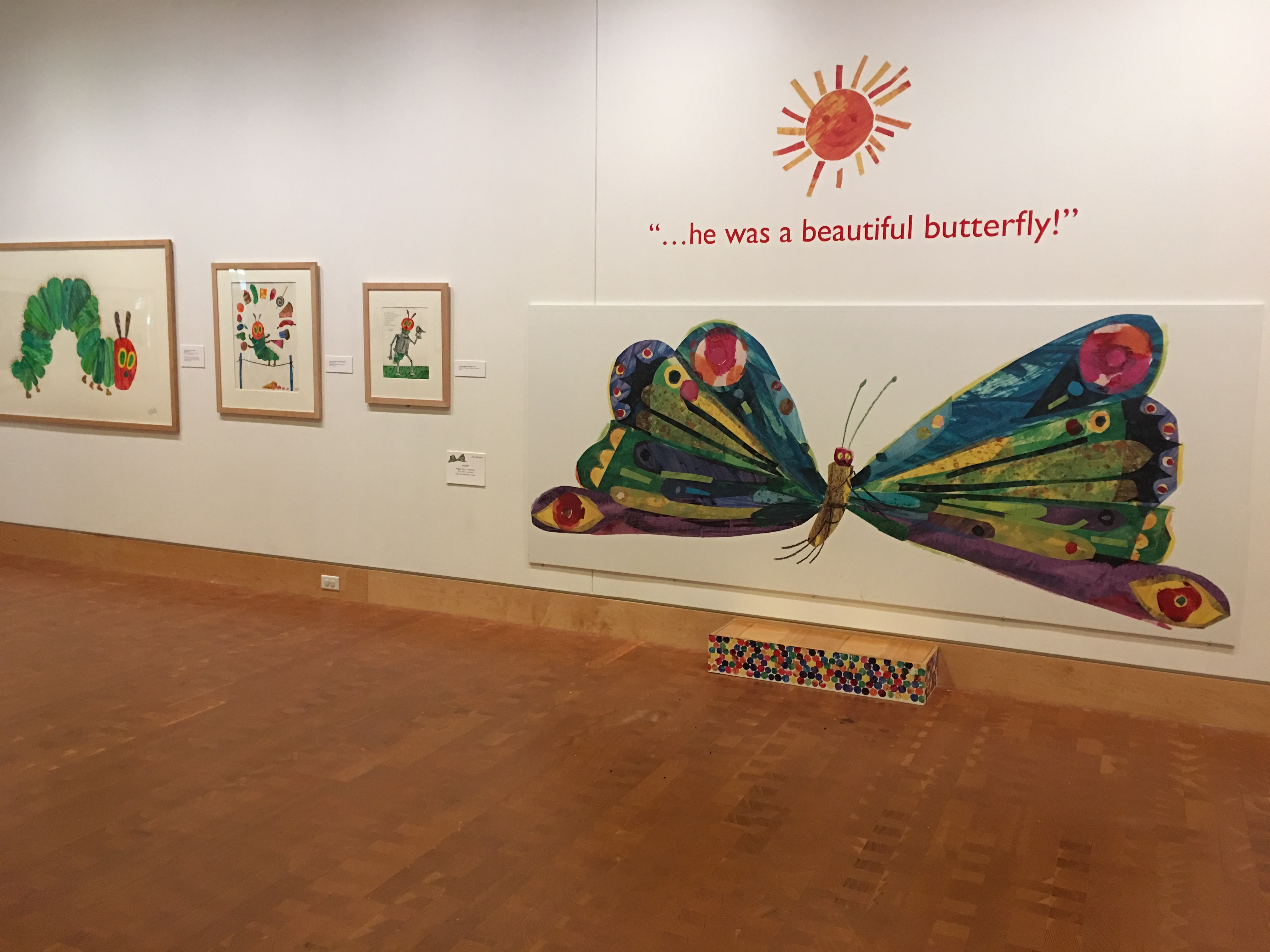
I walked to the big glass doors to leave the almost empty room, and then, in walked the man himself. Eric Carle. We were face-to-face. Behind him was a group of the museum directors and more, all carrying big cameras for a photo shoot. For a few moments it was just the two of us. I had no words. I smiled and crossed my arms over my chest, embracing myself in complete surprise. He smiled, walked straight over to me, and gave me a big hug. Big.
Are you getting this?!
It was a suspended moment. No words were needed. Eric Carle finally said, “Thank you. Good to see you.” And then the group entered and started taking pictures. The first photo taken was just after our hug. My face says it all:
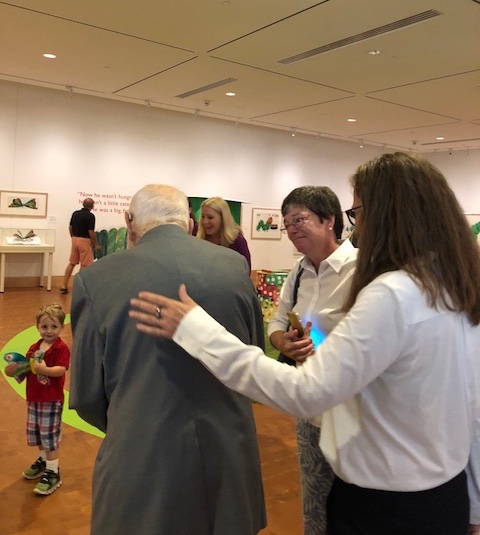
I sneaked behind the photo shoot and took a few of my own. I felt like the paparazzi as I was snapping photos.
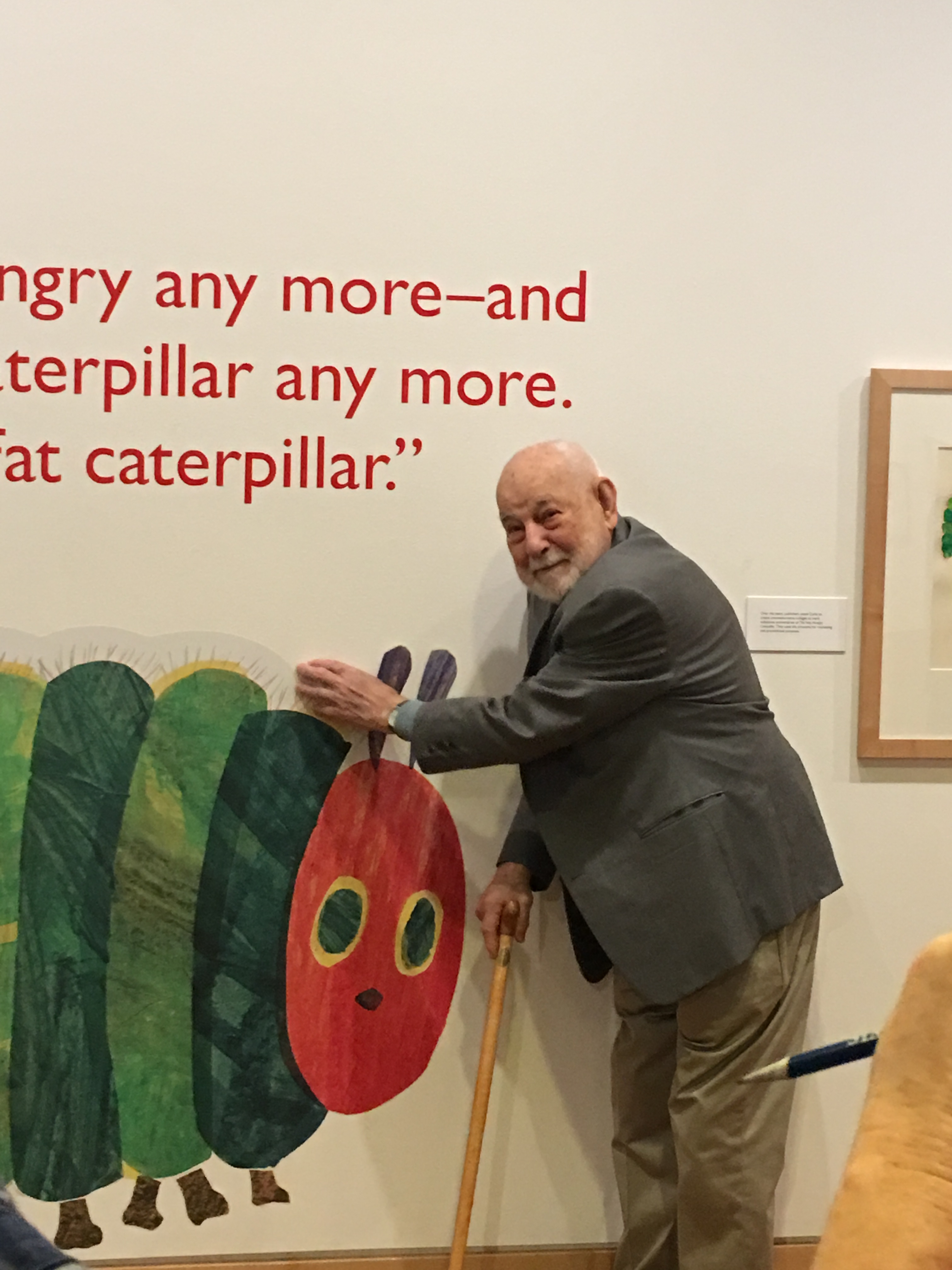
I returned to the front of the museum, waiting to hear if I ‘got in’ to the big event to hear Eric Carle speaking about fifty years of The Very Hungry Caterpillar. “Fitzkee, number ten. You’re in.” Yes!!
Eric Carle’s presentation was fascinating. At 89 years old he is witty and humorous, and captivates his audience. The Very Hungry Caterpillar is sold every thirty seconds and is written in over forty languages. While those facts are amazing, it is the stories behind creating the book that I will remember.
“It all started with a hole punch. I was bored”, said Carle. He picked up a hole punch and started using it on paper. “I thought of a bookworm, and created a story about Willi the Worm. My editor suggested a caterpillar, I said butterfly, and that’s how the story began.”
Eric Carle and the original Willi the Worm. Note the banana.
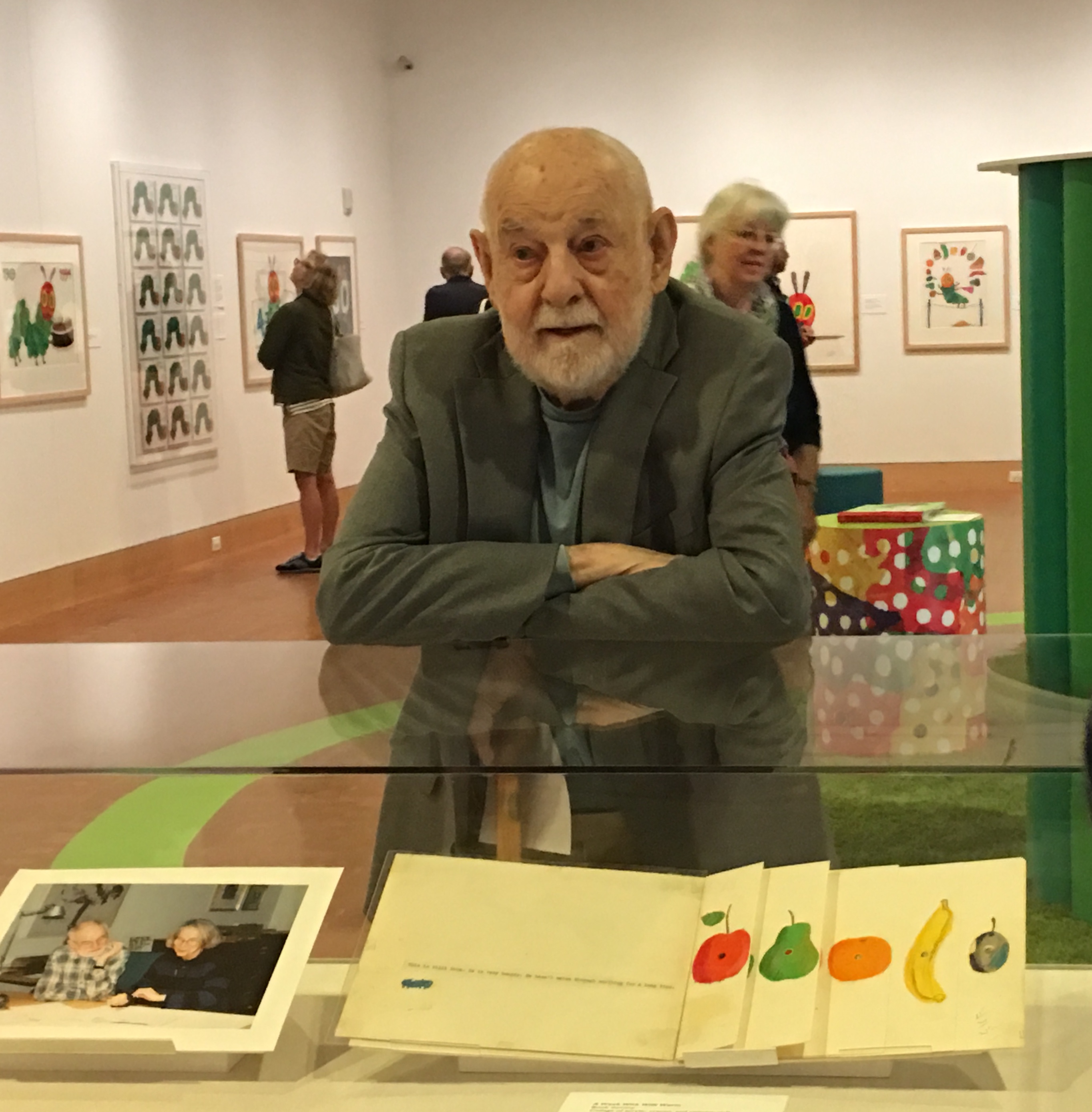
Of course there were many questions, and his answers were funny. The audience loved it:
“Were those short pages of the fruit and punched holes a nightmare for your publisher?”
“Oh, yes!”
“Why didn’t you use the banana in The Very Hungry Caterpillar?”
“I don’t know.”
“Really?”
“Well, it was longer than the other fruit.”
And that was the spark, the trigger that drives Eric Carle – how he creates his art. Of course the fruits needed to be uniform to work in the book. No banana. He became impassioned, wanting his audience to understand his work.
“Do you know there are only four colors? Red, blue, yellow, and black. They make up all the colors. Every color in the world. Red and blue are complementary colors. So are yellow and green.”
Then Eric Carle pulled out his box of tissue papers. Remember the tissue paper that came with shirts in boxes? That’s what he likes. Colored tissue paper? No thank you! He paints the paper with anything you can imagine, even carpeting. His box was filled with wonder.
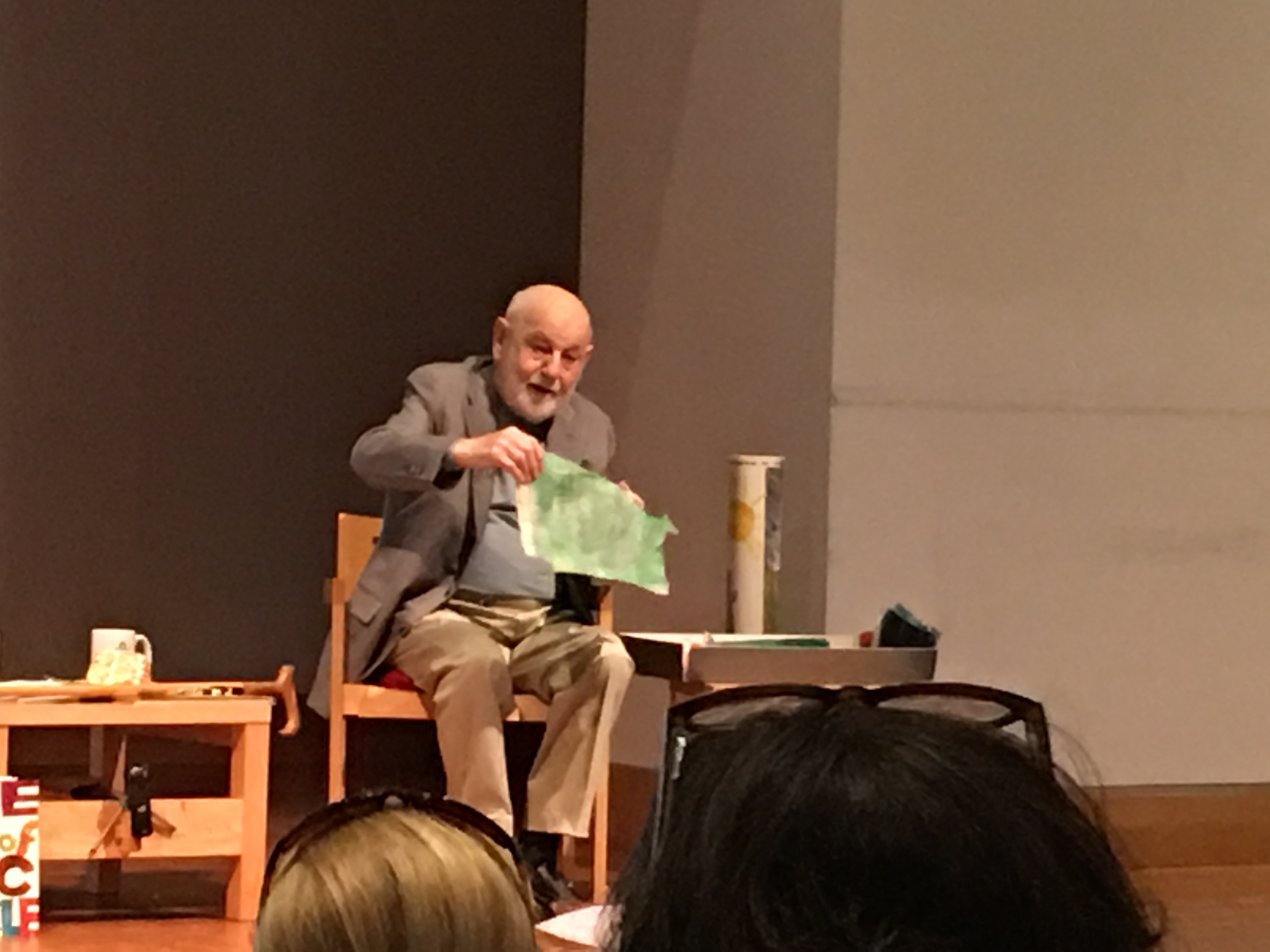
I was struck with the fact that Eric Carle only works on a white background, white paper. He was firm about this, talking about other books using too much background color. He is absolutely right, and I do the same thing in my classroom; my color is only in the activity at hand. The rest of the classroom is neutral and filled with plants and nature. He understands, and so do I.
For those of us who were ticket holders and ‘got in’, we were given a golden ticket, good for purchasing the 50th anniversary edition of the book, signed by the author. I was #5 with my golden ticket, in line to get the book, just like Charlie in “Charlie and the Chocolate Factory.”
This anniversary book will be released next month.
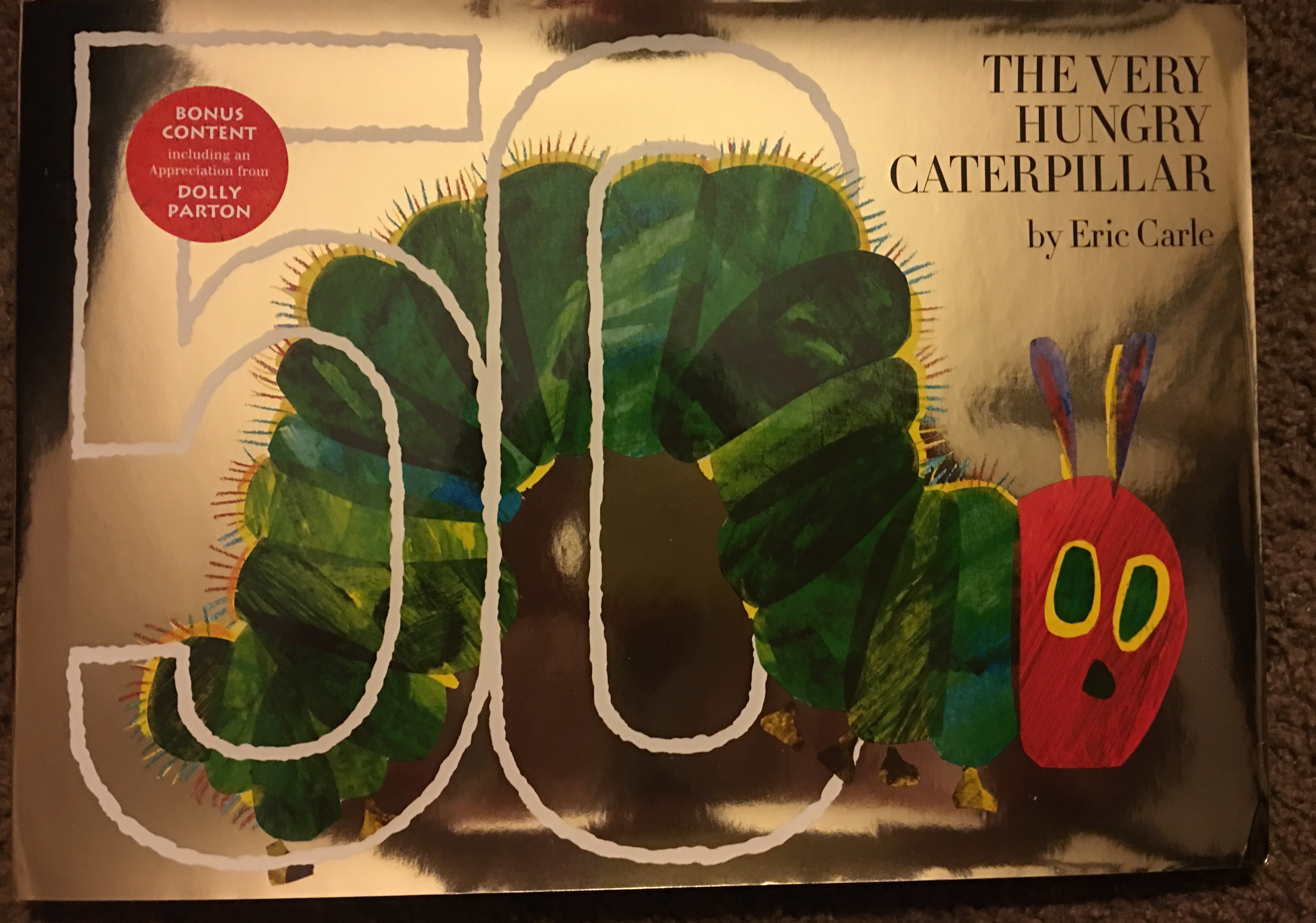
A day to remember.
Jennie
Originally posted on Playful Directions:
Yesterday was our first official Forest Four Day. Kindergarten and Pre-Kindergarten spent about two hours exploring our Northbound Trail. The undergrowth sprouted up beyond our knees over the summer, leading to a lovely, wild excursion.…
This week my Book Bears reading group at the public library had our first meeting of the year. September is always ‘bring your favorite book that you read over the summer’. It’s a great way to meet the kids – grades 2 & 3 – and see what everyone likes to read. I host the discussion, and invite each child to read a page aloud from their book. It’s a wonderful ice breaker.
I also get a feel for how they read, and how much they read. My wonderful all-boy group likes dragons, book series like The Boxcar Children, American war history, and much more. Book series are very popular. The diversity of interest is exciting.
At this point, everyone had talked about their book, and more importantly talked about why they liked it. Everyone was listening to each other. It’s about more than just the book. It’s about getting to know each other. I understand every child, from the ‘I don’t know anyone here’ and the ‘I don’t like to talk’, to the chatterbox. Somehow, in 20 minutes, we have all become pals. Me included.
And then something happened. A boy said that he reads every night. Another boy said he does, too. And another, and another…
The conversation went something like this:
A child: “I read 40 pages at night.”
Me: “That’s terrific.”
A child: “I read 100 pages a night. Well, one time I read 100.”
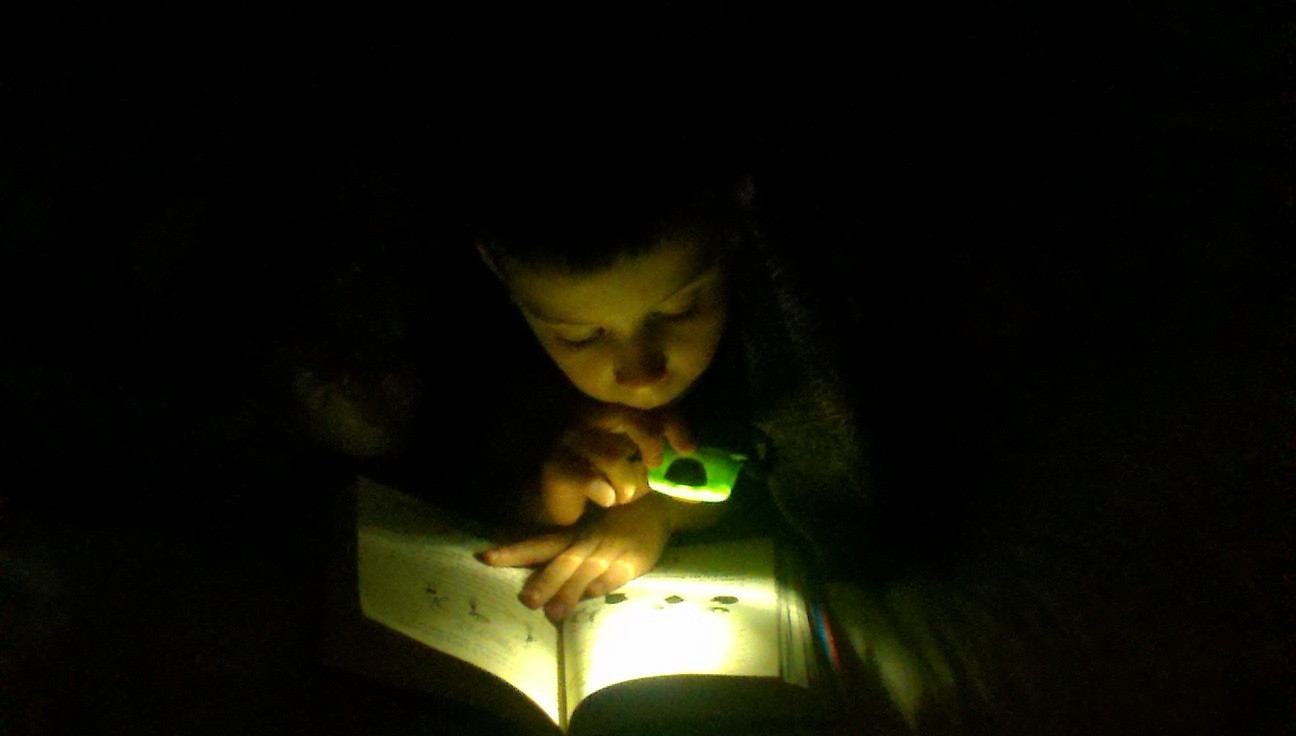
Me: “That’s hard to read so many pages. When I go to bed and read, I don’t read 100 pages. 40 or 50 is what I read at bedtime. Do you ever read in the dark?”
A child: “Sometimes I read in the dark.”
A child: “I do, too!”
Me: “Do you have a night light?”
All the children: “Yes!”
And this is where it gets interesting…
Me: “Do you ever read in the dark with a flashlight, under the covers, after Mom and Dad say it’s lights out?”
A child: “Yes! Sometimes I can’t stop reading because there’s an important part.”
A child: “I don’t have a flashlight. But my toothbrush does.”
Me: “Your toothbrush has a flashlight?”
The child: “No, it doesn’t have a flashlight. It just has a light inside. When Mom and Dad turned off the lights and said it was time for bed, I waited. Then I tip-toed into the bathroom and got my toothbrush so I could keep reading.”
Just wonderful!
Jennie

9/11 at school is Kindness, Peace, and Love Day. How do we help young children honor the brave people on 9/11? By remembering and celebrating how people were united in brotherhood and came together to help each other. We talk about heroes – firefighters, police officers, nurses, doctors, teachers…
Yes, heroes. They are the ones who face a tragedy and find goodness and strength. We can, too. Children can be heroes. There is a hero in us all.
Today we held the American flag. I talked to a whole school of children filled with big eyes and wearing red, white, and blue. I showed them how to stand and put their hand on their heart. We sang “God Bless America.” Then I asked, “Who is a hero?” The shout-outs were terrific:
Firefighters! Police officers! Teachers! Moms!
“You can be a hero, too. Yes, you can. You can help a friend. You can spread kindness. And when you see a firefighter or a police officer, please say ‘thank you’. So who’s going to celebrate Kindness, Peace and Love Day today?” Every hand went up.
We then sang one of our favorite songs about America, “Red, White and Blue” by Debbie Clement. While the song is a book, based on quilting America, it is the children’s favorite.

We will never forget 9/11, and we will always celebrate Kindness, Peace, and Love Day. Today was a wonderful day.
Jennie


