The Importance of Storytelling

Storytelling is akin to reading aloud. It ignites the mind and the spirit. It is the most important thing I do in my classroom, as year after year students return and want to hear those words again.

michellesaul's avatarMichelleSaulTheWordWitch

Currently in my Irish Literature class we are reading the novel Ireland by Frank Delaney. This novel focuses a lot on storytelling and the importance of telling stories to each other. The main character, Ronan, is deeply impacted by a storyteller who visited his village when he was nine-years-old and his main goal in this novel is to find the storyteller who changed his life. Reading this novel made me think of when I was younger and would have people tell me stories about their life or the lives of people they knew and the impact they had on me. From a very young age, I was drawn to words, I was drawn to reading and writing. As a child, there was no better feeling than having someone read to me or tell me a story because for a time, I was in another world, a world that I felt…

View original post 490 more words

Posted in Uncategorized | 1 Comment

Dear Teachers, Joy is the Magic Word

Dear Teachers,

As you start your new school year there is one word that will get you through the uncertainty and the worry.  It’s the same word that is the heart of educating.  That word is ‘joy’.  No, it’s not the happiness that children bring.  It’s the happiness that you bring because it inspires and ignites the mind and the heart of children.  Yes, that’s how it works.

Children come to you with big eyes, looking at you to teach them.  They don’t know what to think.  They want to learn, yet what they really want is to be inspired to learn.  That is where you can make a difference.

What do you like?  Because whatever it is, from math to music, that ‘like’ will become your best buddy, your guiding star, and the foundation to teach all the things that you like.  It will also become a portal to help you teach the things you may not enjoy.  If you know that every day you have some window of time to teach what you love, then you become an educator.  You go beyond teaching curriculum; you teach the child.

Do you like reading?  Does Because of Winn-Dixie or Charlotte’s Web make your heart jump?  Well, carry that book around and read it aloud on the playground, in the lunchroom, or at the bus stop.  If this is your passion, children will know, and they will listen.  They will learn.

Do you like science?  Carry a tuning fork, magnet, magnifying glass or flashlight in your pocket.  Pick up interesting pieces of nature and explore them with children.  This is one of the fundamental constants for learning.  If you are grounded in nature and science, bring your curiosity and discovery to the classroom and the playground; then the world will open up for children.

Do you love music?  Sing your favorite songs, sing the words to a book, sing poetry, or just sing the words that you say.  If this is your passion children will know.  They’ll listen and learn.  Introduce children to the music you love.  I bring my record player and old albums into the classroom.  Some years they love Beethoven, other years the Beatles.  The point is, they will love the music because you do.

Do you love art?  Don’t be afraid to use real artist’s watercolors when introducing art.  Children enjoy learning about famous pieces of art, too.  If you treat a child like an artist and treat the work s/he creates like a masterpiece, the results are remarkable.  When a child has created something and is incredibly proud, ask the child to give the art a title and record that to the work of art.  This simple affirmation has done more for the confidence and character of children than most anything I have done.

You may only like one thing, but that alone will open the door to help you teach the rest.

We all know that the emotional and social pieces for children need to be ‘there’ before effective learning takes place.  Well, flip-flop that fact from the child to the teacher.  If you the teacher are not grounded in an emotional and social component of educating, then how in the world can you get your message across to children?  You have to share your love and passions.  That’s your joy.  In that way, you are sharing you.  And, all that children want to know is that you love them and love what you are teaching.  If they know that, the floodgates will open to learning.

Maya Angelou was right when she said, “…people will never forget how you made them feel”.  The children I have taught for decades often return to school to visit.  They can’t put a finger on what it was in my classroom, but they come back.  Joy is the magic word.

Jennie

Posted in Teaching young children, Uncategorized | Tagged , , , , , , | 30 Comments

My Summer of Reading

This summer I immersed myself in great children’s books and quite a few young adult (YA) books that I’d never read, for a host of reasons.  So many wonderful books for older children were written when my children were very little.  At that time I was reading all the picture books I could get my hands on.  That started my passion for reading aloud good books, and yes, I became quite picky.  I knew the ‘good ones’.

A decade slipped by as I read furiously not only with my own children, but in my classroom.  I was building my library.  I was also building my greatest strength.  Then I began chapter reading.  To this day I can tell you where every family member was sitting in the den as I read aloud Little House in the Big Woods That was the turning point when I knew I could (and should) read good chapter books to preschoolers.  And I did.

This was way out of the box for preschoolers, yet I knew I could stretch those minds by painting pictures with words, reading with excitement, and always stopping to ask questions.  Oh, did it ever work!  I still wonder why teachers hesitate to chapter read to preschoolers.  My chapter book reading aloud became strong and successful for children. When Jim Trelease visited my classroom and included me in the latest edition of his million copy best seller book, The Read Aloud Handbook, I knew I was doing the right thing and doing it well.

So, this summer I set aside adult reading and dove into great older children’s and YA books.  It was the best summer of reading!  Here is the list of books I read:

Indian in the Cupboard,  by Lynne Reid Banks.  (A boy is faced with caring for and protecting someone that is both alive and miniature.  LOVED this book.  I’m reading it at the library.)

Because of  Winn Dixie,  by Kate DiCamillo.  (Dog lovers and people lovers, this book is about the courage of meeting many different people, and the open heart of a young girl.  This dog is the center of all that happens.)

Wonder,  by R.J. Palacio.  (This book is my MUST read for everyone.  A great kid, and ‘his story’.  He looks different, and he transitions into school.  His positive attitude and also the perspective of people around him are part of the story.)

A Wrinkle in Time,  by Madeline L’Engle  (This book must have influenced J.K. Rowling.  A girl helps to find her father, with the help of some ‘spirits’ and her brother and friend.  I think Mrs. Whatsit is my favorite character.)

The Witches of Worm,  by Zilpha Keatley Snyder.  (A spy adventure, along with a girl who is independent and finds a cat.)

From the Mixed Up Files of Mrs. Basil E. Frankweiler,  by E.L. Konigsburg.  (Children run away and hide in the Metropolitan Museum of Art.  They learn how to ‘survive’, and they discover amazing parts of the museum, like the angel statue.  That ignites a contact with the woman who originally had the statue.  The development of the characters in the museum is superb.)

Number the Stars,  by Lois Lowry.  (I am deeply moved by Annemarie.  She is not Jewish and neither am I, yet we both have dear childhood Jewish friends.  We both went to Temple and visited when our friends celebrated Jewish holidays.  Annemarie’s story is from Denmark in WWII.)

I plunged into every book.  I was a character in each book; protecting an Indian, traveling in time, defending, supporting dogs and cats, making magic, exploring the Metropolitan Museum of Art, being a Jew in Denmark, and championing  a great kid who sees the world in a wonderful way.  Many books are Newbery winners (no surprise). I can’t say enough good things about each book.

I think my summer of reading barely touched the surface of the great older children’s books I had not read.  YA books are just good as the normal fare.  Yes, I have read many, but not enough.  I’m on a roll!  It is never too late to read the books you have always heard about or wanted to read. Pleasure reading is as good as it gets.

Jennie

Posted in Teaching young children, Uncategorized | Tagged , , , , , , | Leave a comment

The Peace Quilt; Yet Another Story

Every so often (and more often than not) I’m surprised with an email about a former student.  Typically it comes from the parent, regaling a wonderful experience with their child, directly related to something from their days in my classroom  Juliet’s adventure at MoMA discovering Starry Night is a classic example.  After decades of teaching, those emails, photos, letters and conversations are my rich rewards.

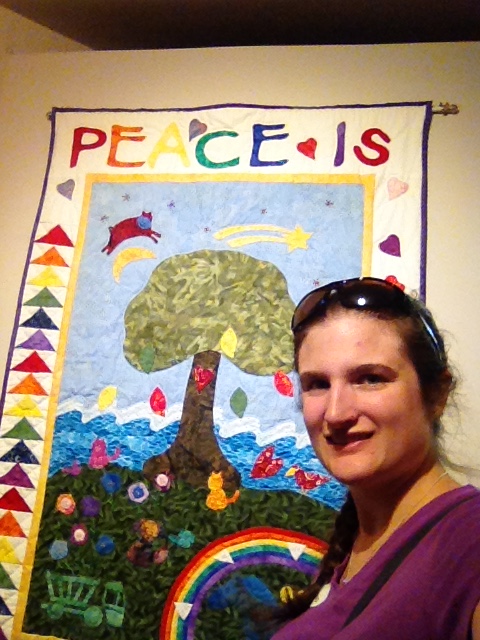
Then, there are the children who contact me directly well into their adulthood, like Michelle.  She has often asked me to retell the ‘Jennie Stories’ she fondly remembers, such as “The Peas and the Piano”.  She recently sent me this selfie with the Peace Quilt at the National Liberty Museum in historic Philadelphia.

Michelle and Peace QuiltShe wrote, “I was feeling homesick.  I visited this piece of Groton in Philadelphia.”  This quilt is my Blog photo; it’s one of the biggest projects I did with children and a path of emergent curriculum that led from making a book on Peace, to building a Peace Portal, to creating this quilt with a master quilter, Milly Cunningham.

Michelle remembers.  More than the quilt, she remembers words and language, reading and storytelling.  She wrote, “…the data is something that needs to be weaved into smaller doses”.  She refers to developing stories over time.  She’s right; as I tell and retell stories those words become the data from which to develop more stories and more thinking. In the words of Albert Einstein, “Imagination is more important than than knowledge.  For knowledge is limited to all we know and understand, while imagination embraces the entire world, and all there ever will be to know and understand.”

Well Michelle, you get it, or better yet you got it years ago in my preschool classroom.  It comes as no surprise that you work for a major literary agency.  You told me that “…often teachers read about the trees’ in education, but few are good at talking about the ‘forest'”.  You’re right.  When teachers see the forest, the trees grow, and the words and imagination flow.

Jennie

Posted in Teaching young children, Uncategorized | Tagged , , , , , , , | Leave a comment

Twists and Turns at Museums, Books and Art

A trip to a museum is much like climbing into a great book with a storyline of unexpected twists and turns.  Yesterday was no exception.  I visited the Eric Carle Museum in Amherst, Massachusetts.  It has the best bookstore I have ever been in, and I am really picky when it comes to books.  My husband actually told me one day that I was a book snob.  Ouch!  “I’m just picky because I know a good book when I read one” I told him. And, so many children’s books that I read are…well, let’s just say they’re ok.  Few have the power to make my heart race or put a lump in my throat.  So many of the books at the Eric Carle Museum do just that.

Before I went into the bookstore I checked out their current exhibit.  It was the illustrations of Fred Marcellino.  I admired his artwork of Puss in Boots.  Then I turned a corner and was face-to-face with the original artwork of The Story of Little Babaji.  I was thunderstruck.  This is one of the best books, ever; one that I have read over and over again, one that the children beg for and help chant the words.  I do play performances about this book for families.

And there I was, two inches away from the tigers running around the tree and Mamaji making pancakes.  Unexpected twists and turns at a museum, indeed.  Oh, there was more.  The museum displayed recent acquisitions, one of which was Paul O Zelinsky’s painting of Rapunzel, the final page of the book with Rapunzel and her family.  Wow!  Here was another great children’s book that I read, displaying the original art.  There’s nothing better than the real thing, seeing something that you have only known and enjoyed in pictures.  Museums do that.

After that heart stopping experience, I finally got to the bookstore.  Their collection of children’s books, chapter reading books and YA books is impressive.  Two hours of reading and exploring books hardly encompassed all I wanted to read.  The three books I had to buy were Take Away the A by Michael Escoffier, The Lion and the Bird by Marianne Dubuc, and My Grandfather’s Coat retold by Jim Aylesworth.

Pleasure reading can be full of learning.  The best part is that learning is a pleasure within a good book.

Jennie

Posted in Teaching young children, Uncategorized | Tagged , , , , , , , | 5 Comments

When Children Tell the Stories

Storytelling is a huge part of my classroom because it ignites the fire of listening and learning; new words, different ideas, adventure, compassion… hearing stories told aloud brings words and ideas to life.  This is exciting, because children are captivated and also absorbing big doses of language.  As they listen and think they gain a ‘golden link’, connecting the words they hear to the building blocks of complex emotions.

What’s the next step?  Having children tell the stories.  Here’s how I do this:  I show the children a picture, something that represents a host of feelings or questions.  Then I simply say, “Tell Me a Story”.  The first time I did this I showed a picture of Humphrey from the book Humphrey the Lost Whale by Wendy Tokuda.  Humphrey was on the bottom of the river, not doing very well.  The stories that children told exploded.  I couldn’t write their words fast enough.  Humphrey was either sick, sad, hungry, or lonely.  Then I asked the best question of all, “Why?”  Children couldn’t wait to answer.  This was exciting, because they had to really think.  This was hard!  We analyzed every ‘why’ from food to water to loneliness.  The more children looked at the picture of Humphrey, the more they thought.  And, the more they came up with answers.

I did “Tell Me a Story” with the Mona Lisa, and the same thing happened.  Children were captivated with telling what they thought was happening.  Did you know there is significant outdoor, woodland background to the portrait?  I didn’t know, but the children certainly picked that up when really looking at the portrait.  I never underestimate children.  The “why” question prompted a long and rather serious discussion.  It was remarkable for preschoolers, because the depth of discussion was on the level of elementary school.  Children’s minds were stretched.

Oh, the picture that children see for “Tell Me a Story” can’t be one with an obvious set of answers.  That would defeat the whole purpose.  It has to be subtle.  Children need to express their thoughts and stretch their minds.  That requires more complex pictures.

I often think that “Tell Me a Story” has the same power as my reading aloud.  Language is the foundation for learning how to read, then all the stories and reading aloud is the groundwork for learning how to think.

Goodness and knowledge.

Jennie

Posted in Teaching young children, Uncategorized | Tagged , , , , | Leave a comment

Storytelling With Children

The reason storytelling has been a mainstay of communication for centuries goes far beyond imparting words to tell a story.  Words come to life when spoken aloud.  People have to listen, stretch their minds, and make the pictures in their head.

With young children this is especially important.  The brain develops first by hearing. Think about it; the primary method of instruction in school through third grade is oral. Take that a step further to telling a story, adding voices and ideas to make a child think. Those words translate into complex thoughts.  Children learn to problem solve, be brave, become accepting.  Storytelling opens a door to learning new things.

Perhaps my storytelling parallels my chapter reading, because they both give children the best learning.  There is no spoon feeding or visual or even a tangible.  It takes concentration.  Yet children beg to hear those words.  Boy, do they listen!

Last summer I wrote many of my ‘Jennie Stories’ on my blog.  One of my followers vividly remembers “The Peas and the Piano” story and pleaded with me to post it.  Of course all my stories are true, which is another element that children love; Jennie is just like the children when she was a little girl.  That’s a special bond.

“The Peas and the Piano”

It happened like this…  I really hate peas.  I always have.  At dinner it seemed like we had peas all the time.  My mother would put three peas on my plate, and I had to eat them.  It was awful, so she would give me three glasses of milk, one for each pea.  Oh, it took forever to swallow each pea with a full glass of milk.

When my parents went out to dinner my big brother and sister babysat us, and we ate dinner in the breakfast room.  Now, our big upright piano was in the breakfast room.  When we had dinner there my brother and sister didn’t pay close attention to us.  So, I would put each pea on my flat, open hand.  Then, I would aim it under the piano and flick it with the finger of my other hand.  Bingo!  Peas gone, under the piano.

This went on for a few years.  One day my mother announced she was moving the piano to wash and wax the floor.  Moving the piano!  Oh, no!  All those years of peas were there!  I left the house on my bike for the whole day.  When dinner time came I knew I had to go home.  I slowly walked into the house.  There was my mother.  One hand was on her hip and the other hand was holding a dustpan filled with a mountain of old, dried peas.  I was in big trouble!

This is one of my many ‘Jennie Stories’.  Children love them.  It’s language and learning and fun, all in one.  More stories to follow…

Jennie

Posted in Teaching young children, Uncategorized | Tagged , , , , , | 9 Comments

Summer Camp Play Performances

Every summer my school offers a summer camp program.  The most exciting part of my camp group (six to eight year olds) is the ‘play performance’.  It didn’t start that way at all.  Camp is camp, and that means having a real experience of outdoors, swimming, nature activities, arts and crafts, and camp songs.  Play performances seemed to evolve on their own.

Our camp has four themes.  When we are Kings and Queens, my older group is the ‘Mighty Mighty Dragons’. When we are The Wild West, my group is the ‘Mighty Mighty Mustangs’.  We’re Stingrays and Cheetahs for the Safari and Ocean units, always ‘Mighty Mighty’, of course.

It started with the Wild West years ago.  I couldn’t help but notice that the children began to do things on their own.  They built a tower for our mustang puppet, made up songs, and pretended to be different characters out west.  This was emergent curriculum, children so ready to act out something.  That ‘something’ turned out to be an incredible play performance. I can’t liken it to the success of building a difficult block structure, or learning to read, or painting the best piece of art; this play had that same level of accomplishment yet much more, because it involved the joint efforts of all the children.  That’s collaboration.  Pretty incredible for six and seven year olds.

Here’s where it gets remarkable; the children planned everything from script to costumes to parts.  I only guided and encouraged.  Well, I added the excitement of surprise by sneaking the children into the storage room to find a prop or a part for a costume.  We did this crawling the hallway and dodging all the other groups, James Bond style.  A scarf became a dress, and poster board was cut into cowboy chaps and a doorway.  The play became a special secret, even to parents.  The camp director ‘got it’ and became a spy.  Of course all of this empowered the children.

Kevin was shy, yet he seemed to like being part of the play.  When we sneaked into the storage room to look for items, he wanted to find something for his dog costume.  He found a piece of brown card stock paper and was eager to cut it out.  I saw that he was cutting out something tiny, a triangle to be exact.  “That’s my tail”, he said.  I asked what else he needed for a costume.  “Nothing”, he said.  When we walked out on stage, he stood so proud and tall.  He loved his costume.  No one else could even see it, but that didn’t matter.  Kevin knew it was there- it was his.  He walked out onto that stage with tall shoulders.  In his performance he was no longer the shy boy.

Owen often asked when his Mom would pick him up or how many hours there were in camp.  Swimming wasn’t his favorite activity, especially with the big water slide and cold water.  He didn’t have a large circle of friends at camp.  Yet when the children planned the play, he wanted to be ‘head of the cheetah family’.  There are six days in a camp session, and by day four he cried.  Day five was too much, and at drop-off Mom just took him home.  Oh, we had talked about the play on and off, and he really wanted to do it.  We even talked about his tall orange socks and how they would be a perfect cheetah costume for the play.  Day six, the last day of camp and ‘play day’ arrived.  Owen came to camp, a little unsure.  He was a star in the play!  Boy, did he pull it off with a huge smile.

I have learned along the way not to assign parts or give costumes or even have a say in the play.  Children always come up with something amazing and far more interesting than I could.  I never underestimate young children.  And, I always support their ideas.  That’s why our play performances are incredible.  When children are empowered and encouraged to do something on their own, they rise to the occasion.

Jennie

Posted in Teaching young children, Uncategorized | Tagged , , , , , , , | Leave a comment

Boston’s Music, “Pops Goes the Fourth”

I moved to Massachusetts in 1984.  Since then, I have faithfully watched the Boston Pops perform every Fourth of July.  Back then, John Williams was the conductor.  He was the man who wrote the music for my favorite movies, “ET”, “Indiana Jones” and “Jaws”.  I couldn’t believe he was conducting the orchestra I was watching.  This was seeing all that I had been listening to for many years.  I was hooked on ‘Pops Goes the Fourth’.

Here’s what matters: the music is universal, from opera to pop to country, and everything in between.  Exposure!  Children need to hear music and see music performed.  They need to listen to different sounds; not just high and low, but sounds that make them feel and wonder.  They need to see a variety of instruments, looking and listening to the sounds they make.  They need to watch musicians play the instruments so they can make a connection with sound.  They need to wonder what it would be like to blow a horn or prop up a cello, or pull a bow across strings.  They need to imagine doing just that in order to make music.

This year I watched Melinda Doolittle sing.  One of the best parts of her performance was her saxophone player.  Then, there was the Sons of Serendipity with their harp and cello.  The sounds of those instruments took me to another place.  I thought, what if someone asked me who the artists or composers are, or what the titles of the songs are, or how I explain music to children.  Instinctively I knew the answer.  Appreciating and understanding music comes from listening and looking, feeling and exploring.  It includes both vocal and instruments.  That’s what I do.  Can a preschooler love Vivaldi or the cello?  You bet!  The Boston Pops concert does that every year.

When I was a child I loved Mickey Mouse cartoons.  I vividly remember the one with the orchestra and the wind blowing away all the musicians.  I also loved Mickey Mouse in Fantasia.  It was adulthood before I realized that classical music was the foundation for those cartoons and movies.  Walt Disney did for children what the Boston Pops does for people; bringing a variety of music and instruments into an ‘every day life’.  Genius!

Jennie

Posted in Teaching young children, Uncategorized | Tagged , , , , | Leave a comment

The Real ‘Teddy’ Story, and More

This weekend I cleaned my office; the yearly organization and the game of ‘keep or toss’.  Every year I take great care with three stories that are worn and torn, written long before computers and the internet.  Those stories are my inspiration, and I will keep them long after they are yellowed and the folds are worn.  I am not a ‘fluff’ teacher; I don’t depend on, or look for feel-good stories.  I am so tuned-in to children that I instinctively follow their interest, and that makes my teaching become incredibly meaningful, for the topic and for the child.  So, why do I keep these three stories?  They just hit my heart.

One is ‘Teddy’.  Recently people on Facebook have been circulating the ‘Teddy’ story.  Unfortunately it is abbreviated.  It’s one of the stories that I keep for inspiration, even though it is probably a story drawn from a collection of the author’s many years of teaching.  I think it’s important to tell the whole Teddy story.  Yes, it is dated, yet still a wonderful story.  Here it is, and it’s a great read:

“As she stood in front of her 5th grade class on the very first day of school, she told the children an untruth.  Like most teachers, she looked at her students said that she loved them all the same.  However, that was impossible, because there in the front row, slumped in his seat, was a little boy named Teddy Stoddard.

Mrs. Thompson had watched Teddy the year before and noticed that he did not play well with other children, that his clothes were messy and that he constantly needed a bath.  In addition, Teddy could be unpleasant.  It got to the point where Mrs. Thompson would actually take delight in marking his papers with a broad red pen, making bold X’s and then putting a big fat “F” at the top of his papers.

At the school where Mrs. Thompson taught, she was required to review each child’s past records and she put Teddy’s off until last.  However, when she reviewed his file, she was in for a surprise.

Teddy’s first grade teacher wrote, “Teddy is a bright child with a ready laugh.  He does his work neatly and has good manners… he is a joy to be around.”

His second grade teacher wrote, “Teddy is an excellent student, well liked by his classmates, but he is troubled because his mother has a terminal illness and life at home must be a struggle.”

His third grade teacher wrote, “His mother’s death has been hard on him.  He tries to do his best, but his father doesn’t show much interest, and his home life will soon affect him if steps aren’t taken.”

Teddy’s fourth grade teacher wrote, “Teddy is withdrawn and doesn’t show much interest in school.  He doesn’t have many friends and he sometimes sleeps in class.”

By now, Mrs. Thompson realized the problem and she was ashamed of herself.  She felt even worse when her students brought her Christmas presents, wrapped in beautiful ribbons and bright paper, except for Teddy’s.  His present was clumsily wrapped in the heavy, brown paper that he got from a grocery bag.  Mrs. Thompson took pains to open it in the middle of the other presents.  Some of the children started to laugh when she found a rhinestone bracelet with some of the stones missing, and a bottle that was one-quarter full of perfume.  But she stifled the children’s laughter when she exclaimed how pretty the bracelet was, putting it on, and dabbing some of the perfume on her wrist.  Teddy Stoddard stayed after school that day just long enough to say, “Mrs. Thompson, today you smelled just like my Mom used to.”

After the children left, she cried for at least an hour.  On that very day, she quit teaching reading, writing and arithmetic.  Instead she began to teach children.  Mrs. Thompson paid particular attention to Teddy.  As she worked with him, his mind seemed to come alive.  The more she encouraged him, the faster he responded.  By the end of the year, Teddy had become one of the smartest children in the class and, despite her lie that she would love all the children the same, Teddy became one of her “teacher’s pets.”

A year later, she found a note under her door, from Teddy, telling her that she was the best teacher he ever had in his whole life.

Six years went by before she got another note from Teddy.  He then wrote that he had finished high school, third in his class, and she was still the best teacher he ever had in life.

Four years after that, she got another letter, saying that while things had been tough at times, he’d stayed in school, had stuck with it, and would soon graduate from college with the highest of honors.  He assured Mrs. Thompson that she was still the best and favorite teacher he had ever had in his whole life.

Then four more years passed and yet another letter came.  This time he explained that after he got his bachelor’s degree, he decided to go a little further.  The letter explained that she was still the best and favorite teacher he ever had.  But now his name was a little longer… The letter was signed, Theodore F. Stoddard, MD.

The story does not end there.  You see, there was yet another letter that spring.  Teddy said he had met this girl and was going to be married.  He explained that his father had died a couple of years ago and he was wondering if Mrs. Thompson might agree to to sit at the wedding in the place that was usually reserved for the mother of the groom.  Of course, Mrs. Thompson did.  And guess what?  She wore that bracelet, the one with several rhinestones missing.  Moreover, she made sure she was wearing the perfume that Teddy remembered his mother wearing on their last Christmas together.

They hugged each other, and Dr. Stoddard whispered in Mrs. Thompson’s ear, “Thank you Mrs. Thompson for believing in me.  Thank you so much for making me feel important and showing me that I could make a difference.”

Mrs. Thompson, with tears in her eyes, whispered back.  She said, “Teddy, you have it all wrong.  You were the one who taught me that I could make a difference.  I didn’t know how to teach until I met you.”

(For you that don’t know, Teddy Stoddard is the Dr. at Iowa Methodist in Des Moines that has the Stoddard Cancer Wing).

I will share my other two stories with you over the summer.  They are really good!

Jennie

Posted in Teaching young children, Uncategorized | Tagged , , , , , | 4 Comments