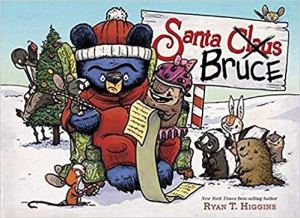
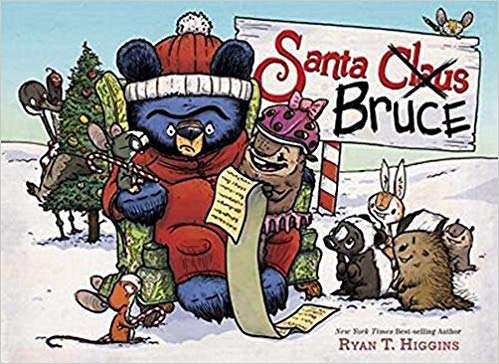
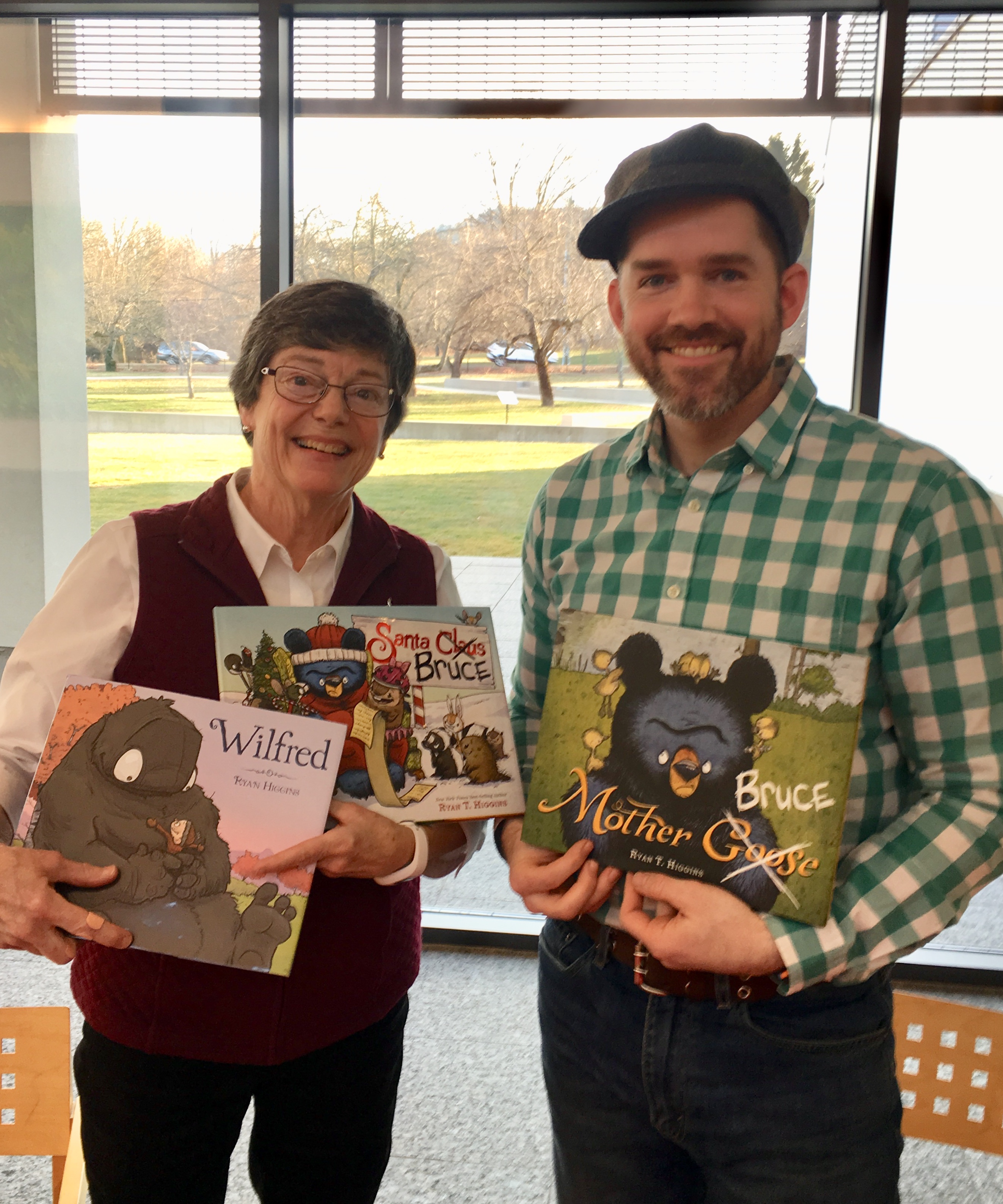
I was fortunate to meet Ryan Higgins, a favorite children’s book author, at the Eric Carle Museum last week. He read aloud his new picture book, Santa Bruce. I’m a big fan of his Mother Bruce books, so I grabbed that chance to meet him and hear him read aloud.
Mo Willems slipped into the back of the room to hear him read, too.
First, Santa Bruce is a winner! Hilarious with a capital H. And I’m picky about good books. Secondly, Ryan is a very good reader-aloud. Not all authors can wear that reader badge.
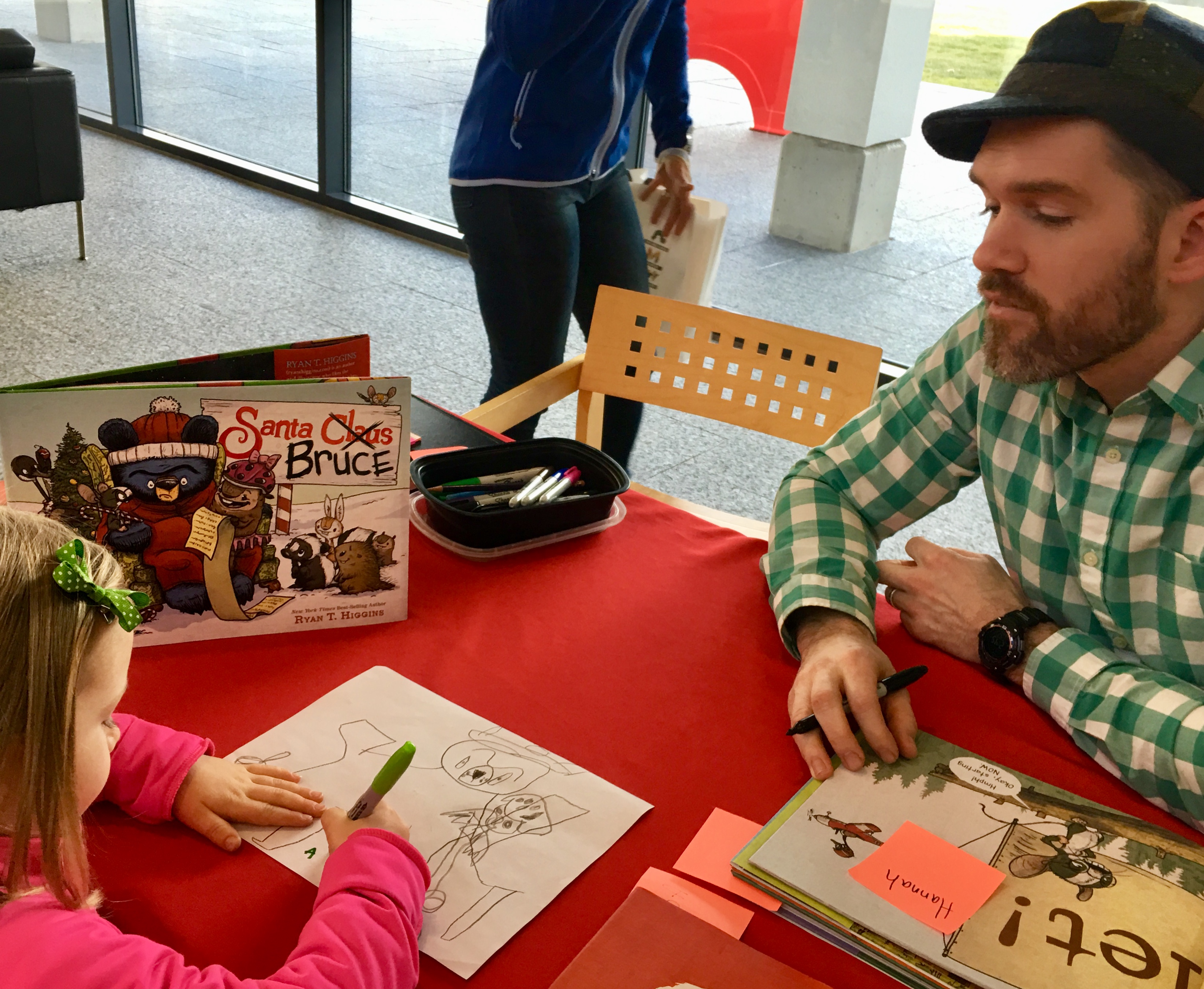
And then there was Addie, the four-year-old little girl who walked right up to Ryan after he finished reading the book and practically shoved a drawing she had made of Bruce the bear into his hands. He was genuinely touched. Ryan took the drawing and happily examined it. He said,
“I have a bulletin board on the wall in my art studio. I’ll put this picture right there. Then, I can see it when I draw and be inspired.”
Yes, he said just that. And it gets even better…
After story time came the book signing. Addie and her mom were in line in front of me. When it was their turn Ryan immediately recognized the little girl and stopped. He went through his things and pulled out her drawing.
“Addie, will you sign your drawing for me?”
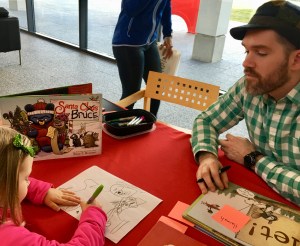
I wanted to turn around and scream to everyone in line, Do you see what this man is doing? Do you see how wonderful this is? Do you see that he ‘gets it’? I was witness to a powerful moment.
Addie and Ryan chatted away. I smiled and took a picture. When it was my turn I told him most preschoolers can’t make representational drawings. He knew and smiled. I also told him how my students like his earlier book, Wilfred.
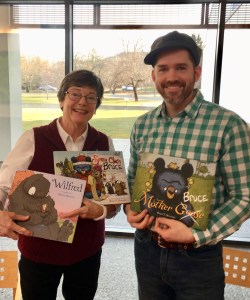
The event was terrific. He also read aloud his new book We Don’t Eat our Classmates about a kindergarten dinosaur named Penelope (really funny), and drew characters for the children. I didn’t know that the endpaper was actual drawings children had made. Thank you, Ryan T. Higgins!
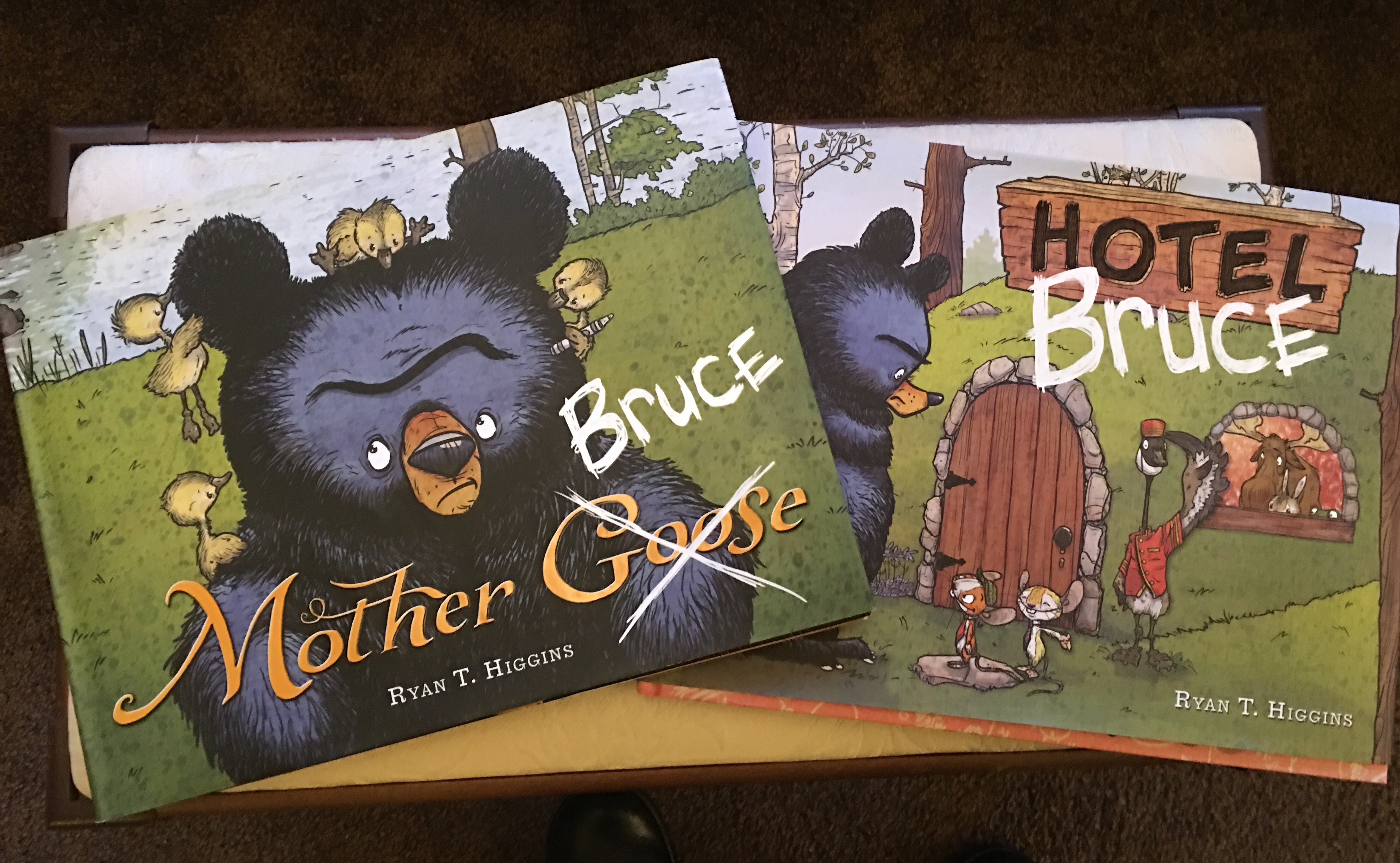
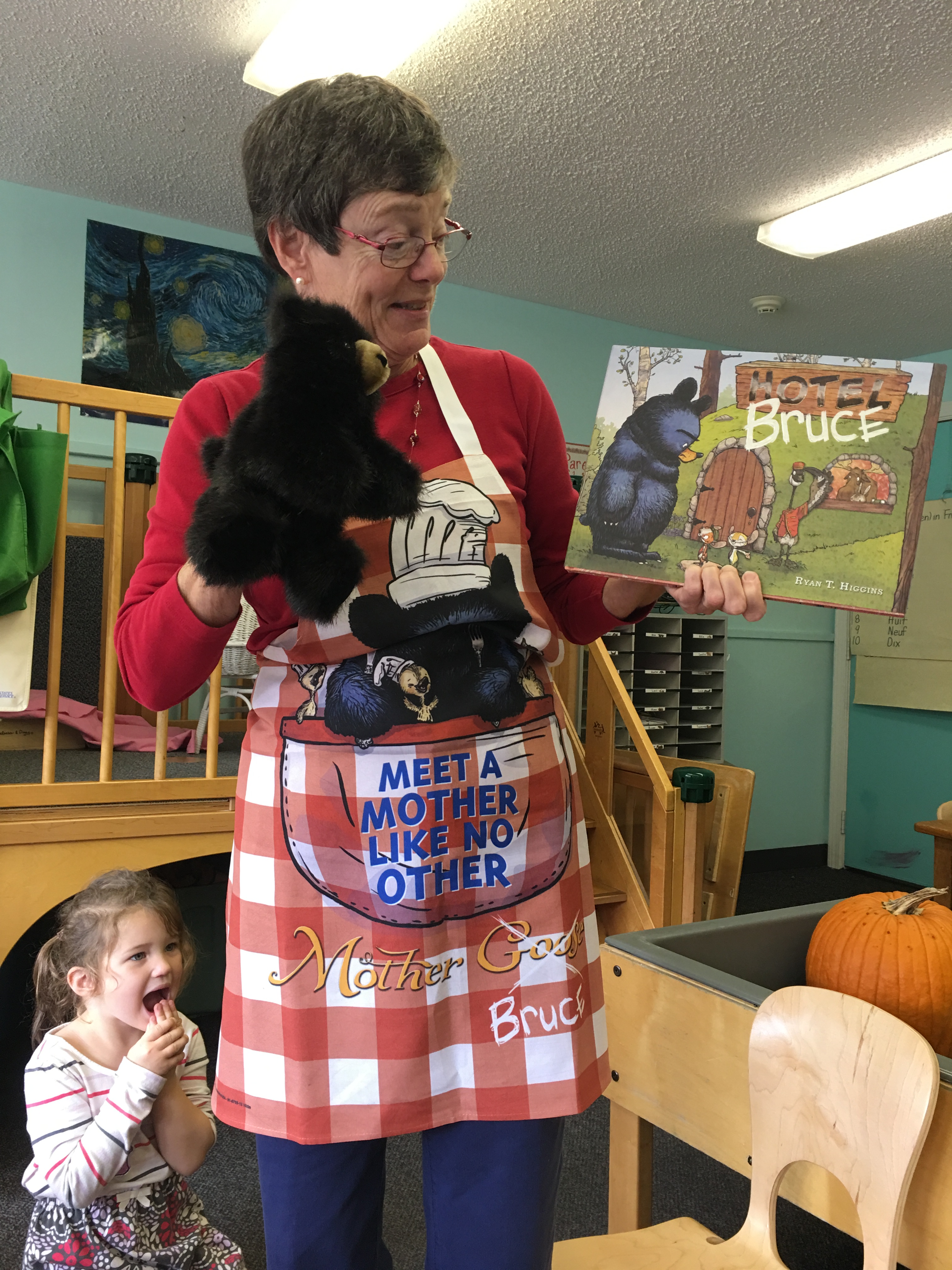
Here is what I wrote about the Mother Bruce books a few years ago:
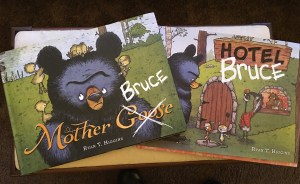
Author Ryan T. Higgins is hysterical. I mean unexpected, fall-down-laughing hysterical. His two children’s books are favorites in my classroom. The storyline is a grumpy old bear who likes eggs, and what happens is imaginative and funny. I read Mother Bruce to all my fellow staff at school and they laughed, out-of-control laughing. It was hard to rein them in.
Here’s the twist; Mother Bruce and Hotel Bruce appeal to both children and adults. That makes it a delightful read for parents and their children. I remember watching The Muppets on TV with our kids. This show appealed to both children and adults (the two old men in the balcony is a case in point). Therefore, families watched it together. If a book is good enough to appeal to both, that’s a brass ring. Parents will want to read the book aloud, and children will benefit from far more than just a good story.
That benefit is vocabulary!
This is the single most important item to ensure that a child will succeed in all subject areas in school. All areas! The more words a child hears, the better s/he will do in school. Period. Wow!
That fact changed my life in teaching.
I have always loved reading books to children, and then I took the next step; I made sure books in the classroom were front-facing, I read stories with a passion, stopping at every ‘new word’. That was brilliant. We looked up those words in the dictionary (yes, in the middle of reading the story). I read a story at least twice a day, and also whenever a child wanted to read.
Yes, they wanted to read. Books were everywhere in my classroom. The more we read together, the more we wanted to read. And, the better the children performed. Morning Meetings became long, sometimes over fifteen minutes, because we had important things to learn- geography, math, science experiments, instruments, famous artists, poetry… there was so much to learn and reading books gave children the focus and vocabulary to absorb it all.
That is powerful and cements why I do what I do.
The vocabulary words in Mother Bruce and Bruce Hotel that children were eager to learn are: victim, stern, pesky, migration, creative, reluctantly, hibernate, rodents, commotion, and translator. My children are three and four years old. I doubt many children of this age learn these words.
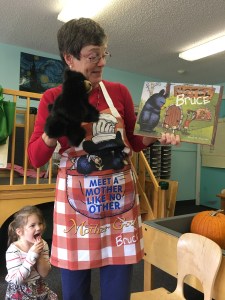
Thank you Ryan T. Higgins for quality literature that appeals to all ages. Good literature is my tool to make a difference.
Jennie









 A Teacher's Reflections