I stopped by school last week, which is currently in Summer Camp mode. High school volunteers are a welcome and fun part of the group. What happened was delightful:
First I was mobbed by children (always wonderful), then Jess, a new teacher who is spectacular, asked if I wanted to pop into the classroom to say hi to the kids. Of course I did. Her volunteer was Sophie, a former student in my class.
Sophie: “Hi Jennie.”
Me: “Sophie! Jess, Sophie was an Aqua Roomer.”
Jess: “Really! That’s so cool.”
Me: “Sophie, do you remember the God Bless America Quilt? Do you remember Milly the quilter?”
Sophie beamed with shooting stars from her eyes and smile. She kept shaking her head ‘yes’.
Jess: “Who’s Milly? What quilt?”
Me: “We designed a quilt because the children loved singing “God Bless America.” Milly made the quilt and we went on a field trip to NYC to the Intrepid Museum.”
Jess: “A field trip to NYC?” Her stunned face said it all.
Me: “Yup. Tell her, Sophie.”
Sophie did. Her cheeks must have hurt from all that smiling.
Me: “Sophie, I still have the book the Aqua Roomers made of the song. I know which page is yours. I’ll bring the book in to show you.”
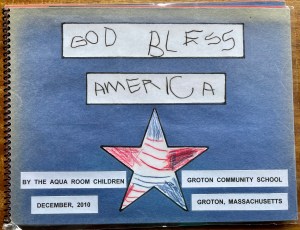
Book cover
 Sophie’s page
Me: “Jess, we talk about emergent curriculum all the time. I had no idea the song would become beloved. I had to follow the interest of the children. I have a book of the entire year. I’ll bring it in to show you.”
 Book cover
 On the Intrepid
Sophie is the second child from the right
I go to school again tomorrow for a meeting. I can’t wait to show Sophie and Jess the books. Stay tuned!
A Nice Bit Of History!
(Did you know there are lyrics before the words “God bless America, land that I love.”?)
Frank Sinatra considered Kate Smith the best singer of her time and said that when he and a million other guys first heard her sing “God Bless America” on the radio, they all pretended to have dust in their eyes as they wiped away a tear or two.
Here are the facts… The link at the bottom will take you to a video showing the first public singing of “GOD BLESS AMERICA”. But before you watch it, you should also know the story behind the first public showing of the song.
The time was 1940. America was still in a terrible economic depression. Hitler was taking over Europe, and Americans feared we’d have to go to war. It was a time of hardship and worry for most Americans.
This was the era just before TV, when radio shows were HUGE, and American families sat around their radios in the evenings, listening to their favorite entertainers, and no entertainer of that era was bigger than Kate Smith.
Kate was also large; plus size, as we now say, and the popular phrase still used today is in deference to her, “It ain’t over till the fat lady sings”. Kate Smith might not have made it big in the age of TV, but with her voice coming over the radio, she was the biggest star of her time.
Kate was also patriotic. It hurt her to see Americans so depressed and afraid of what the next day would bring. She had hope for America and faith in her fellow Americans. She wanted to do something to cheer them up, so she went to the famous American songwriter, Irving Berlin (who also wrote “White Christmas”) and asked him to write a song that would make Americans feel good again about their country. When she described what she was looking for, he said he had just the song for her. He went to his files and found a song that he had written, but never published, 22 years before – way back in 1917. He gave it to her and she worked on it with her studio orchestra. She and Irving Berlin were not sure how the song would be received by the public, but both agreed they would not take any profits from God Bless America. Any profits would go to the Boy Scouts of America. Over the years, the Boy Scouts have received millions of dollars in royalties from this song.
This video starts out with Kate Smith coming into the radio studio with the orchestra and an audience. She introduces the new song for the very first time, and starts singing. After the first couple of verses, with her voice in the background still singing, scenes are shown from the 1940 movie, “You’re In The Army Now.” At the 4:20 mark of the video you see a young actor in the movie, sitting in an office, reading a paper; it’s Ronald Reagan.
To this day, God Bless America stirs our patriotic feelings and pride in our country. Back in 1940, when Kate Smith went looking for a song to raise the spirits of her fellow Americans, I doubt whether she realized just how successful the results would be for her fellow Americans during those years of hardship and worry… And for many generations of Americans to follow.
Now that you know the story of the song, I hope you’ll enjoy it.
Many people don’t know there’s a lead-in to the song since it usually starts with “God Bless America …..” So here’s the entire song as originally sung….. ENJOY! Please click the below:
https://www.youtube.com/embed/TnQDW-NMaRs?rel=0














 A Teacher's Reflections