
Death is the dreaded “D” word when talking with children, but it doesn’t have to be. It can be an open door to a much needed conversation. Here’s what happened at school:
Our Memory Garden at school is visited by children, but often in a fleeting way. Questions are welcome, and sometimes when that happens, they turn into much more.
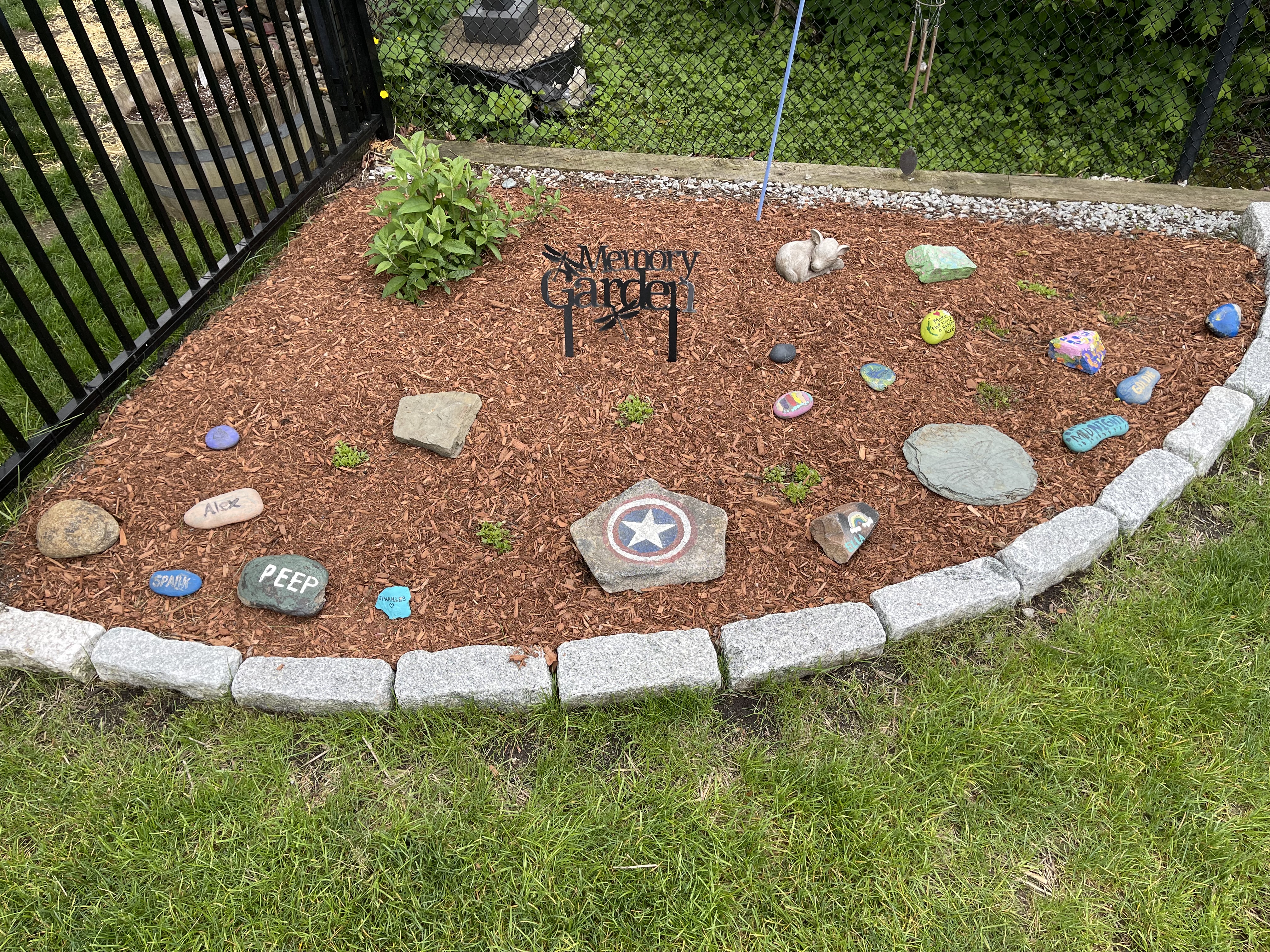
One child stops to look, asks a question, and it becomes a magnet for other children to see what’s happening and join in. It was Eloise. The painted rocks caught her eye, and she asked me what they were. Well, Eloise is very intuitive, so explaining they were in memory of classroom pets who had died was not enough. By now there was a big crowd around the Memory Garden. I read the name on every stone and recalled the pet and the classroom. It was Captain America that stumped Eloise. She wanted to know if the father was buried there. Of course she did. Then there was the deer, in memory of a baby who died, and the dragonfly in memory of a student who died. I answered all the questions. Children were silent, but they didn’t want to leave. A Memory Garden does that. The dreaded “D” word is no longer dreaded.
I want to share a blog post from 10 years ago about the Memory Garden. Hang on to your hats, because what happened is something I will never forget. Never.
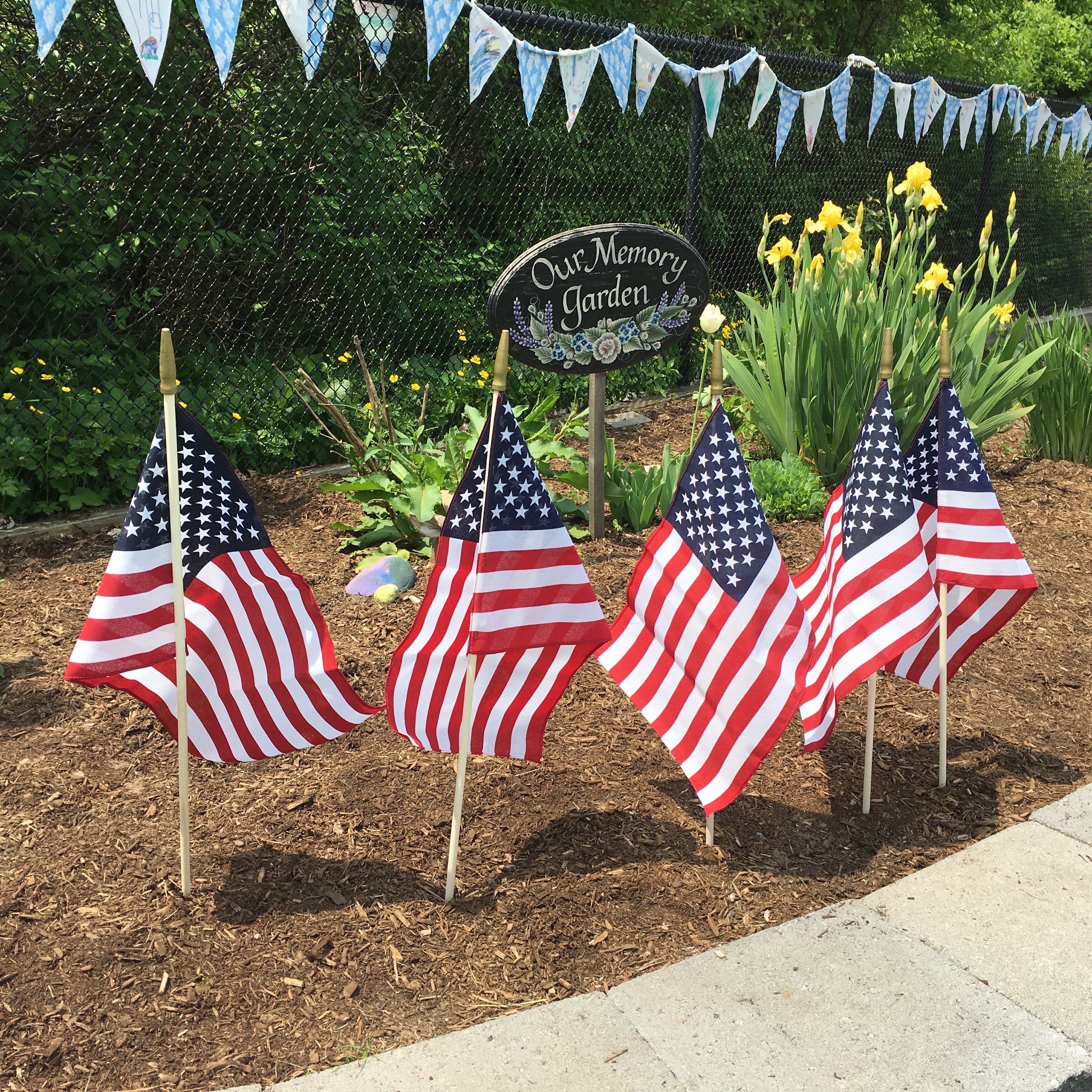
Our Memory Garden at school is a raised bed of beauty; flowers, sculptures, American flags, and a collection of painted rocks, all to mark classroom pets and loved ones who have died over the years. The garden sits quietly as children run and play alongside. It is welcoming, and children who visit inevitably ask questions.
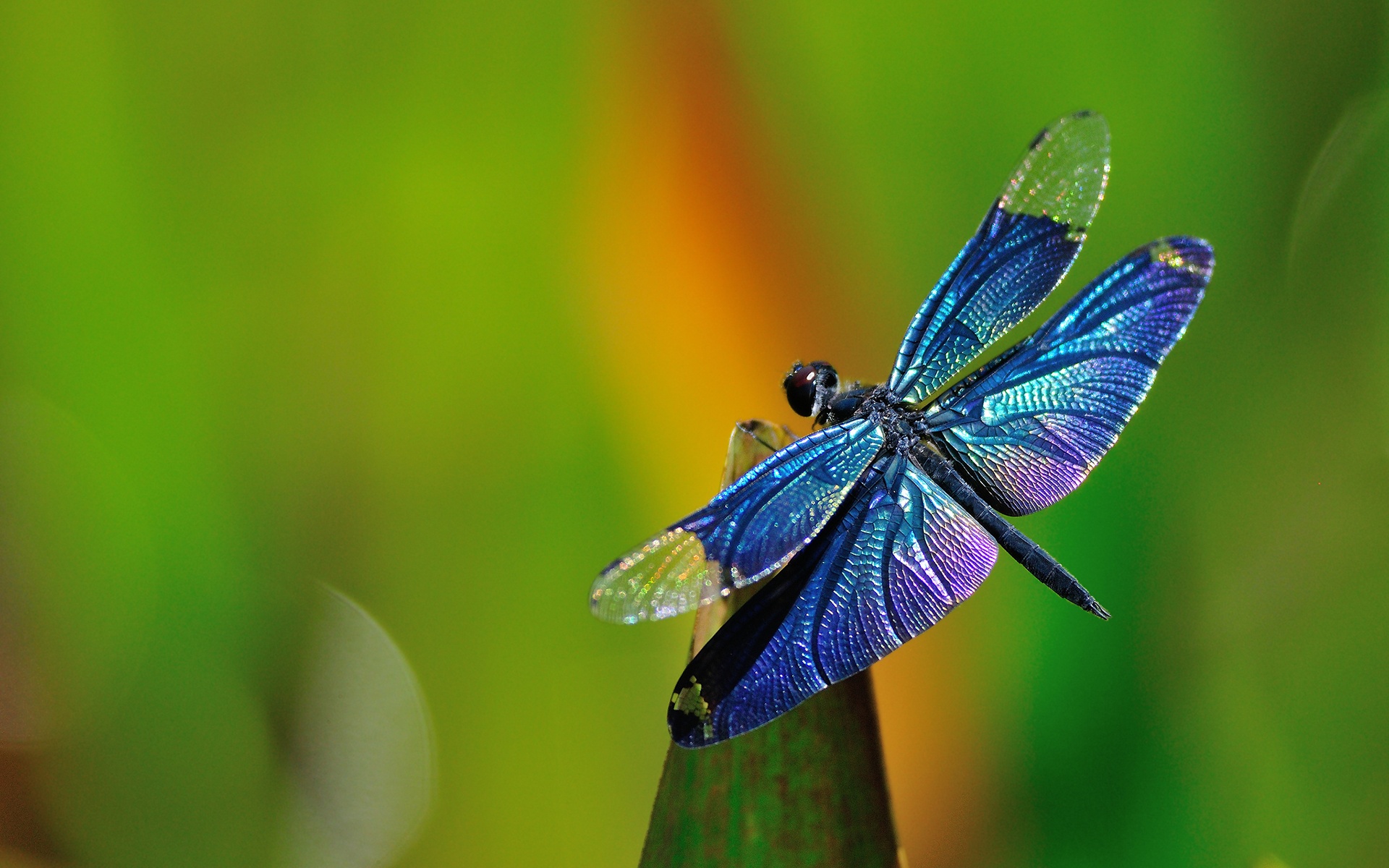
Additionally, there is a flat paving stone with a carved dragonfly in remembrance of Taylor, a little boy in our school who died some years ago. Taylor adored dragonflies. Yesterday I noticed the garden needed weeding, and sat on the low stone wall to take care of Taylor’s dragonfly. Emma came over to ask what I was doing. She wanted to help me weed. That was the beginning of a remarkable series of events about dying.
Yes – dying – the word that scares teachers and parents. The “D” word. Something they hope they’ll never have to talk about until their child is older. I wasn’t scared.
Emma noticed the dragonfly and we weeded together to make things beautiful again. She was quiet, and this work seemed to be soothing to her. Well, that’s what I thought at first. Yet, it was far more than the weeding that was soothing Emma which I would soon discover. Ever-cheerful Scarlet bounced over with her signature big smile and curiosity. It was Scarlet’s first real visit to the garden.
“What’s that statue?”
“It’s a baby deer.. It’s for someone who died long ago.”
“Died? Is he under the deer?”
“Oh, no. People would have to be buried in a real cemetery.”
Long pause…
“Scarlet, the deer helps us to remember the person. See how beautiful his eyes are? We can remember the good. All statues and painted rocks represent pets and people who have died”, I said waving my arm across the garden. “Look here. What are those letters on the green rock?”
“They spell P-E-E-P”.
“Peep was our Guinea pig before Ella.”
“Emma, do you remember Peep?”
Emma nodded her head yes. She was there to love Peep when he was alive, and she was there when he died. Emma had not talked this entire conversation. She had not even made eye contact with either of us. I told the children how Peep was buried deep under the rock in a pink lunchbox. I told them the story of how he had died at Audrey’s house on Christmas Eve, and how we had buried him in the snowy weather.
Then we talked about Peep and all the things he did when he was alive. We looked at the blue rock for Goldie the fish, and the rock for Sparky, and for many other pets. I told them stories of our first guinea pig. We weeded and talked. Finally Emma said, “My Nana died yesterday. She was ninety-five.” Relief. She said it. We talked some more, but now it was Emma who did the talking, all about her Nana.
Scarlett jumped right in, “My sister Ruby died.”
My silence must have been deafening. “Do you want to tell us about it?”
“Yup. She was bigger than me. She died in Mom’s belly before I was born. We have her birthday every year.”
Elena, the inquisitive and thoughtful one, walked right over to Scarlet. “What happened? Your sister died?” And, Scarlett told the whole story over again, including the birthday part. Emma asked me if all the animals in the Memory Garden celebrated birthdays. I told her I didn’t know, but wouldn’t that be a wonderful thing. Everyone nodded and looked at me, hoping I could make something happen, or perhaps make things ‘right’ for the animals.
“Let’s sing Happy Birthday to everyone. What do you think”. Squeals of “yes”, hand-clapping, and jumping up and down told me that singing the song was indeed a good idea. We all held hands, including other children who had gathered at the Memory Garden, and belted out Happy Birthday, twice. It felt good. The children were satisfied.
Our Memory Garden is an open door for children to wonder about the circle of life and ask questions. Don’t we all need that? Don’t we need a remembrance, a garden to weed and take care of, and others who can listen and understand?
The next evening a friend and fellow teacher came over for dinner. She was the mom of the child with the dragonfly stone in the Memory Garden. I have the same stone in my garden. As we walked outside she noticed my dragonfly stepping stone in my garden. We stopped. This was a moment for her, beautiful memories after a tragedy. When we walked out to sit by the pool, a rare ‘dragonfly show’ suddenly appeared. Imagine that!
Jennie


 A Teacher's Reflections
The memory garden idea is a beautiful way to think of people and pets who have died. It takes some of the sadness out of the loss.
It does! Thank you, Anneli.
Heartwarming. Keep sharing your experiences and insights Jennie. They are so inspiring. 🌼
Hi Diane! Thanks so much.
That was an amazing experience both the other day and ten years ago. It is amazing that you don’t have to introduce all the difficult parts of life for discussion they simply pop up when the time is right. It beautiful that you just let the conversation flow and the children took the subject where it needed to go. … Children can be very wise because they have clear vision…their opinions are not clouded by others.
A beautiful post Jennie 💜💜💜
Spot on, Willow. Letting it happen naturally is essential to having a meaningful conversation and ‘moment’. Many thanks!
Yes indeed and you handled it perfectly 💜💜💜
😍❤️🥰
Jennie did you see Earls message to you , Gloria and the Aquaroomers?
No, I’m a few days behind. I’ll find it soon!
I hope you like it 😀💜💜💜
I have no doubt! 😀
The garden is a wonderful idea Jennie, xx
I agree. Thank you, FR.
I’m tearing up. I am from a generation where death is not talked about with children, and I clearly remember being in class the day after news of a fire that killed four of my cousins. The story that day involved a village on fire and that triggered my tears. The poor teacher was overwhelmed and sent me home. You do such a service to these children.
What a story! I’m from the same generation. I wish your teacher could have sat everyone on the floor, even though you were at desks, and opened questions and conversations. But that never happened in our day. Your four cousins died, and of course your teacher was overwhelmed. Bless you! Thank you for your lovely comment.
Oh my. Thank goodness that garden was/is there for Emma at first, but for all of them.
Yes, indeed! Well said, Jacqui.
thank you for this and for guiding children to a safe place and way to honor and remember those who have passed
You’re welcome, Beth. I’m so glad I could be ‘there’ for the children.
Death was talked about a lot when I was a child. My maternal grandfather kept rabbits and chickens in his small London garden. He killed them for food, telling me that some animals have to die so we can eat. He used the example of birds killing insects for food, and other predators killing birds in turn. He drew it in the dirt as a circle. I was a small child, but I understood. Later on, he lost pets. Two dogs, a cat, a large goldfish. Each was buried in the small garden, with due reverence. He told me, “One day, that will be us. Nothing lives forever”. He died at the age of 65 when I was 13, and I was taken to the house to see his body laid out in an open coffin. The first dead person I saw. I remembered what he had told me
Best wishes, Pete.
Pete, you were one of the few, and one of the lucky ones. Your grandfather knew death was part of life, and that children can understand. I remember seeing my first dead body as a teenager, too.
What a nice idea. Maybe I’ll create a memory garden, as my grandchildren have begun losing some family members (and pets). They aren’t here often but they always come for a week in the summer, and this might be such a sweet thing to share with them.
That’s a great idea! They can paint a rock for each pet, and even for family members. You can have some rocks done, and perhaps let your grandkids decide on what else they want to place in the memory garden. I’m so glad, and I know this will be wonderful for your grandkids.
Thank you for sharing this heartwarming memory. I was largely shielded from death when I was a child. I do love the idea of a memory garden.
I was shielded, too. I wish I could have asked questions or talked about the people who died, but that was a no-no. Thanks, Liz. I’m so glad the Memory Garden is there for children.
You’re welcome, Jennie.
Thank you for this! The dad of two little boys at our church died a few months ago and it is such a challenge; to help them talk and not scare the other kids
That’s so sad. I know what you mean, how it is a challenge. Are there always other kids around? Maybe the boys would be okay talking with other kids. The conversation doesn’t have to be scary. Just let children ask questions. They need that. Children are very resilient and far more understanding than adults.
So lovely…taking the time…being there…answering the questions, allowing the children to feel safe enough to ask what’s in their hearts. Thank you, Jennie. So much. 💝
Beautifully said, Vicki. Thank you! 🥰
One fish in my aquarium died last week, and I had to deal with a similar situation, explaining death to my son. Thanks for sharing. 🙂
I’m glad this helped. I’ve been in your shoes many times, and finally having a place for all those pets who have died has been something we needed for a long time. You never know when a pet dying leads to conversation about a person dying. Thank goodness, the Memory Garden does that. Many thanks for sharing your story.
Oh I do love this post. What a remarkable experience, and I love that you have the memory garden. At the farm we moved to there is an old family cemetery. I think the children might like visiting it and learning about who lived there. I have been weeding out the brambles and bittersweet, and also researching the history of its inhabitants.
I think children would absolutely love visiting the old cemetery and learning about the people. That makes death a great learning experience in so many ways, including history. Thanks, Alethea!
That is a beautiful way to have children engage in a conversation about death. Thanks for sharing, Jennie.
It happens so naturally, especially when you pay attention to curious children and their questions. Many thanks, Cathy.
That dragonfly story is beautiful, Jennie. Teaching children about death is so helpful for their growth. My parents nor teachers ever touched on the subject. When death came when I was ten. it was a terrific blow.
I’m so glad you enjoyed the story, John. Like you, death was a taboo subject in my school and at home. No wonder death was a terrific blow when you were ten. When children can’t ask questions or talk, they are very scared. Thank goodness for the Memory Garden. Oh, Eloise in the post, the one who asked the questions… she is not in my class, and her dad was not happy! I took him to the Memory Garden after school and we talked. He ‘got it’. I think I converted an ‘old school’.
A memory garden is the perfect way to honor the passing of someone beloved. One of the saddest events in my career was when a girls soccer team was having their end of the year season party at the school on the weekend. The parents and the kids had a soccer game on our playground among other things. One of the parents had a heart attack during the game and died. I taught several girls from that team. We planted a tree in our garden area and held a ceremony later in the year. It was a very difficult time for my students.
That is so sad, Pete. Planting a tree is much like a Memory Garden.
This is indeed a very difficult topic but it only gets scarier if you avoid it like a taboo. The death and the memories of pets that have passed is good way to start the discussion. This was an interesting and thought provoking post.
Well said, Thomas. It’s much scarier for children if they can’t ask questions or talk about it. Yes, a pet is a good place to start. Thank you.
And I am very grateful for what you teachers do for our children and all of us. Thank you so much.
Thanks for your kind words!
Hi Jennie, death used to be an ordinary part of life because people walked hand-in-hand with death. Women died in pregnancy, infants and children died of illness and men died at war and in accidents. Now we shield our children from death and create a barrier about it. I think you did a really good job in this situation with the children.
You are so right, Robbie. We used to talk about death because it was more commonplace, and now ‘heaven forbid’ we’d talk about that with children! Children are resilient and need to know. I’m glad you liked how I handled the situation.
Yes, exactly right. It is not a good idea to overprotect children in my opinion. It leads to an inability to cope when the inevitable happens.
Exactly!
You’re so wonderful with the children, Jennie. Hugs.
Awww… that’s so nice! 🥰 Many thanks!
It is so important to talk about death with children. We can’t hide it from them, but we need to gently guide them through it. Thanks for this, Jennie.
Well said, Darlene! Many thanks.
Heart touching and keep on sharing all this with the children. They are so inspiring Jennie ❤️
Thank you, Kamal. Will do!
Hi Jennie, thank you for this extraordinary post. Death is difficult for people of all ages, and your lesson is excellent. I wish you were in charge of education!
That’s so kind, Charles. Thank you! I wish I were in charge of education, too.
Such a beautiful thing to have a memory garden, Jennie. The D word is scary for everyone but it’s important to ease the little one’s minds about it. After all, they are like little sponges, and they shouldn’t have to worry at their tender ages. 💜
Always welcome dear Jennie ❤️😊
As ever, you deal with a difficult subject with children on their own terms and in ways they can cope and process it. Huge admiration – and what a lovely idea to have a Memory Garden at the school. I wish every school had one – in fact, I think they should have one.
Thank you for your kind words, Sarah. Like you, I wish every school had a Memory Garden. It does so much for children.
What a lovely way for kids to be able to talk about and maybe understand death a little bit. My grandkids lost both their grandfathers within a few years of each other, and I love the way their parents keep them alive in their thoughts and minds. We celebrate them every year as well. I wish more schools had a memory garden, it would be a wonderful addition to the lives of everyone at the school and in the community.
Your grandkids were lucky, and thank goodness you celebrate them. When I was little, death was never talked about. What a shame. I do wish more schools had a Memory Garden. It opens so many doors.