
Language is the key to literacy, and literacy is the key to writing and reading. That’s the pattern, how it develops. So, what do I do in school to make this happen?
I sing. Singing cements words. I sing “The Days of the Week” song. I sing the “Hello To” song to each child. I sing books, like Goodnight Moon. I sing in the bathroom with children. When I was a child I learned how to spell ‘encyclopedia’ from Jiminy Cricket singing in the movie “Pinocchio.”
I read aloud. When it comes to language and words, the receptive part of the brain is well-developed compared to the expressive part of the brain. That means children ‘get it’ long before they can verbalize. I read picture books throughout the day, sometimes to a group, sometimes to an individual child. It often happens that a child brings me a book and asks, “Jennie, will you read this to me?” I chapter read at rest time. This is a work-out for the brain, as there are no pictures.
Pouring all these words into little brains is the beginning. Next, they need to see words in print. In the classroom, everything is labeled. Does that mean children can read those words? No. But it lets a child know there is a written word for everything. This helps develop familiarity and comfort. This is the start of literacy.
Next, I write their names and I write letters, all with children looking on beside me. Sometimes children want to try and write, too. We play games with alphabet letters, and we focus on the first letter in a child’s name. Children roll playdoh to make letters. There is no structure or agenda, just exposure and fun.
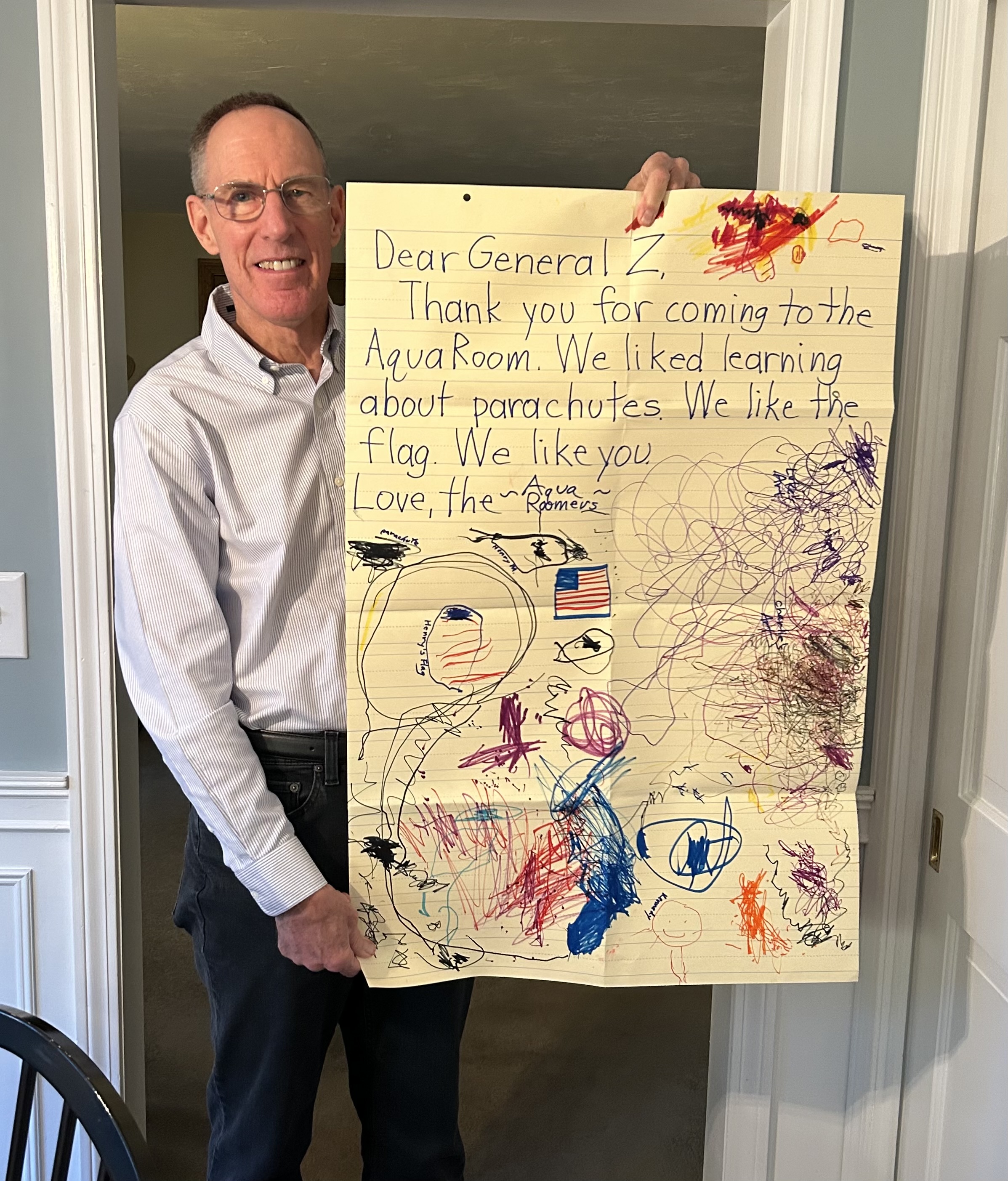
Ramping up words into writing happens when we write giant thank you notes to guests. I write the words with children, and they decorate the thank you note. Here is smiling General Z holding the thank you note we mailed to him:
It gets better! We are learning about woodland animals. Bears have been a big focus and very popular. I have a huge collection of stuffed bears and clothing which we put into dramatic play. Nothing else, just bears. Children started to give bears names and personalities. I added a doll so we could do “Goldilocks and the Three Bears”. Children used voices. They were ‘in the zone’.
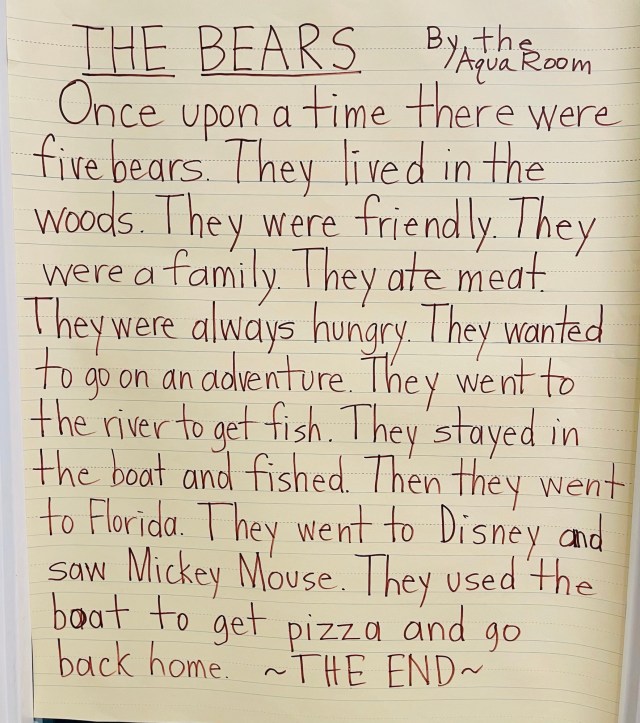
I seized the moment; “Let’s write a bear story!” Yes, they were eager. “Wait, I have to get the clipboard so I can write your words.” We were all huddled together. I had my pen and paper ready. Here is their bear story:
THE BEARS
Once upon a time there were five bears.
They lived in the woods.
They were friendly.
They were a family.
They ate meat. They were always hungry.
They wanted to go on an adventure.
They went to the river to get fish.
They stayed in the boat and fished.
Then they went to Florida.
They went to Disney and saw Mickey Mouse.
They used the boat to get pizza
and go back home.THE END
Isn’t this wonderful? Do you see what’s happening here? Language and literacy are spilling over into writing, making connections between the spoken word and the written word. This will set up a foundation for reading. I’m so proud!
Jennie
P.S. Speaking of language, there is only one common denominator among National Merit Scholars. One. It’s not class president or captain of a team. They have dinner together with their families at least four times a week. That speaks volumes (pun intended.)


 A Teacher's Reflections
I cherish the giant thank you note I received from the children after my visit. It was such a rewarding experience, I should have been the one thanking them.
Aww… that’s so nice, Dan. 🥰
How can they not learn when they have a teacher as enthusiastic as you? Great work Jennie!
Thanks, FR. Enthusiasm helps. 🙂
I love the bear story! Such fabulous activities to lay the framework for reading and writing. And having dinner together is so important. That’s when we all chatted and talked about our day. Good communication skills, learned at a young age, will take an individual far in life.
Well said, Darlene. You are spot on! No wonder you became a great author. I love the bear story, too.
I learned that as an employment councillor. People with good communication skills got the better jobs.
😀
This is a vital mission. Clear writing isn’t possible without clear thinking. We are awash in half-baked opinions and shoddy notions. I believe the decline in reading ability is the direct source of much of today’s social anxiety and dysfunction.
Your comment and thinking is outstanding, Mike. I couldn’t agree more. Thank you!
yes, yes to all of this, words heard, written, shared, used, read, seen, words everywhere inside and outside of us. and the meals together where more words and stories are shared
Exactly!!! You know all too well. You’ve walked the walk and talked the talk (pun intended.) Thank you, Beth.
What an Education!! Such a wonderful connection throughout your class, and I have said it many times and will say it again.. I wish you had been my teacher way back when.. 🙂 It wasn’t until I went to secondary school, aged 11 here in England, when I was taken under the wing of my English teacher, who saw perhaps I had potential that had been neglected, as I was way behind others in my class, to be nurtured, and brought out of me… Which she did with her extra help and mentoring.
Without Mrs Woodhouse, my English language and love of writing and reading would not have been brought out in me…
I am sure many of these children will also look back at you Jennie and your teaching methods to give thanks for your love of words, stories and Language.. Helping them also share that love xx
Many thanks for sharing xx Love and Happy Thanksgiving xx ❤ 💖
Thank you for you kind words, Sue! What a wonderful story about Mrs. Woodhouse. She was THE teacher, and you were a lucky child. Your words ring true. ❤️
I still remember her fondly. Xx 💗
Have you tried to find her to say thank you?
Sadly, Jennie she passed away 3 years after I left school she retired the year after I left and enjoyed 2 years of her retirement. Her husband had passed away many years before her.
I know she worked past her designated retirement age too.
She was a beautiful soul, dhe shared many of her own private books with me to encourage me to read.
Reading took me to another realm where I could often escape into away from parental arguments.
Xx 💗 💗 💗 xx
Thanks for telling me her story, Sue. I’m sure she has smiled down at you, and knows she made a difference in your life. 💕
She really did. And I hope she’s smiling 😃
😍
So very much wisdom, not only for the kids, but adults also.
Thank you, Don. You are spot on.
As Charlie discovered in his public health work, dinner with the television on doesn’t build the same skills!
True! The plus to television is the closed caption element that prints the words along with the show. I tell parents.
I love how the kids had the bears doing things they like to do, or want to do. Going to Disneyland, and using the boat to go and get pizza. 😊The honesty of childhood.
Best wishes, Pete.
Yes! Children incorporated their stories into the bear story. That’s how it should be, and as you say, the honesty of childhood. Best to you, Pete.
My first years in education I was a high school speech and drama teacher…my last years I was a kindergarten teacher assistant….the kids loved me reading out loud…so did the teachers. The school had some videos made of me and I still read out loud at our church. You are so right about their learning capacity.
Thank you for your story! I bet your drama teaching from high school made your reading aloud the best! Of course the kids and teachers loved your reading aloud. You made a difference. Children’s learning capacity is far beyond what we realize. That makes my teaching exciting.
I love learning about how literacy develops! I never take it for granted.
I feel the same way, Liz, and I never take it for granted
A lovely post, Jennie. The full experience of realizing the power of words is a game changer. The bear story is marvelous. I can almost hear the children excitedly adding their thoughts as the the plot rolled out. Family dinner is/was a must at our house and what made us feel we were doing the right thing our children believe in it too.
Thank you, John. I echo everything you said. It really is a game changer. I wish you had been a fly on the wall when we wrote the bear story and the plot rolled out. And family dinner; I’m not surprised at all that you did this. You children are shining examples of the difference it makes. Hats off to you, John!
Thank you, Jennie.
You’re welcome.
😊
You do such a great job with the kids.
Thank you, Anneli.
Makes hanging out with the bears seem like fun!
Yes, it does! Thank you, Annette.
Oh, the joys of reading aloud to children and looking out at the sea of engaged faces. It’s the most natural and easiest way to build vocabulary.
I still have your class letter, Jennie. Of course, I love how you engage your class in writing a story.
Joy really is the magic word, Pete. I like how you say it’s the most natural and easiest way to build vocabulary. So true! How wonderful that you kept our class letter. 😍 Many thanks!
You sound like a wonderful teacher! Yes to all of this I constantly sing to my one year old and we read a story every night. I want her to grow up with a habit of reading before bed and having dinner with us.
I’m so glad you’re singing and reading aloud to your little one. You’re truly giving her the best foundation. Many thanks!
EVERYTHING about this post is wonderful, including the bear story and the tall thank you note! In my writing class this past Monday (all adults) suddenly we were all singing that song “Head shoulders knees and toes.” Don’t ask me why – but all seven women were standing up singing and touching head shoulders knees and toes. Those childhood songs are never forgotten. And YOU will never be forgotten by your lucky students.
Thank you, Pam! I love, love your “Head Shoulders Knees and Toes” story. I can picture everything. Childhood songs really stick. Your kind words are much appreciated. 🥰
🙂
Hi Jennie, thank you for this post! You are a remarkable teacher!
That’s so nice, Charles. Thank you!
Jennie you are wonderful with the children. Great work and children love to learn from childhood 😊🙏😊
Many thanks for your kind words, Kamal! Yes, children love to learn from childhood. 😀
You are always welcome dear Jennie 💞🙏💞
Thank you, Kamal!
Always welcome dear Jennie ❤️
Thank you, Kamal!
Always welcome Jennie 😊
Thank you, Kamal!
What stands out here is how literacy grows not from drills, but from joy, songs, stories, play, and shared writing. It’s a reminder that the foundation of reading isn’t just letters on a page, but the human connections that make words come alive.
Well said, and spot on. The human connections are most important. They truly make words come alive. Thank you!
Hi Jennie – singing and reading aloud and then writing together really offers so much to these growing children! Such a gift you are! and. having dinner together a few times a week can have many perks
Thank you, Yvette. It really offers children so much. Your kind words are appreciated!
😊
also, your bear story and studies mentioned in this post reminded me of Sally Cronin’s post – she shared about the Grizzle bear dance:
The Grizzly Bear is an early 20th-century dance style. It started in San Francisco, along with the Bunny Hug and Texas Tommy and was also done on the Staten Island ferry boats in the 1900s. It has been said that dancers John Jarrott and Louise Gruenning introduced this dance as well as the Turkey Trot at Ray Jones Café in Chicago, Illinois around 1909. The Grizzly Bear was first introduced to Broadway audiences in the Ziegfeld Follies of 1910 by Fanny Brice.
The dance was rough and clumsy. During the dance, the dancers would yell out: “It’s a Bear!” The genuine Grizzly Bear step was a correct imitation of the movements of a dancing bear, moving or dancing to the side. A very heavy step to the side with a decided bending of the upper part of the body from one side to the other, a decidedly ungraceful and undignified movement when performed as a dance.
It was reported that one of the reasons former President Woodrow Wilson’s inaugural ball was cancelled was because of his “disapproval of such modern dances as the turkey trot, the grizzly bear and the bunny hug”.
Not long before this, in 1912, New York placed the dance under a “social ban”, along with other “huggly-wiggly dances”, like the Turkey Trot and the Boston Dip. It was also condemned in numerous cities across the US during the same time period, with many considering it to be a “degenerate dance”. eggo321
link is here -just FYI https://smorgasbordinvitation.wordpress.com/2025/12/16/smorgasbord-blog-magazine-music-column-the-big-band-era-with-william-price-king-and-sally-cronin-1930s-benny-goodman-hal-kemp-and-the-grizzly-bear/
Thank you!
😊
I remember Sally’s post. What a shame that these dances were banned. They look mild compared to some of the dances today. Thank you for your newsy information, Yvette, I so enjoyed it. Maybe Woodrow Wilson put down the final axe.
I know so mild – and it sure says a lot about culture shifts
It does.
Love it!
Along with all the wonderful things you do, parents reading with and to their children is also so important. When I was in JK classes, I loved journal time. They would draw a picture and then tell me about it. I would write their words under the picture. I loved when some of them tried to write their own sentence first.
What you did was exactly the best thing. They drew the picture and you wrote their words. Parents reading to their children is SO important! Many thanks for your lovely comment, Carla!